When we’re planning a trip, we almost never look at one option and say, “Yep, that’s it.”
Even when something looks good at first glance, we usually pause and compare it against a few other paths before we book.
Not because we want to overcomplicate travel.
Because we’ve learned that the best travel option is not always the cheapest one, the easiest one, or the one everyone online says you should book.
Sometimes the best option is the one that fits your actual trip better.
- The timing.
- The people going.
- The points you already have.
- The credits you need to use.
- The cancellation rules.
- The transportation.
- The stress level.
- The experience you actually want.
That is the part of trip planning we think gets missed the most.
Want Help Comparing Your Own Travel Options?
This is exactly what we help with through our Planning & Consulting services — looking at real options, comparing the trade-offs, and helping you decide what actually makes sense before you book.
Whether you are comparing hotels, cruises, flights, points redemptions, credit card perks, or booking paths, our Trip Planning service can help you sort through the options without feeling like you have to figure it all out alone.
If you have a question, feel free to text us at 480-331-1263.
Related Reading
- The Cheapest Option Isn’t Always the Best Value
- The Trip That Looks Good vs. The Trip That Feels Good: How to Plan for the Right Experience
- We’ll Always Present All the Options — Even When There’s Nothing in It for Us
We Start With the Actual Goal of the Trip
Before we compare prices, points, hotels, flights, or cruises, we try to figure out what the trip is actually supposed to be.
The goal of the trip changes what “best” means. A quick weekend getaway has different priorities than a once-in-a-lifetime trip. A cruise with family has different needs than a couples trip. A city hotel used mostly for sleeping is different from a resort where you plan to spend most of your time on property.
More detail: Why the goal of the trip matters
Sometimes we are trying to keep costs low. Sometimes we are trying to use credits before they expire. Sometimes we are trying to make travel easier. Sometimes we are trying to stretch points. Sometimes we are choosing the option that gives us the best overall experience, even if it costs a little more.
That is why we do not start with, “What is the cheapest?”
We start with, “What are we trying to get out of this trip?”
We Compare Cash Prices Against Points Prices
Once we know the goal, we usually compare the cash price against the points price.
This is one of the easiest ways to avoid wasting points. A hotel that costs 30,000 points per night might be a great deal if the cash rate is high. But if the cash rate is low, we may decide to save the points for another trip.
More detail: How we think about points value
The same is true with flights. Sometimes points make a lot of sense because they reduce the cash cost of a trip. Other times, the cash price is low enough that we would rather pay cash and save the points for something better later.
We are not trying to squeeze the absolute maximum value out of every point every single time. But we do want to make sure we are using points in a way that actually helps.
A good points redemption should either save meaningful money, create flexibility, improve the experience, or make a trip possible that might not have happened otherwise.
If you want help sorting through when to use points and when to pay cash, our Points & Rewards Strategy service is built around this kind of practical decision-making.
We Look at the Full Cost, Not Just the Advertised Price
This is where travel options can get tricky.
The price you see first is not always the price that matters. A hotel rate might look cheaper until you add resort fees, parking, breakfast, transportation, or the fact that it is farther away from where you actually want to be.
More detail: What we include in the real cost
A cruise fare might look better until you compare what is included, what costs extra, and whether you would actually use the perks.
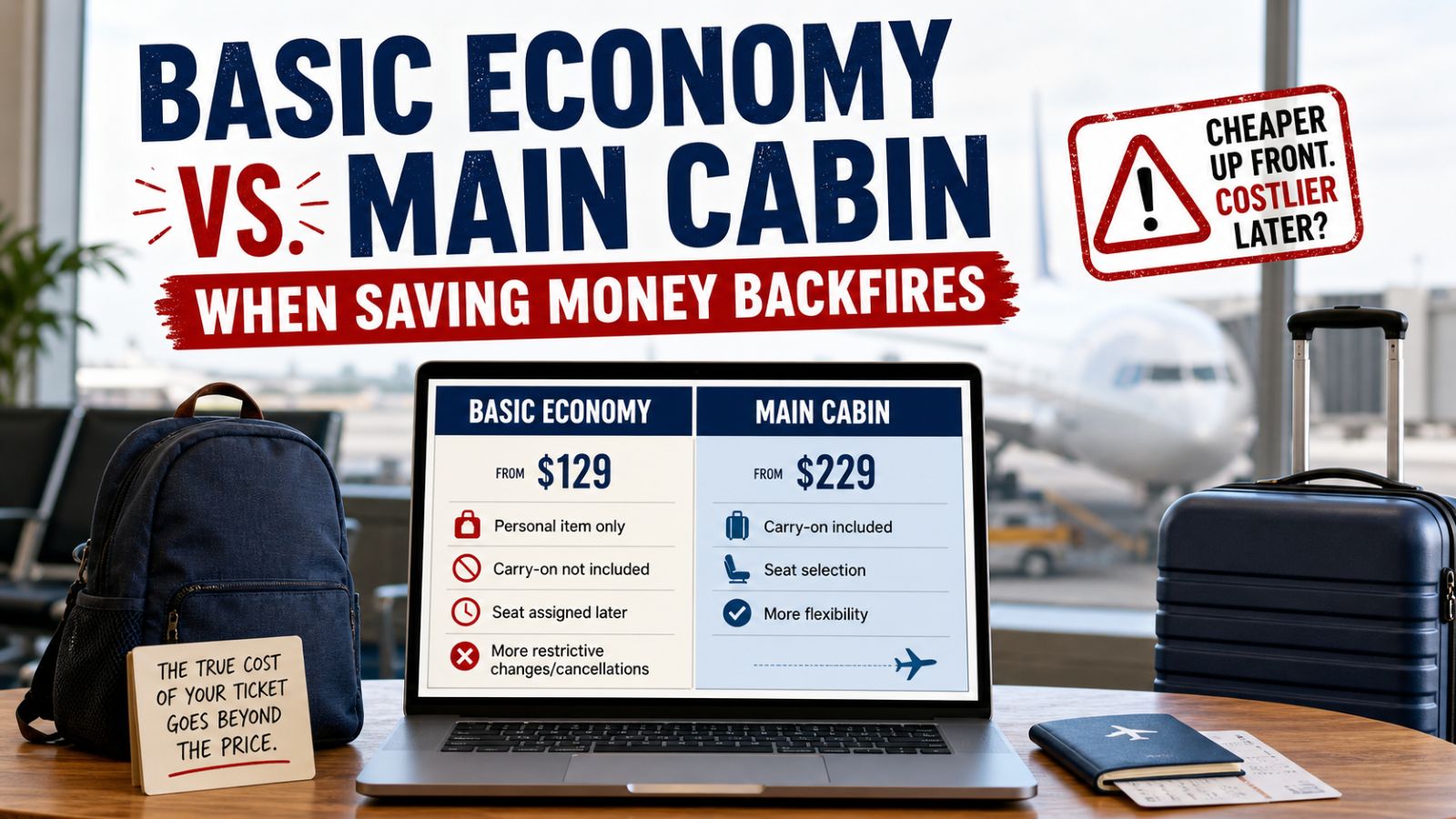
A flight might look like the obvious winner until you factor in baggage fees, seat selection, long layovers, airport transfers, or the risk of arriving too late.
We try to compare the real cost, not just the headline price. That usually means looking at things like:
- Taxes and fees
- Resort fees
- Parking
- Checked bag fees
- Seat selection
- Food and beverage credits
- Breakfast benefits
- Transportation costs
- Cancellation rules
- Change flexibility
- Arrival and departure timing
- Whether we are likely to spend more because of the option we chose
A lower price can still be the wrong choice if it creates more costs somewhere else.
We Factor In Credits and Perks We Already Have
This is one of the biggest reasons our best option is not always the same as someone else’s best option.
Sometimes a hotel looks expensive on paper, but a credit card benefit changes the math. Sometimes a lounge benefit makes an airport experience easier. Sometimes a travel credit gets used naturally on something we were going to book anyway.
More detail: When perks actually matter
Sometimes a free checked bag, breakfast credit, resort credit, elite status perk, or statement credit makes one option better than another.
We try not to force ourselves to use perks in ways that do not make sense. But when we already have a benefit and it fits naturally into the trip, we absolutely include it in the comparison.
The key is whether the perk reduces a real cost or improves the trip in a way we actually value.
A credit is not valuable just because it exists. It is valuable when we can use it without overspending, overcomplicating the trip, or choosing something we would not have otherwise wanted.
We Compare Convenience, Not Just Cost
This is the part that can be easy to dismiss when you are trying to save money.
But convenience matters. A cheaper flight with a bad connection may not be worth it. A cheaper hotel far from everything may not save much once you add transportation.
More detail: Why convenience can be worth paying for
A cheaper cruise excursion may not be worth the stress if timing is tight. A less expensive airport may cost more once you add time, parking, gas, or rideshare costs.
We still love a good deal. But we also try to be honest about the trade-off.
Sometimes convenience is worth paying for. Sometimes it is not. The point is to make that decision intentionally.
For us, that might mean paying a little more for a better flight time, choosing a hotel that makes the day easier, or booking something through a path that gives us more flexibility if plans change.
The cheapest option can look good in a spreadsheet and still make the trip feel worse.
We Ask What Could Go Wrong
This may not sound fun, but it has saved us from making some bad travel decisions.
Before we book, we try to think through the weak spots. What happens if the flight is delayed? What happens if the hotel benefit does not work the way it is advertised? What happens if the cruise ship gets into port later than expected?
More detail: Planning for risk without overplanning
What happens if we are tired, hungry, or traveling with bags? What happens if we need to cancel?
This does not mean we plan every trip around worst-case scenarios. But we do like to know where the risk is.
For example, a DIY port day can be a great value when there is plenty of time and transportation is easy. But if the ship is only in port for a short window, a cruise-line excursion may be worth considering because of the added peace of mind.
A non-refundable hotel rate may save money. But if the trip has moving pieces, that savings might not be worth losing flexibility.
A tight connection may be fine when everything goes right. But if missing that connection would ruin the start of the trip, we may choose a safer option.
Good travel planning is not about avoiding every risk. It is about understanding which risks are worth taking.
For cruise-specific decisions like excursions, timing, cabins, packages, and booking paths, our Cruise Planning service can help compare the trade-offs before you commit.
We Think About Who Is Going
A trip that works perfectly for us may not work perfectly for someone else.
That matters. We may be comfortable walking more, using public transportation, figuring out a DIY excursion, or staying a little farther away to save money. But that does not mean those choices are right for every traveler or every trip.
More detail: Why the traveler matters as much as the deal
When family, friends, or clients are involved, we try to compare options through their lens too.
- Do they want easy?
- Do they want flexible?
- Do they want the lowest possible price?
- Do they need more structure?
- Do they care about hotel quality?
- Are they comfortable using points?
- Do they want help, or do they want to book on their own?
This is one of the biggest reasons we believe in presenting options instead of pushing one answer.
The right choice depends on the traveler, not just the deal.
We Compare Booking Paths Too
Sometimes the question is not just what to book.
It is how to book it.
More detail: Why the booking path can change the value
- Directly with the hotel?
- Through a credit card travel portal?
- Through a travel advisor?
- With points?
- With cash?
- Through a cruise line?
- Through a package?
- Through a program that adds perks?
Each booking path can come with different trade-offs.
One path may have a better price. Another may include breakfast or property credits. Another may earn more points. Another may give better cancellation terms. Another may allow a travel advisor to help if something changes.
We do not assume one booking path is always best. We compare them.
That is especially true when there are benefits involved, because the value can depend on the exact property, cruise line, room type, rate, timing, and traveler.
The best booking path is the one that gives you the best overall combination of price, perks, flexibility, and support.
If you want help comparing whether to book directly, use a travel advisor, use points, or go through another booking path, our Travel Booking & Advising service can help you sort through the options.
We Decide What We Are Willing to Pay For
At some point, every comparison comes down to priorities.
There is usually no perfect option. One choice might be cheaper. One might be easier. One might use fewer points. One might give better perks. One might be more flexible. One might simply feel better.
More detail: How we make the final decision
So we ask ourselves what we are willing to pay for.
Sometimes we are willing to pay for location. Sometimes we are willing to pay for a better flight time. Sometimes we are willing to pay for a hotel that makes the trip smoother. Sometimes we are willing to use more points to reduce cash cost. Sometimes we are willing to give up convenience because the savings are meaningful.
There is no universal answer. But there should be a reason.
When we spend more, we want to know what we are getting for it. When we spend less, we want to know what we are giving up.
That mindset helps us feel better about the final decision.
Our Basic Travel Comparison Framework
When we are comparing travel options, this is the basic framework we come back to:
- What is the actual goal of this trip?
- What is the cash price?
- What is the points price?
- What is the full cost after fees, transportation, food, and extras?
- What credits or perks do we already have that could apply?
- What option gives us the best timing?
- What option gives us the most flexibility?
- What could go wrong?
- Who is going, and what matters most to them?
- Which booking path gives the best overall value?
- What are we paying more for?
- What are we giving up if we choose the cheaper option?
We do not always go through every question in detail. But this is the way we think.
It helps us avoid chasing the cheapest option just because it looks good upfront. It also helps us avoid overspending just because something feels more exciting in the moment.
The Best Option Is the One That Fits the Trip
The more we travel, the more we realize that good planning is not about finding one perfect travel hack.
It is about comparing the realistic options and choosing the one that fits the trip best.
Sometimes that means using points. Sometimes that means paying cash. Sometimes that means booking direct. Sometimes that means using a travel advisor. Sometimes that means choosing the cheaper option. Sometimes that means spending more because the value is there.
The goal is not to book the option that looks best on paper.
The goal is to book the option that makes the most sense for the trip you are actually taking.
And that is where comparing travel options before you book can make all the difference.
Latest Posts from Trip Planning | All Posts
- Basic Economy vs. Main Cabin: When Saving Money Backfires

- Why Most “Free” Travel Advice Breaks Down in Real Life

- How We Compare Travel Options Before We Book

- The Most Common Booking Mistakes We See (And How to Avoid Them)

- Why the Cheapest Price Isn’t Always the Best Deal

- Our Approach to Trip Planning & Consulting