At first glance, the cheapest flight looks like the obvious choice.
Lower price = better deal… right?
Not always.
In reality, the cheapest flight can sometimes cost you more — in time, stress, missed experiences, or even actual money once everything is factored in.
We’ve made that mistake before. And we’ve also learned when it does make sense to go cheap.
Plan Smarter Flights (Not Just Cheaper Ones)
If you’re trying to figure out which flights actually make sense — not just what’s cheapest — this is exactly the kind of thing we help with.
We look at timing, risk, total cost, and how everything fits into your trip so you’re not just booking blindly.
You can also learn more about how we help with full trip planning here: Trip Planning.
If you have a question, feel free to text us at 480-331-1263.
Related Reading
- Using Points for “Normal” Trips — Not Just Luxury Travel
- The Most Common Booking Mistakes We See (And How to Avoid Them)
- What Travel Booking & Advising Actually Means (And When You Need It)
In this Article:
The Problem With “Cheapest Flight Wins”
Flight search tools are designed to sort by price.
So naturally, most people click the cheapest option and move on.
But that price usually doesn’t tell the full story.
What it often doesn’t include:
- Long or inconvenient layovers
- Bad flight times (very early or very late)
- Separate tickets or risky connections
- Extra baggage fees
- Seat selection costs
- Airport transfers or parking differences
That “$150 cheaper” flight can quickly become:
A worse overall experience
A longer travel day
More out-of-pocket costs
The Hidden Costs Add Up Fast
That low base fare can be misleading.
By the time you add:
- Carry-on or checked bags
- Seat selection
- Priority boarding
- Food or drinks
- Transportation to a farther airport
You may end up paying more than a slightly higher-priced flight that includes those things.
This is especially common with ultra-low-cost carriers.
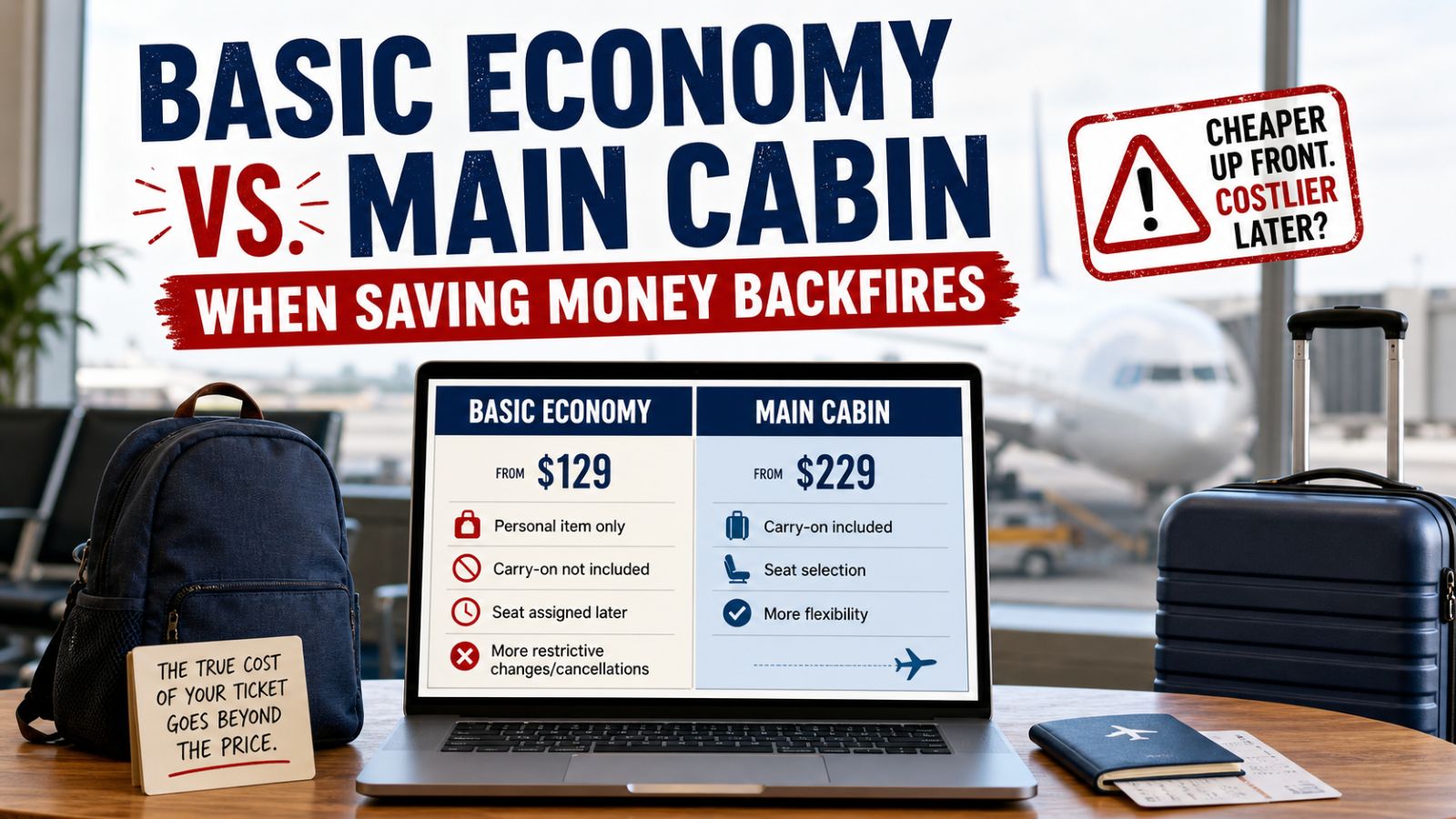
The Basic Economy Trap (What You’re Actually Booking)
One of the biggest reasons “cheap flights” aren’t always a great value?
You’re often not comparing the same thing.
Many flight search tools default to showing Basic Economy fares — which look cheaper, but come with restrictions that matter.
Depending on the airline, Basic Economy may include:
- No free seat selection (or very limited options)
- Extra fees for carry-on bags
- No changes or cancellations
- Last boarding group
- Limited or no mileage/points earning
So that “cheap” flight might actually turn into:
- $30–$60 for a seat
- $35–$75 for a carry-on
- No flexibility if plans change
- Fewer (or zero) rewards earned
At that point, you’re often within $20–$80 of a standard economy ticket — with far fewer benefits.
This is where people accidentally choose the worst value option without realizing it.
We’ve seen this play out firsthand.
One of our nieces booked what looked like a great deal — a Basic Economy ticket that saved her some money upfront. What she didn’t realize was that her carry-on would cost extra, which immediately ate into the savings.
Then things got worse.
She ended up getting sick and couldn’t take the trip. Because of the Basic Economy restrictions, she didn’t have the flexibility to simply change or cancel her flight. Instead, she had to pay a penalty just to reuse a portion of the ticket later.
What started as a “cheap flight” ended up costing more — and added stress she didn’t expect.
Time Has Value (Even If It’s Not on the Receipt)
One of the biggest things people overlook is time.
Example:
- Flight A: $250, nonstop, 2.5 hours
- Flight B: $180, 7–8 hour travel day with a layover
You “save” $70… but spend an extra 4–5 hours traveling.
How much would you pay to turn an 8-hour travel day into a 4-hour one?
For some people, that number is $0.
For others, it’s $50… $100… or more.
There’s no right answer — but there is a right answer for your trip.
On a short trip, this matters even more.
Losing half a day each way can turn a 3-day trip into something that feels rushed and exhausting.
Cheap Flights Can Increase Risk
Not all cheap flights are created equal.
Some introduce real risk into your trip.
Things to watch for:
- Tight layovers (especially on separate tickets)
- Budget airlines with limited rebooking options
- Last flight of the day (no backup if delayed)
- Airports with frequent delays or weather issues
A missed connection can easily wipe out any savings.
We’ve seen situations where:
- A cheap flight turned into a same-day rebooking at 3x the cost
- Travelers missed the first day of a cruise or trip
- Hotel nights or excursions were lost
Cheap upfront doesn’t always mean cheap overall.
When We Personally Choose the Cheap Option
We’re not against cheap flights — we use them all the time.
A great example is our Frontier GoWild pass.
We’ll book last-minute flights on a whim when:
- We’re flexible
- We don’t have a strict schedule
- We’re okay with trade-offs
- The goal is just to get somewhere cheap
In those cases, the cheap flight is the best value.
Because we’re not expecting:
- Perfect timing
- Flexibility
- A premium experience
We’re choosing it intentionally — not assuming it’s the best option by default.
That’s the difference.
A Simple Example: Paying More to Improve the Trip
On one of our trips to Hawaii, timing mattered more than saving a little money.
We could have chosen a cheaper flight — but it would have:
- Added significant travel time
- Made the day more exhausting
- Reduced the overall experience
Instead, we chose a better-timed option.
It cost more upfront — but made the entire trip smoother and more enjoyable.
That’s what we mean by value.
This Is the Same Way We Think About Points
This idea doesn’t just apply to cash flights.
It’s the same reason we don’t always chase the “highest cents per point” value.
Sometimes the best redemption is:
- The easiest option
- The most convenient flight
- The one that actually fits your plans
Value isn’t just math — it’s how the trip actually feels.
The Bottom Line
Cheap flights aren’t bad.
But they’re not always the best value.
The goal isn’t to spend more — it’s to make better decisions with your travel.
Sometimes that means saving money.
Sometimes that means spending a little more to improve the entire trip.
Latest Posts from Airlines & Flights | All Posts