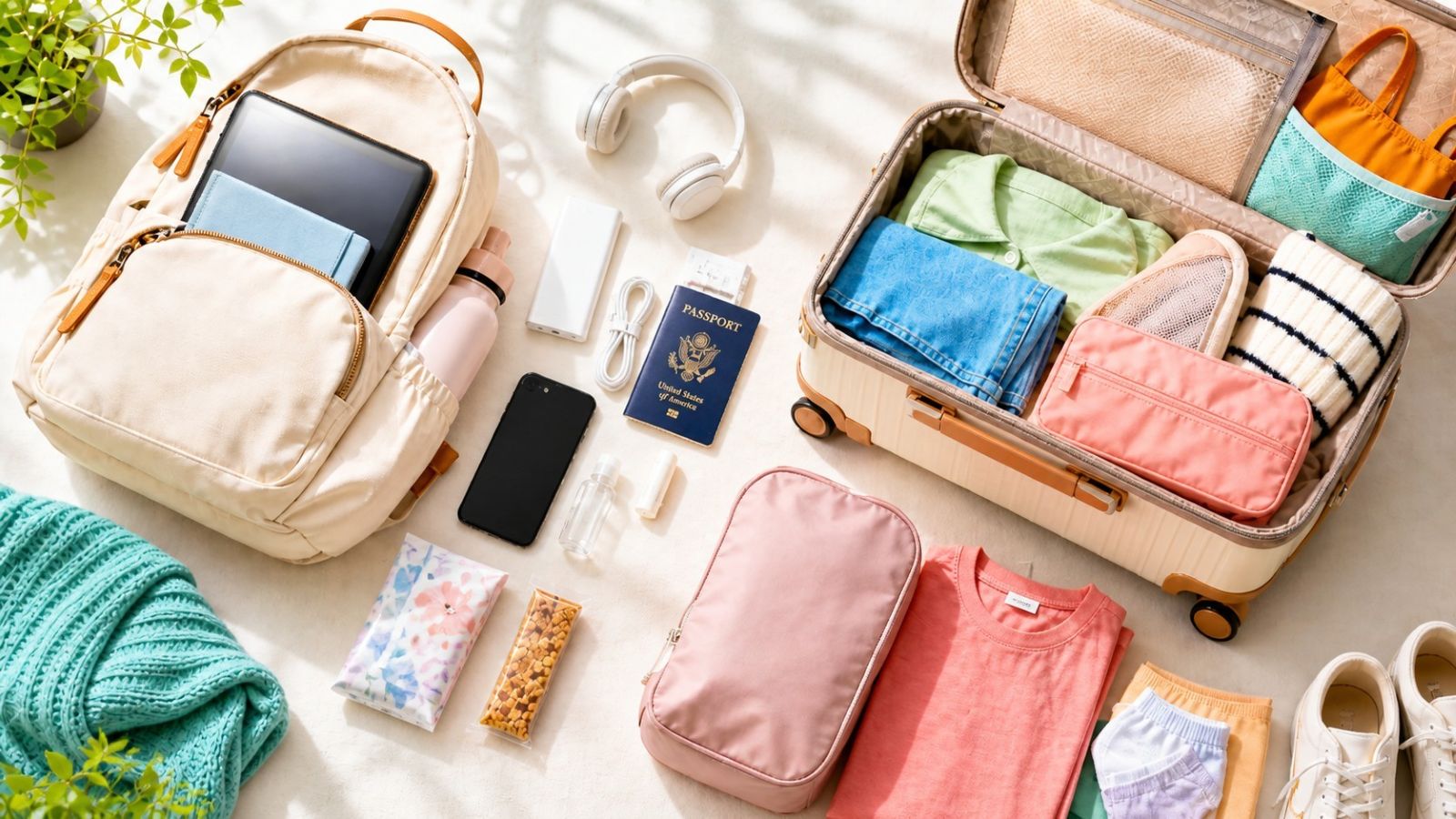
Flying feels a lot easier when the things you need are packed where they actually make sense.
Not everything belongs in your personal item.
Not everything needs to be under the seat in front of you.
And not everything should be buried in a checked bag either.
That is why we like to think about packing in two parts:
Your personal item is for the things you may want during the flight.
Your carry-on bag is for the things you want with you on the plane, but probably do not need to access mid-flight.
Even then, not every packing suggestion is a must-have.
Some things are true essentials. Others are nice-to-have items that depend on your flight, destination, comfort level, and personal travel style.
That distinction matters, because the goal is not to overpack.
The goal is to keep the right things with you so your travel day feels smoother, calmer, and less annoying.
Want Help Planning Trips That Feel Easier From the Start?
A smoother travel day usually starts before you ever get to the airport.
We help travelers think through the small details that can make a trip feel less stressful — from choosing better flight times to packing smarter, avoiding avoidable fees, and planning around real-life comfort instead of just the cheapest option.
If you want help planning a trip that feels better from start to finish, our Trip Planning & Strategy service can help.
If you have a question, feel free to text us at 480-331-1263.
Related Reading
- The Cheapest Option Isn’t Always the Best Value
- The Trip That Looks Good vs. The Trip That Feels Good
- How to Choose the Right Type of Trip Based on Your Budget, Time, and Energy
- Do You Know What Perks You Already Have on Your Credit Cards?
The Simple Packing Rule We Use
Before packing, we like to ask one simple question:
Will I need this during the flight, or do I just need it with me?
That one question helps decide what goes under the seat, what goes overhead, and what can be checked.
More detail: How we split personal item, carry-on, and checked bag items
That is the difference between a personal item and a carry-on.
Your personal item should be easy to reach. It goes under the seat in front of you, so it should hold the things you may actually use while seated.
Your carry-on can go in the overhead bin. It is still with you on the plane, but you probably do not want to stand up, open the bin, pull down your suitcase, and dig through it every time you need a charger, snack, or lip balm.
This keeps your personal item useful instead of chaotic.
It also helps you avoid stuffing your under-seat bag with things you do not actually need during the flight.
Start with the must-haves. Then add the extras that make sense for the trip you are actually taking.
Your personal item should hold the things you may want during the flight or immediately after landing.
Your carry-on should hold the things you want with you on the plane, but probably do not need to access from your seat.
Your checked bag, if you use one, should hold the things you can wait for.
This simple split makes packing feel less overwhelming because every bag has a job.
What to Pack in Your Personal Item
Your personal item should be your “during the flight” bag.
Keep the things you may want while seated, during delays, or right after landing within easy reach.
Everything else can go in your carry-on.
More detail: Personal item must-haves and suggestions
That does not mean you need every possible travel gadget packed under the seat.
It means your personal item should hold the items you are most likely to reach for during the travel day.
Personal Item Must-Haves
For most travelers, these are the items that make sense to keep under the seat and within reach:
- Wallet
- ID or passport
- Phone
- Boarding pass or travel documents
- Prescription medications or health items you may need during travel
- Headphones or earbuds
- Charging cord
- Portable power bank
- Empty water bottle
- At least one snack
- Glasses or contacts, if needed
These are the things that are either important, frequently used, or annoying to access from the overhead bin.
If you would be frustrated digging through your carry-on to find it during the flight, it probably belongs in your personal item.
Personal Item Suggestions to Consider
Depending on your flight length, destination, and comfort preferences, you may also want to consider:
- Gum or mints
- Lip balm
- Tissues
- Hand sanitizer or wipes
- Light sweater, wrap, or hoodie
- Kindle, tablet, or book
- Downloaded entertainment
- Eye mask
- Earplugs
- Compression socks for longer flights
- Small pouch for cords or comfort items
These are not all required.
For a short nonstop flight, you may only need a few of them. For a long travel day, overnight flight, or international trip, more of them may be worth the space.
The goal is not to copy someone else’s packing list. The goal is to build a personal item that makes your actual flight easier.
Keep Your Documents and Travel Details Easy to Find
Even if everything is on your phone, travel details should be easy to access.
Apps can log you out, airport Wi-Fi can be unreliable, and some travel days have a lot of moving pieces.
A little organization here can prevent a lot of unnecessary stress.
More detail: Documents and travel details to keep handy
This matters even more when the trip has multiple moving pieces, like flights, hotel check-in, a rental car, cruise embarkation, or international travel.
Document Must-Haves
At minimum, make sure you can quickly access:
- ID or passport
- Boarding pass
- Payment card or wallet
- Any required travel paperwork
These should not be buried in your overhead carry-on or checked bag.
Document Suggestions to Consider
Depending on your trip, it may also be helpful to have easy access to:
- Hotel confirmation
- Rental car details
- Cruise documents
- Travel insurance information
- Entry forms
- Screenshots of important confirmations
- Emergency contact details
We like having screenshots of important details saved on our phones, especially for travel days with multiple stops or reservations.
It does not mean you need to print everything. It just means you should not be relying on perfect internet, perfect apps, and perfect timing.
Keep Electronics and Chargers Within Reach
A smoother flight often comes down to staying powered up and entertained.
Even when planes have outlets or USB ports, we do not like relying on them completely.
A simple backup charging setup can make a long travel day much easier.
More detail: Electronics and charging items to pack
Sometimes airplane outlets do not work. Sometimes they charge slowly. Sometimes the outlet is in an awkward spot.
And on a long travel day, your phone may be doing everything: boarding pass, entertainment, hotel check-in, rideshare, directions, payment, and messaging.
Electronics Must-Haves
For most flights, we would keep these in the personal item:
- Phone
- Charging cord
- Portable power bank
- Earbuds or headphones
A charged power bank is especially useful on long travel days, delays, connections, or trips where your phone is handling most of the logistics.
Electronics Suggestions to Consider
Depending on your trip, you may also want:
- Tablet
- Kindle
- Laptop
- Headphone adapter
- Extra charging cord
- Charging block
- Small cord organizer
- AirTag or luggage tracker
- Portable phone stand
Not everyone needs a full tech setup.
If you are taking a short flight and only using your phone, keep it simple.
But if you are working, traveling internationally, flying with kids, or relying on downloaded entertainment, a few extra electronics can be worth it.
Download Entertainment Before You Leave Home
Do not assume the airplane Wi-Fi will work.
Do not assume the plane will have seatback entertainment either.
A little prep at home can save a lot of frustration once you are in the air.
More detail: Entertainment options to download before your flight
Even if you plan to sleep, having something downloaded gives you options.
And options are the whole point of packing smarter.
Entertainment Must-Haves
The real must-have here is simple:
- Download at least one entertainment option before you leave home
That may be a show, podcast, audiobook, playlist, or Kindle book.
It does not need to be complicated. You just want something available if the flight is longer, louder, more delayed, or more boring than expected.
Entertainment Suggestions to Consider
Before your trip, consider downloading:
- Movies
- Shows
- Podcasts
- Audiobooks
- Music playlists
- Kindle books
- Offline games
- Work files if needed
This is especially helpful on budget airlines, shorter domestic flights, older aircraft, or flights where entertainment options are limited.
Bring Snacks and an Empty Water Bottle
Airport food is expensive, airplane snack options can be limited, and delays happen.
This is not about packing a full meal for every flight.
It is about having enough with you that you are not completely dependent on airport prices, airplane service, or perfect timing.
More detail: Easy food and drink items to bring
A few simple items can prevent the “we should have eaten before we boarded” regret.
Food and Drink Must-Haves
For most flights, we like having:
- Empty reusable water bottle
- At least one snack
Take the water bottle through security empty, then fill it before boarding.
That helps you avoid paying airport prices for bottled water and keeps you from relying only on the small cup during drink service.
Food and Drink Suggestions to Consider
Good flight snacks include:
- Protein bars
- Crackers
- Trail mix
- Jerky
- Nuts
- Candy or mints
- Small packaged snacks
- Kid-friendly snacks if traveling with children
We like snacks that are easy, contained, and not annoying to the person sitting next to us.
In other words, nothing too messy, crumbly, or strong-smelling.
Pack Small Comfort Items You Actually Use
A few comfort items can make a flight feel much better, but this is where people can easily overpack.
You probably do not need every travel gadget that shows up in a packing video.
The key phrase is if you actually use it.
More detail: Comfort items that may be worth packing
You just need the items that actually solve a problem for you.
A comfort item is only helpful if it solves a real problem for you.
Comfort Must-Haves
Comfort must-haves are personal, but for many travelers, these are the basics worth considering:
- Lip balm
- Tissues
- Hand wipes or sanitizer
- Light sweater or hoodie if you tend to get cold
Comfort Suggestions to Consider
Depending on the flight, you may also want:
- Compression socks
- Eye mask
- Earplugs
- Neck pillow
- Toothbrush or disposable toothbrush
- Face wipes
- Small lotion
- Hair tie or comb
- Deodorant for long travel days
Some people love neck pillows.
Some people carry them through three airports and never touch them.
Some people need a hoodie because planes are always cold. Others are fine without it.
Pack for your actual habits, not someone else’s perfect packing list.
What to Pack in Your Carry-On Bag
Your carry-on bag is for the things you want with you on the plane, but do not necessarily need during the flight.
This is where you put backup items, valuables, and anything you would not want to lose if your checked bag was delayed.
This matters most if you are checking luggage.
More detail: Carry-on must-haves and backup items
Checked bags usually arrive just fine, but when they do not, having the right things in your carry-on can save the first day or two of your trip.
Carry-On Must-Haves
If you are bringing a carry-on, we would prioritize:
- Prescription medications and important health items
- Valuables
- Important trip items that would be hard to replace quickly
- Basic toiletries within TSA rules
- Chargers or extra cords
- A change of clothes if checking a bag
These are the items that you may not need mid-flight, but would not want to lose access to if your checked bag was delayed.
Carry-On Suggestions to Consider
Depending on the trip, you may also want:
- Extra underwear and socks
- Swimsuit if heading to a cruise, beach, or resort
- Sleepwear
- Extra shirt
- Camera gear
- Laptop or work items
- Makeup or skincare basics
- Trip-specific clothing or accessories
- Small laundry bag
- Backup pair of glasses or contacts
Again, this is not about packing for every possible disaster.
It is about thinking through what would be difficult or frustrating if your checked luggage was delayed.
Why a Backup Outfit Can Be Worth It
A full extra wardrobe is not necessary, but one small backup outfit can be smart on certain trips.
You do not need to pack like your luggage is definitely going to get lost.
It is about protecting the first day of your trip.
More detail: When a backup outfit is worth the space
But it is worth asking what would make the first day of your trip harder if your checked bag did not arrive.
This is not about packing for disaster.
A backup outfit can be especially helpful if you are:
- Checking a bag
- Flying internationally
- Heading to a cruise
- Traveling for a wedding or special event
- Arriving late at night
- Going somewhere where shopping would be inconvenient
- Flying with tight connections
Backup Clothing Must-Haves
If you are checking a bag, a practical backup might include:
- Clean underwear
- Socks
- One lightweight shirt
That alone can make a delayed bag much less stressful.
Backup Clothing Suggestions to Consider
Depending on your destination, you may also want:
- Swimsuit for a cruise, beach, or resort trip
- Sleepwear for an overnight arrival
- A nicer outfit for a wedding, event, or dinner reservation
- Lightweight change of clothes for hot-weather destinations
- Jacket or layer if arriving somewhere cold
A swimsuit is one of those items that can be surprisingly annoying to replace quickly.
If you are heading somewhere warm and your checked bag is delayed, having it in your carry-on may be the difference between enjoying the pool or beach right away and waiting on luggage.
Keep Medications With You, Not in Checked Luggage
Prescription medications and important health items should stay with you.
Do not put them in checked luggage.
If it would be stressful, expensive, or difficult to replace quickly, keep it with you on the plane.
More detail: Medication and health items to keep with you
Even if you do not need them during the flight, medications should be in your personal item or carry-on bag.
This is one area where it is better to be practical than overly minimalist.
Medication Must-Haves
At minimum, keep these with you:
- Prescription medications
- Medical devices or supplies
- Anything you would need urgently or could not replace easily
Medication Suggestions to Consider
Depending on your needs, you may also want:
- Allergy medicine
- Motion sickness medicine
- Pain reliever
- Stomach medicine
- Eye drops
- Contact lens supplies
- Bandages
- Any over-the-counter medicine you regularly rely on
You do not need to pack a full medicine cabinet.
But a small, practical health kit can make a big difference if something comes up during the trip.
Use Small Pouches to Keep Everything Organized
The easiest way to make your personal item and carry-on work together is to group items by category.
Small pouches can help keep things organized without making your bags feel complicated.
The point is to avoid digging through your entire bag for one tiny item.
More detail: Simple pouch organization ideas
This makes it easier to know where everything is, especially when you are trying to find something quickly during boarding, on the plane, or after landing.
It also helps prevent the classic travel-bag problem where you know you packed something, but somehow cannot find it when you actually need it.
Organization Must-Haves
You do not need a full packing cube system, but you should have some way to keep small items from disappearing.
At minimum, consider using:
- A pouch for cords
- A pouch for medications
- A pouch for toiletries or comfort items
The point is not to create a complicated system.
Organization Suggestions to Consider
You may also want separate pouches for:
- Snacks
- Travel documents
- Kids’ items
- Makeup or skincare
- In-flight comfort items
- Backup clothes
- International travel documents
A few small pouches can make your bag feel much less chaotic without adding much weight or bulk.
Personal Item vs. Carry-On: Quick Guide
Here is the simple version.
Your personal item is for what you want within reach.
Your carry-on is for what you want with you, but probably do not need during the flight.
More detail: Quick personal item, carry-on, and checked bag guide
Personal Item Must-Haves
Pack these under the seat where you can reach them:
- Wallet
- ID or passport
- Phone
- Boarding pass or travel documents
- Prescription medications or urgent health items
- Charging cord
- Portable power bank
- Headphones or earbuds
- Empty water bottle
- Snack
- Glasses or contacts, if needed
Personal Item Suggestions to Consider
Add these if they fit your flight and travel style:
- Gum or mints
- Lip balm
- Tissues
- Hand sanitizer or wipes
- Light sweater or hoodie
- Kindle, tablet, book, or downloaded entertainment
- Eye mask
- Earplugs
- Compression socks
- Small comfort pouch
Carry-On Must-Haves
Pack these overhead or in your carry-on if you are bringing one:
- Important medications or health items not kept in your personal item
- Valuables
- Basic toiletries
- Extra chargers or cords
- Important trip items
- Backup outfit if checking a bag
Carry-On Suggestions to Consider
Add these depending on the trip:
- Extra underwear and socks
- Swimsuit
- Sleepwear
- Extra shirt
- Camera gear
- Laptop or work items
- Makeup or skincare basics
- Destination-specific items
Checked Bag Items
Pack these in your checked bag if you do not need them during travel:
- Larger clothing items
- Extra shoes
- Full-size toiletries
- Non-essential extras
- Items you do not need until later in the trip
This simple split can make the whole travel day feel more organized.
What Not to Overpack Under the Seat
Your personal item becomes less useful when it is too full.
The personal item should be easy to open, easy to search, and easy to slide under the seat.
A useful personal item is not the fullest bag. It is the bag that gives you easy access to the right things at the right time.
More detail: What not to overpack under the seat
If it is packed so tightly that you have to unpack half of it to find a charging cord, it is probably doing too much.
Try not to pack the under-seat bag with:
- Extra clothes you will not touch during the flight
- Bulky items that could go overhead
- Too many “just in case” gadgets
- Heavy books or devices you will not use
- Toiletries you do not need until the hotel
- Backup items that belong in your carry-on instead
This is where separating your personal item and carry-on really helps.
Your personal item should make the flight easier, not turn into a packed-to-the-top storage bag.
Final Thoughts: Keep the Right Things Close
Packing for a smoother flight is not about bringing more.
It is about putting the right things in the right place.
Your personal item should make the flight itself easier.
Your carry-on should protect the important things you want with you on the plane.
Your checked bag, if you use one, should hold the things you can wait for.
And not every packing suggestion needs to come with you every time.
Start with the must-haves. Then add the extras that actually make sense for your trip.
Once you separate those jobs, packing gets simpler.
And your travel day gets a lot less annoying.
Latest Posts from Travel Essentials | All Posts
- What to Pack in Your Personal Item and Carry-On for a Smoother Flight
- Our Favorite Travel Essentials
- Cruise Packing Essentials We Actually Use
- Melanie’s Themed Cruise Lanyards: A Simple Cruise Tradition We Love
- Why You Should Always Have (and Carry) a Passport — Even on Closed-Loop Cruises
- Why You Should Always Have a Passport — Even When You’re Not Traveling