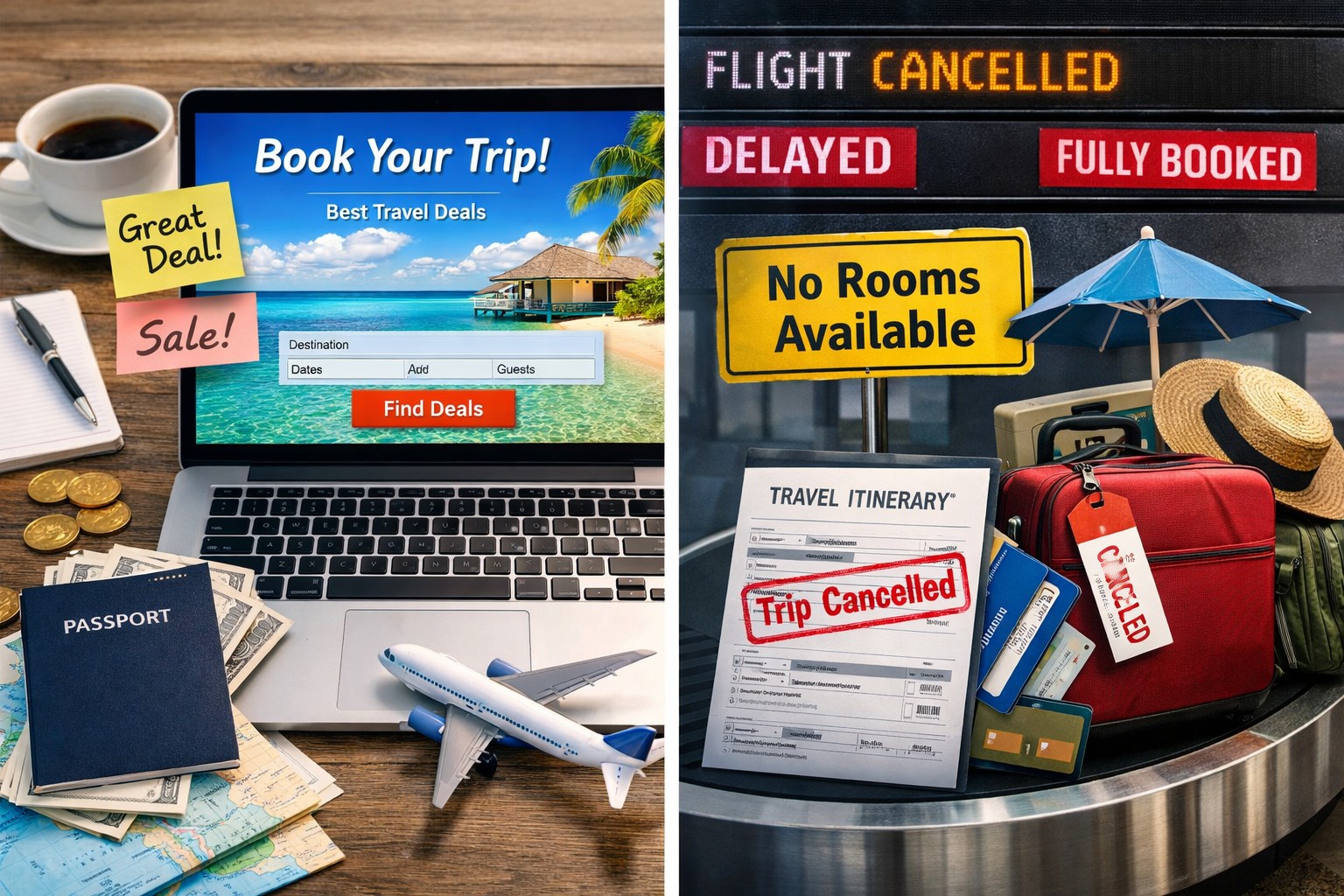
Most travel mistakes don’t happen during the trip.
They happen before you ever leave home — when you’re booking flights, hotels, cruises, resorts, rental cars, and experiences.
And the tricky part is that a lot of these mistakes don’t feel like mistakes at the time.
They feel like:
- “I found a great deal.”
- “This looks cheap.”
- “I’ll figure the rest out later.”
- “We can make it work.”
Sometimes you can.
But sometimes, that “great deal” turns into a more expensive, more stressful, or less enjoyable trip than you expected.
We’ve made plenty of these mistakes ourselves, and we see them all the time. The goal is not to make travel planning complicated. The goal is to slow down just enough to make sure the trip actually works.
Want Help Avoiding These Mistakes Before You Book?
This is exactly the type of thing we help people avoid.
Not just finding a cheaper flight, hotel, cruise, resort, or package — but looking at the whole trip before you commit. Because a good price on one piece of the trip does not always mean the full trip makes sense.
Through our Planning & Consulting services, we can help you compare options, think through the real cost, look at points versus cash, check whether your credits or perks fit, and avoid booking decisions that look good on the surface but fall apart later.
If you are planning a trip, this is the step most people skip — and it is often where the biggest mistakes happen.
If you have a question, feel free to text us at 480-331-1263.
Related Reading
- How We Compare Travel Options Before We Book
- Why Most “Free” Travel Advice Breaks Down in Real Life
- The Trip That Looks Good vs. The Trip That Feels Good: How to Plan for the Right Experience
- How to Choose the Right Type of Trip (Based on Your Budget, Time, and Energy)
- The Cheapest Option Isn’t Always the Best Value
Booking Based On Price Alone
This is probably the most common booking mistake we see. Finding the cheapest option feels like a win, but cheap and good value are not always the same thing.
More detail: Why price alone can mislead you
A cheaper flight might include a long layover, an inconvenient arrival time, no seat selection, or a basic economy restriction you did not notice. A cheaper hotel might be farther from the area you actually want to visit. A cheaper cruise cabin might be fine for one person and a terrible fit for someone else.
The price is only one part of the decision.
Travel booking sites are built to make the lowest number stand out. That makes sense. We all want to save money. But the lowest number does not always show the full cost of the decision.
A cheap flight might cost you half a day of vacation. A cheaper hotel might require more rideshares. A discounted resort might not include the food, drinks, transfers, or flexibility you assumed it did.
That does not mean you should always spend more. It means you should ask a better question:
What am I giving up to get this lower price?
Sometimes the answer is “nothing important.” Other times, the answer is time, comfort, flexibility, sleep, convenience, or peace of mind.
What to do instead:
- Look at total trip value, not just the price.
- Factor in time, transportation, location, flexibility, and what is included.
- Ask whether the cheaper option will actually make the trip better or just make the booking screen look better.
Chasing A “Great Deal” Without Looking At The Full Trip
This one can get expensive fast. A great hotel deal, discounted all-inclusive, cruise promo, or limited-time resort offer can fall apart if you do not look at the whole trip.
More detail: The resort deal problem
Someone finds a great hotel deal, a discounted all-inclusive, a cruise promo, or a limited-time resort offer and wants to jump on it right away.
That excitement makes sense.
But then they realize the flights are expensive. Or the best dates are blacked out. Or the resort deal only works during a time they cannot actually travel. Or transportation to get there wipes out much of the savings.
A great deal on one piece of the trip does not automatically mean the full trip is a great deal.
This happens a lot with hotels, resorts, and all-inclusives. The nightly rate looks amazing. The promo looks strong. The photos look beautiful.
But before booking, you still need to check:
- Are the dates actually available?
- Are there blackout dates?
- What does airfare cost for those dates?
- Are flights nonstop, reasonable, or painful?
- What time do flights arrive and depart?
- Are airport transfers included or expensive?
- Does the deal require a longer stay than you wanted?
- Are you saving money, or just shifting the cost somewhere else?
We have seen situations where the hotel or resort was a “steal,” but airfare made the total trip far less attractive.
That does not mean you should ignore hotel deals, resort promos, or a discounted all-inclusive. It means you should look at the whole trip before you get emotionally attached to one part of it.
What to do instead:
- Check flights, lodging, dates, transportation, and timing together.
- Look at the real total cost before booking.
- Confirm blackout dates, deposit rules, cancellation policies, and payment deadlines.
- Ask: Does this deal still make sense once everything is included?
Not Understanding What Is Actually Included
A price is rarely the full story. This is where a lot of people get surprised after they book.
More detail: What included really means
People see the price, assume certain things are included, and then later realize the trip costs more than expected.
That can happen with flights, hotels, resorts, cruises, rental cars, tours, and packages.
Common surprises include:
- Resort fees
- Parking fees
- Paid Wi-Fi
- No breakfast
- Baggage fees
- Basic economy restrictions
- Seat selection fees
- Cruise gratuities
- Specialty dining costs
- Beverage package rules
- Airport transfer costs
- Cancellation or change restrictions
Sometimes the higher-priced option is actually the better deal because it includes things you would otherwise pay for separately.
Other times, the cheaper option is still fine because you do not need the extras.
The mistake is not choosing the cheaper option. The mistake is not understanding what the cheaper option leaves out.
What to do instead:
- Compare what is included and what is not.
- Look at the final total before deciding.
- Pay attention to cancellation rules, payment timing, and restrictions.
- Do not assume two options are equal just because they look similar.
Waiting Too Long — Or Booking Too Early Without A Plan
Timing matters, but not always in the way people think. The better question is: What is the downside if I book this now?
More detail: Booking early can be smart when there is flexibility
Some people wait too long and lose availability, pay more, or miss out on better options. Others book too early and lock themselves into something that is hard to change.
But if there is little or no downside to booking early, it can actually be one of the smartest things you do.
For example, booking early may make sense when:
- The hotel rate is fully refundable.
- The cruise deposit is manageable and the final payment date is far away.
- The points booking can be canceled or rebooked.
- The airfare can be changed or credited if prices drop.
- You are not coming out of pocket in a meaningful way yet.
- The best options are likely to disappear.
In those situations, booking early can give you a solid backup plan while you keep watching for better prices, better points availability, or better routing.
We do this all the time.
Book something solid. Keep looking. Rebook if something better appears.
That is very different from locking yourself into a nonrefundable booking too early just because you are afraid prices might go up.
What to do instead:
- Ask what happens if prices drop later.
- Check whether the booking is refundable, changeable, or rebookable.
- Understand deposit and final payment deadlines.
- Keep watching for price drops after booking when it makes sense.
- Create flexibility instead of trying to guess the perfect timing.
Ignoring Points, Credits, And Perks You Already Have
This one hurts because it is often avoidable. A lot of people have points, credits, or benefits they could use — but they do not check before booking.
More detail: The easiest value is often the value you already have
A lot of people already have points, miles, hotel certificates, credit card credits, loyalty perks, dining credits, travel credits, or benefits they could use toward a trip.
But they do not check until after they have already booked. Or they never check at all.
This does not mean every trip should be booked with points.
Sometimes cash is the better option. Sometimes points are better saved for something else. Sometimes a credit card portal makes sense, and sometimes direct booking is better.
But before you book, it is worth checking:
- Do you have points that could reduce the cost?
- Do you have travel credits that need to be used?
- Do you have hotel free night certificates?
- Do you have lounge access that changes your airport plan?
- Do you have status or perks that only apply when booking a certain way?
- Do you have offers or statement credits that could make one option better than another?
The mistake is not paying cash.
The mistake is paying cash without taking a few minutes to check your points, credits, and perks before booking.
What to do instead:
- Take a few minutes to check your points, credits, and perks before booking.
- Compare points and cash side by side.
- Use points where they improve the trip, not just where they look impressive.
- Remember that the best redemption is not always the “highest value” redemption. Sometimes it is the one that makes a real trip happen.
Overcomplicating The Booking Strategy
There is a lot of noise in the travel world. Strategy can help, but complicated is not always better.
More detail: Complicated is not always better
Transfer partners. Sweet spots. Stacking strategies. Portal values. Award charts. Credit card credits. Status perks. Limited-time offers.
Those things can be useful.
But they can also make people freeze.
A smart booking strategy should make your trip better, not make you feel like you need a spreadsheet and a finance degree before you can go anywhere.
Sometimes the best move is simple:
- Book the refundable hotel.
- Use the points that save you real money.
- Pay cash when the points value is weak.
- Use the credit before it expires.
- Choose the nonstop flight.
- Pick the hotel that makes the trip easier.
The goal is not to win the internet’s version of travel math.
The goal is to book a trip that fits your budget, time, energy, and priorities.
What to do instead:
- Keep the strategy connected to the actual trip.
- Do not delay a good option while chasing a perfect one.
- Use points and credits as tools, not as the whole plan.
- Focus on good decisions you understand.
Not Thinking Through The Full Trip
A lot of bookings happen in pieces. Flight first. Hotel later. Activities after that. Transportation eventually.
More detail: Everything connects
Booking in pieces can work, but only if each piece still fits together.
When people do not think through the full trip, the small gaps can become the biggest headaches.
We see issues like:
- Flights that arrive too late for check-in.
- Return flights that leave too early after a cruise.
- Hotels that are cheaper but nowhere near the actual plans.
- Long layovers that make a short trip feel exhausting.
- Tours that conflict with dining reservations or show times.
- Airport transportation that costs more than expected.
- Multi-stop trips that look fun on paper but feel tiring in real life.
None of those are dramatic mistakes by themselves.
But together, they can change the entire feel of a trip.
This is why we like looking at the full flow before booking the individual pieces. Not because every minute needs to be scheduled, but because the trip should make sense in real life.
What to do instead:
- Map out arrival times, check-in times, transportation, and key activities.
- Think about how the trip will feel, not just how it prices out.
- Leave room for delays, meals, rest, and real life.
- Make sure the pieces support the trip you actually want.
Choosing The Wrong Booking Method
There is no single best way to book travel. The booking method is part of the decision.
More detail: Where you book can matter
Sometimes direct booking is best. Sometimes a credit card portal makes sense. Sometimes Costco Travel is worth checking. Sometimes points are the right answer. Sometimes a travel advisor can add value, perks, or support.
The mistake is assuming one booking method is always best.
The booking method can affect:
- Price
- Flexibility
- Cancellation rules
- Loyalty benefits
- Elite status recognition
- Travel credits
- Portal value
- Support if something goes wrong
- Advisor perks or promotions
- How easy it is to make changes later
For example, a hotel might be slightly more expensive through one channel but include breakfast, a property credit, or better flexibility. A cruise booking may look the same everywhere, but the support, onboard credit, or available promotions can differ. A flight may be cheaper through a third party, but harder to fix if something changes.
Again, this does not mean one method is always right.
It means the booking method is part of the decision.
What to do instead:
- Compare direct booking, portals, points, and advisor options when relevant.
- Look at flexibility and support, not just price.
- Understand what you gain or give up with each method.
- Choose the booking method that fits the trip, not the one that sounds best in theory.
Forgetting To Recheck After Booking
Booking the trip is not always the end of the process. If your booking is flexible, there may be value in checking again later.
More detail: A booking can be a placeholder, not a final answer
Sometimes prices drop. Points availability opens up. Better flight times appear. Cruise promotions change. Hotel rates move. Plans shift.
If your booking is flexible, there may be value in checking again later.
This is where refundable and flexible bookings can be powerful.
If you book something solid early, you are not necessarily done. You may have simply created a backup plan.
Later, you might be able to:
- Rebook a hotel at a lower rate.
- Switch to a better flight time.
- Change a points booking.
- Apply a better cruise promotion.
- Move from cash to points.
- Cancel a backup option once the better plan is secure.
This works best when you understand the rules upfront.
If the booking is nonrefundable, prepaid, or difficult to change, rechecking may not help. But if the booking is flexible, it can absolutely be worth keeping an eye on.
What to do instead:
- Save your cancellation and final payment dates.
- Recheck prices occasionally.
- Watch for points availability if you are using rewards.
- Do not assume the first booking has to be the final version.
- Only rebook when the math, timing, and rules actually make sense.
Final Thoughts
This is really what it comes down to.
A great flight deal does not matter if the dates are awful.
A discounted resort does not matter if airfare wipes out the savings.
A cheap hotel does not matter if it makes the trip harder.
A “perfect” points redemption does not matter if it is not the trip you actually want.
Better trips usually come from looking at everything together.
The cost. The timing. The location. The flexibility. The perks. The points. The trade-offs. The way the trip will actually feel once you are there.
That does not mean every trip needs to be expensive or perfectly planned.
It means the best booking decisions usually happen when you slow down long enough to ask:
Does this work for the whole trip — or just one piece of it?
Latest Posts from Planning & Consulting | All Planning & Consulting Posts