Planning a trip today is easier than ever.
You can open a few tabs, compare prices, watch a few videos, read reviews, and book flights, hotels, cruises, and activities in a single afternoon.
So where does getting help actually come in?
And more importantly, what really changes when you do?
The answer is not that one way is always better than the other. We book plenty of things ourselves. We also know there are times when a second set of eyes, better context, or someone who has done the research before can completely change the value of a trip.
This is not about taking control away from you. It is about helping you make better decisions before your money is locked in.
Want to Double Check Before You Book?
If you are not sure whether to book it yourself or get help, that is exactly where our Travel Booking & Advising service can fit in.
Sometimes you need full help planning the trip. Sometimes you just need someone to look at what you are about to book and say, “Yes, that makes sense,” or “Wait, let’s compare one more option first.”
If you have a question, feel free to text us at 480-331-1263.
Related Reading
- What Travel Booking & Advising Actually Means (And When You Need It)
- The Most Common Booking Mistakes We See (And How to Avoid Them)
- We’ll Always Present All the Options — Even When There’s Nothing in It for Us
The Truth: Both Options Can Work
Booking your own trip is not wrong. Getting help is not required.
The better question is not, “Which option is better?” It is: what kind of trip are you planning, and how much support do you actually want?
More detail: Why this matters
For a simple trip, booking it yourself may be completely fine.
A quick hotel stay. A familiar destination. A flight you already understand. A cruise you have taken before. A road trip where the details are easy to adjust.
There are plenty of situations where DIY booking works well.
But there are also trips where the choices start to stack up:
- Flights
- Hotels
- Cruises
- Transfers
- Points
- Credits
- Excursions
- Timing
- Cancellation rules
- Pre- and post-trip logistics
That is where getting help can make a difference.
Not because you are incapable of booking it yourself.
Because sometimes there is more happening than what shows up on the first search results page.
What Booking It Yourself Looks Like
DIY booking gives you full control. You can move at your own pace, compare options, and make every decision yourself.
That can be a real advantage, especially when you enjoy the research process and know exactly what you want.
More detail: Where DIY works well
Booking it yourself can make sense when:
- You know exactly where you want to go
- Your dates are flexible
- You are comfortable comparing prices
- You understand the cancellation rules
- You enjoy researching hotels, flights, cruises, or activities
- You are confident you are looking at the right options
The upside is control.
You choose the flight. You pick the hotel. You decide which cruise ship, cabin, or itinerary makes sense. You book when you are ready.
But the downside is that you are also responsible for everything you might miss.
That includes things like:
- Booking the wrong airport
- Picking a hotel in the wrong location
- Missing a better flight schedule
- Overlooking resort fees or parking costs
- Assuming a cruise fare includes more than it actually does
- Forgetting to compare points, credits, or perks
- Choosing the cheapest option without realizing why it is cheaper
DIY booking works best when the trip is simple, familiar, or low-risk.
The more moving parts there are, the more useful it becomes to have someone else look at the bigger picture.
What Changes When You Get Help
Getting help does not mean handing over the trip and hoping someone else gets it right.
Getting help means adding context, strategy, and a second set of eyes before you commit.
More detail: The difference between options and advice
Online booking tools are great at showing options.
They can show you prices, dates, times, hotels, cruise cabins, room categories, flight routes, and activity choices.
But they do not always tell you what those options mean.
A hotel may look close on a map but be inconvenient in real life.
A cruise may look inexpensive until you factor in flights, hotels, gratuities, Wi-Fi, excursions, and onboard spending.
A flight may be cheaper because it lands too late, connects too tightly, or puts you in basic economy when you really need flexibility.
A points redemption may look like a good deal until you compare what those points could do elsewhere.
That is where help changes the process.
Instead of only asking, “What is available?” you start asking:
- What actually fits this trip?
- What is worth paying extra for?
- What looks cheap but may cost more later?
- What would we avoid?
- Where can points, credits, or perks actually help?
- What option gives you the best overall value?
The booking itself may still be simple.
The decision behind it becomes better.
You Get Context, Not Just Search Results
One of the biggest differences between booking alone and getting help is context.
A website can show you hundreds of choices. That does not mean it helps you understand which ones are right for your trip.
More detail: Why context matters
Online, everything starts to look similar.
A hotel is a hotel. A cruise is a cruise. A flight is a flight. A “deal” is a deal.
But in real life, small differences matter.
A hotel across the street may be much better than one six blocks away.
A cruise ship with the same itinerary may feel completely different depending on ship size, entertainment, dining, layout, and passenger style.
A flight that saves $80 may not be worth it if it adds a risky connection, bad arrival time, or baggage restrictions.
A hotel credit may only be valuable if you were actually going to use the restaurant, breakfast, or property perk.
A cabin category may look like a small upgrade but make a big difference on a specific itinerary.
Getting help adds the “what does this mean in real life?” layer.
That is often the missing piece.
You Avoid Small Mistakes That Can Change the Trip
Most travel mistakes are not huge disasters.
They are small choices that quietly make the trip more expensive, more stressful, or less enjoyable than it needed to be.
More detail: Common mistakes help can catch early
Some of the most common issues are things people do not realize until after they book.
Things like:
- Booking a flight into the wrong airport
- Choosing a hotel based only on price
- Missing cancellation deadlines
- Picking a cruise cabin without understanding location
- Assuming drinks, gratuities, Wi-Fi, or specialty dining are included
- Forgetting about transportation costs
- Using points in a way that saves less than expected
- Booking an activity that does not fit the timing of the day
- Overlooking resort fees, parking, or port logistics
None of these automatically ruin a trip.
But they can change the experience.
A hotel that saves money but adds 30 minutes of transportation each way may not be a better value.
A flight that lands late at night may require an extra hotel night or make the first day harder.
A cruise that looks cheap upfront may not be cheap once you add everything you actually want.
Getting help is not just about finding something “better.”
Sometimes it is about catching the thing you did not know to question.
You May Pay the Same Price — But Get Better Value
A lot of people assume getting help means paying more.
That is not always true. In many cases, the price may be the same, close to the same, or even better once you compare the full value.
More detail: Price and value are not always the same thing
This is one of the biggest misunderstandings around travel help.
The cheapest visible price is not always the best deal.
Sometimes the better value comes from:
- Included perks
- Better cancellation terms
- A more convenient location
- A better flight schedule
- A smarter cabin choice
- A hotel credit you will actually use
- A cruise promotion that fits your trip
- Points or rewards used in the right place
- Avoiding a booking mistake before it happens
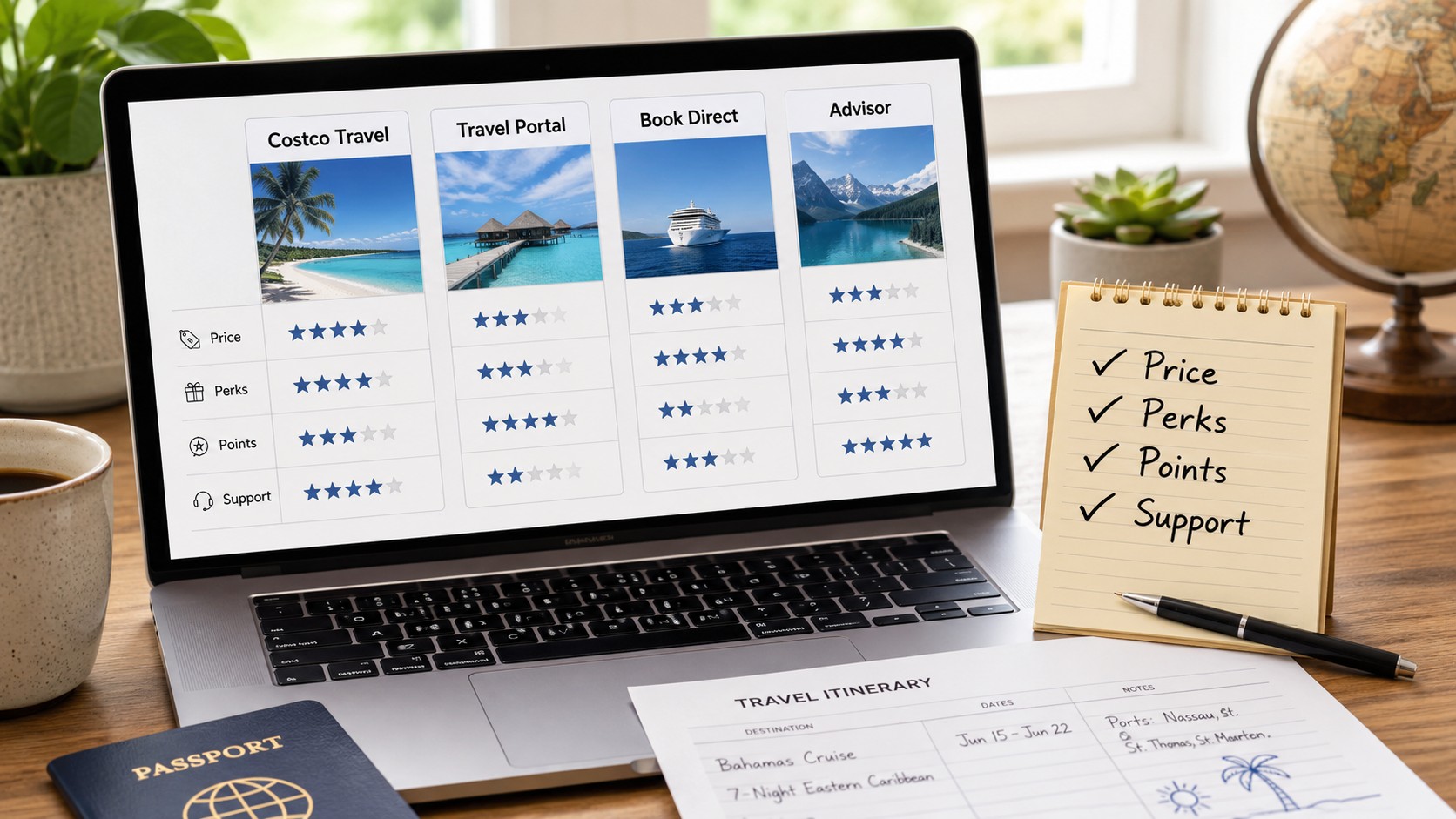
There are also situations where booking direct is the best move.
There are situations where a credit card travel portal makes sense.
There are situations where Costco Travel, a cruise line promotion, hotel loyalty program, or travel advisor booking may be worth comparing.
The goal is not to force one booking path.
The goal is to look at the options and decide which one actually gives you the best overall result.
That is why we care less about “cheap” and more about good value for the trip you actually want.
You Have a Plan, Not Just Bookings
When you book everything yourself, it is easy to end up with separate pieces.
A flight. A hotel. A cruise. A few activities. But that does not always mean the trip flows well.
More detail: Why the full plan matters
A good trip is not just a collection of reservations.
It is how those reservations work together.
- Does the flight arrival time make sense?
- Is the hotel location convenient for what you want to do?
- Do you need a pre-cruise hotel?
- Is the port transfer simple?
- Are you trying to do too much on the first day?
- Is there enough time between activities?
- Are you using points where they help most?
- Are you spending money on things that actually improve the trip?
This is where planning help can be valuable even if you still want to book some pieces yourself.
Sometimes the best support is not, “Let us book everything.”
Sometimes it is, “Let’s make sure all of this fits together before you finalize it.”
That can make the difference between a trip that technically works and a trip that feels smooth.
What Getting Help Does Not Mean
Getting help does not mean you lose control.
It does not mean you have to upgrade everything. It does not mean someone else decides what matters. The best version of getting help keeps you involved while giving you better information.
More detail: You still make the decisions
This part matters because a lot of people hesitate to ask for help because they think it means handing everything over.
That is not how we think about it.
Getting help does not mean:
- You have to spend more
- You have to book the most expensive option
- You have to travel the way someone else would travel
- You cannot still do your own research
- You cannot make the final decision
- You cannot say no to an option
In most cases, it is the opposite.
You stay in control.
You just get more context before you decide.
That could mean we help compare cruise options, review a hotel, look at flight timing, explain whether a points redemption makes sense, or walk through the pros and cons of booking through different channels.
The decision is still yours.
The goal is to make that decision easier.
When It Makes the Most Sense to Get Help
Some trips are perfect for DIY booking.
Others are where help becomes more valuable. The more money, complexity, unfamiliarity, or moving parts involved, the more useful it can be to ask for help before booking.
More detail: Trips where help can matter most
Getting help often makes the most sense when:
- The trip has multiple moving parts
- You are planning a cruise
- You are using points or travel rewards
- You are going somewhere new
- You are comparing several destinations
- You are traveling with family or a group
- You are booking for a special occasion
- You are trying to stay within a budget
- You are not sure which option is actually best
- You do not want to spend hours researching everything yourself
Cruises are a great example.
The fare is only one piece.
You may also need to think about:
- Cabin type
- Ship style
- Itinerary
- Drink packages
- Specialty dining
- Wi-Fi
- Gratuities
- Excursions
- Flights
- Hotels before or after the cruise
- Transportation to the port
- Travel insurance
That does not mean every cruise needs help.
But it does mean there are a lot of places where a little guidance can prevent expensive or frustrating choices.
The Middle Ground Most People Miss
You do not have to choose between doing everything yourself and handing the whole trip to someone else.
There is a middle ground. For a lot of travelers, that is where the real value is.
More detail: Help does not have to be all-or-nothing
Some people want full trip help.
They want someone to research options, compare pricing, explain the trade-offs, and help with the booking path.
Others already have a plan.
They just want a second opinion.
Both are valid.
The middle ground can look like:
- Reviewing a cruise before you book
- Comparing two or three hotels
- Checking whether a flight option makes sense
- Looking at whether points are worth using
- Helping decide between booking direct, using a portal, or using an advisor
- Sanity-checking the total trip cost
- Making sure the trip flow makes sense
This is one of the most practical ways to get help.
You still do the parts you enjoy.
You get support on the parts that are confusing, time-consuming, or easy to overlook.
Booking Is Only the First Step
The goal is not just to book a trip.
The goal is to have a trip that feels the way you hoped it would feel. That is the real difference.
More detail: What actually changes
A booking confirmation is not the finish line.
It is the beginning.
The real value comes from making sure the trip matches the experience you want.
- Do you want easy and relaxing?
- Do you want the lowest reasonable cost?
- Do you want better perks?
- Do you want flexibility?
- Do you want a cruise that fits your travel style?
- Do you want a hotel that makes the trip easier?
- Do you want to use points without wasting them?
- Do you want someone to help you avoid second-guessing every decision?
That is where getting help can matter.
Not because you cannot book it yourself.
Because sometimes a little more context changes the whole trip.
Final Thought
Booking it yourself can absolutely work.
Getting help can also make a huge difference.
The real question is not whether you are capable of planning your own trip. You probably are.
The better question is whether you want to spend the time, compare all the options, and take on every decision yourself — or whether you would rather have someone help you think through the parts that matter most.
Sometimes DIY is enough.
Sometimes a second set of eyes is exactly what keeps a trip from being more complicated, more expensive, or less enjoyable than it needed to be.
And sometimes the best answer is simply: book it yourself, but double check first.
Latest Posts from Travel Booking & Advising | All Posts in Category