There is a side of credit card rewards that most people never think about.
When someone earns cash back, airline miles, hotel points, lounge access, travel credits, or premium card perks, that value does not appear out of nowhere. Some of it comes from annual fees. Some of it comes from interest and fees paid by people who carry balances. And some of it comes from the fees merchants pay every time a credit card is used.
That last part is where this gets interesting.
When a business accepts credit cards, it pays processing costs. In many cases, those costs are built into the prices everyone pays, whether they use a premium rewards card, a basic credit card, a debit card, or cash.
So if you pay with cash or debit at the same price everyone else pays, you may still be helping cover the cost of the credit card rewards system — without getting any rewards back.
That does not mean everyone should run out and open a wallet full of travel cards. It does mean the system is worth understanding, because once you see how it works, it changes the way you think about paying.
Want Help Building a Smarter Points and Rewards Strategy?
Credit card rewards can be valuable, but only when they fit your real spending, your travel goals, and your ability to pay the balance in full. We help people think through points, rewards, travel credits, and everyday spending in a practical way — without pushing cards that do not make sense.
If you have a question, feel free to text us at 480-331-1263.
The Simple Version: Prices Often Include Card Fees
Most businesses do not charge every customer a different price based on how they pay. Card processing fees often become one more cost built into the final price.
More detail: Why the same price can benefit rewards card users
A restaurant, grocery store, hotel, gas station, or local shop usually builds its costs into the price of the product.
- Labor is in the price.
- Rent is in the price.
- Utilities are in the price.
- Card processing fees are often in the price too.
So when a merchant pays more to accept credit cards, that cost may be spread across all customers. The person using a rewards card gets points, miles, cash back, or perks. The person paying with cash or debit usually pays the same price and gets nothing back.
That is the part that feels frustrating.
It is not as simple as one cash customer directly handing money to one points traveler at the register. But the broader idea is pretty straightforward: when payment costs are baked into prices, people who do not earn rewards may still help fund the rewards earned by people who do.
Cash and Debit Users May Be the Ones Missing Out
There are plenty of good reasons someone may avoid credit cards. But if the price is the same no matter how you pay, cash and debit may not always be the better value.
More detail: When paying cash does not actually save money
Maybe someone does not want debt. Maybe they have had a bad experience with credit. Maybe they prefer the simplicity of cash or debit. Maybe they are trying to stay disciplined. Maybe they do not qualify for better rewards cards right now.
Those are all valid reasons.
But if the price is the same no matter how you pay, cash and debit may not actually save you money unless the business offers a real cash discount.
In a lot of places, the cash price and credit card price are identical. When that happens, the rewards card user gets something back. The cash or debit user pays the same price and gets nothing back.
That is why we think people should at least understand the system.
You do not have to chase every sign-up bonus. You do not have to carry ten cards. You do not have to turn every purchase into a spreadsheet.
But if you are already paying the same price as everyone else, using a rewards card responsibly can help you get some of that value back.
The key word is responsibly.
Rewards Are Not Worth Paying Interest
This is the part that gets lost when people talk about points and cash back. Credit card rewards only work when the balance is paid in full and the spending still makes sense.
More detail: The difference between using rewards and getting used by rewards
A 2% cash back card is not a win if you pay credit card interest.
A travel card bonus is not a win if it causes you to overspend.
A premium card is not a win if the annual fee is higher than the value you realistically use.
For us, the strategy is not “use credit cards no matter what.”
The strategy is:
- Use the right card.
- Pay it off.
- Use the benefits you already have.
- Compare the reward value against any added fee.
- Do not let points talk you into bad math.
That is the difference between using the rewards system and getting used by it.
The Flip Side: Credit Card Surcharges and Cash Discounts
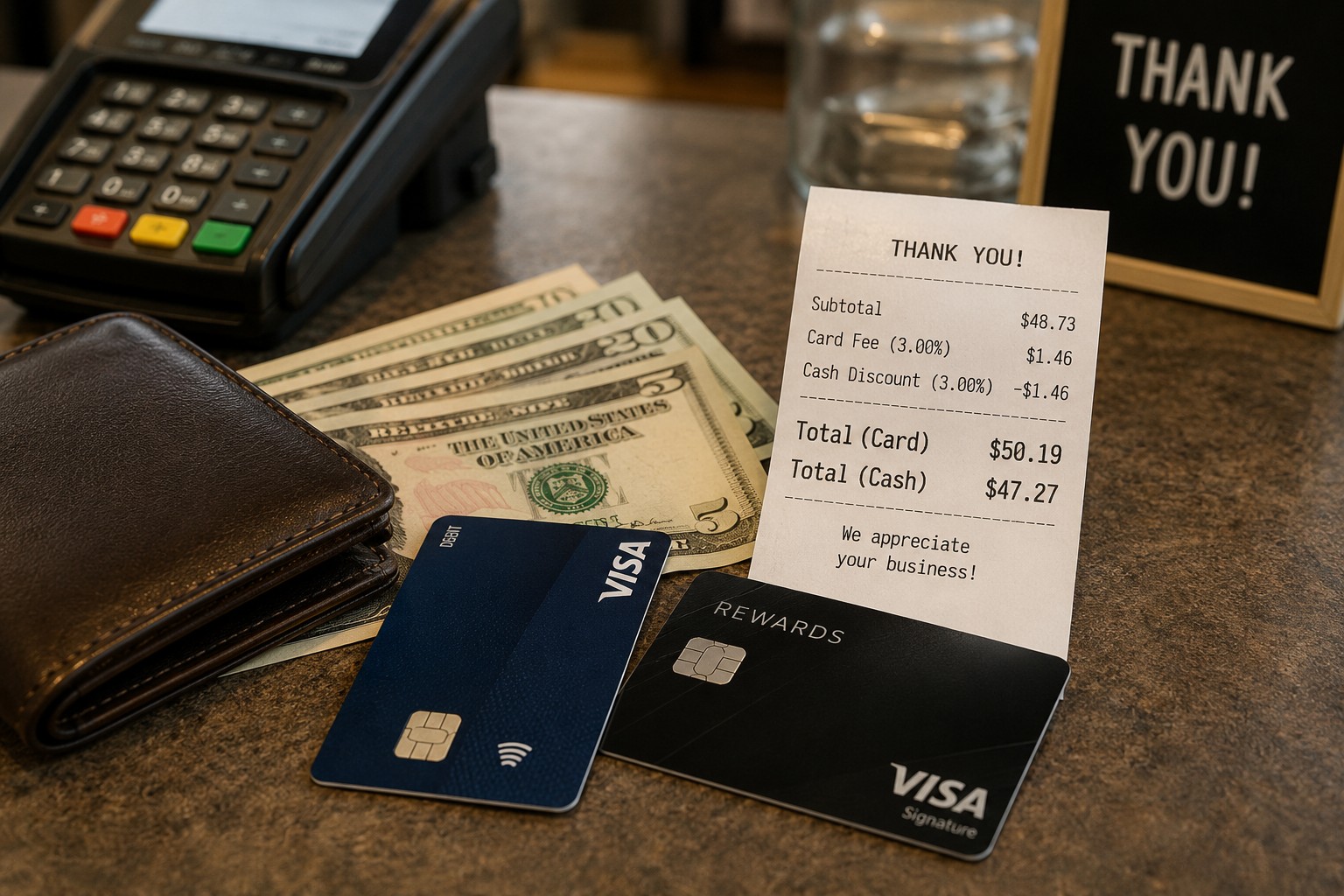
More places are adding credit card surcharges, “non-cash adjustments,” convenience fees, or cash discounts. Once that happens, the math changes.
More detail: Why visible fees change the decision
For a long time, many businesses simply charged everyone the same price and quietly absorbed or built in the card processing cost.
That is changing.
Sometimes these fees are clearly posted. Sometimes they are buried on a menu, taped near the register, shown on a checkout screen, or discovered when the bill arrives.
If a restaurant adds a 3% credit card fee and your card earns 1% cash back, paying with that card probably does not make sense unless there is another reason to use it.
But if the fee is 3% and your card earns 3x transferable points that you can reasonably use for at least 1 cent per point — or more — then the math may be close to break-even or better.
That does not mean we blindly pay every fee.
It means we do the math.
Sometimes we still use the card. Sometimes we pay another way. Sometimes we decide the place is not worth going back to.
When We Walk Away From Card Fees
We have stopped visiting a few places because the added credit card fee felt too high, too poorly disclosed, or not worth it when we had other options.
More detail: Why transparency matters as much as the fee
Businesses are allowed to make pricing decisions. We are allowed to make spending decisions.
If a place clearly posts a reasonable fee, provides good value, and we still want to go there, we may accept it.
If a place surprises us with a fee at the end, adds too much, or makes the pricing feel sneaky, that changes how we feel about going back.
The issue is not always the fee itself. Sometimes the bigger issue is transparency.
- Tell us up front.
- Make the cash price and card price clear.
- Do not wait until the bill arrives.
- Do not make the customer feel tricked.
When pricing is clear, we can decide whether the experience is still worth the total cost.
Cash Discounts Can Be a Real Win
A true cash discount is different from a surprise card fee. When a business is clear about the lower cash price, you can compare the savings against the rewards.
More detail: When cash may beat the points
If a business says the price is lower when paying cash, that can be a fair and transparent way to handle payment costs. You can decide whether the cash savings are better than the rewards you would earn.
Sometimes cash wins.
If a place gives a meaningful cash discount and your credit card rewards are worth less than that discount, cash may be the smarter choice.
If a gas station has a lower cash price, the cheaper price may beat the points.
If a small business is clear about its pricing and gives customers a choice, that is much easier to respect.
The important part is comparing the total cost, not just the payment method.
A rewards card is not automatically better.
Cash is not automatically better.
The best choice depends on the numbers.
Where Credit Cards Still Add Value Beyond Points
Rewards are only one part of the equation. Sometimes we use credit cards because of the protections and benefits that may come with them.
More detail: Why protections can matter too
Depending on the card and the purchase, that might include purchase protection, extended warranty coverage, travel protections, rental car coverage, fraud protection, or easier dispute rights.
That does not mean you should pay a big fee just for protections you may never use. But it does mean the decision is not always as simple as “fee versus points.”
For travel purchases especially, the right credit card can add meaningful protection if something goes wrong.
That is one reason we think people should know what benefits they already have before booking flights, hotels, cruises, rental cars, tours, or other travel purchases.
The Real-Life Takeaway
There are really two different systems happening. One hides the cost inside the price. The other makes the fee or discount more visible.
More detail: Why neither system is perfect
In one system, merchants build card fees into prices and everyone pays the same. In that world, rewards card users may come out ahead while cash and debit users help absorb the cost without getting anything back.
In the other system, merchants add a separate credit card fee or offer a cash discount. In that world, the math becomes more visible, and each customer has to decide which payment method makes the most sense.
Neither system is perfect.
Built-in fees are less annoying at checkout, but they can quietly make cash and debit users worse off.
Visible fees are more transparent, but they can feel frustrating — especially when they are not disclosed clearly up front.
Our approach is simple: know the system, do the math, and make the payment method work for you.
Final Thoughts
Credit card rewards are not free. Someone is paying for them.
Sometimes it is the merchant.
Sometimes it is built into prices.
Sometimes it is the person carrying a balance and paying interest.
Sometimes it is the customer who pays with cash or debit and does not receive any rewards back.
That does not mean everyone should rush out and open a premium travel card. It does mean that if you are already paying the same higher prices as everyone else, using the right rewards card responsibly can help you get some of that value back.
Just keep the bigger rule in mind: points are only valuable when the math works.
Paying interest does not work.
Overspending does not work.
Ignoring a surcharge does not work.
But using the right card, paying it off, comparing fees, and knowing when to walk away?
That can work.
Latest Posts from Credit Card Strategy
- When Credit Card Credits Create Bonus Travel
- Credit Card Surcharges and Cash Discounts: When Paying the Fee Still Makes Sense

- Cash, Cards, and the Reward Game: Are You Paying for Someone Else’s Points?

- Travel Protections by Credit Card and Network: What They Really Cover

- Credit Card Benefits You Might Have Without Realizing It: Visa Signature, Visa Infinite, Mastercard World Elite, Amex, and More

- Points Are Not Free If You Carry a Balance