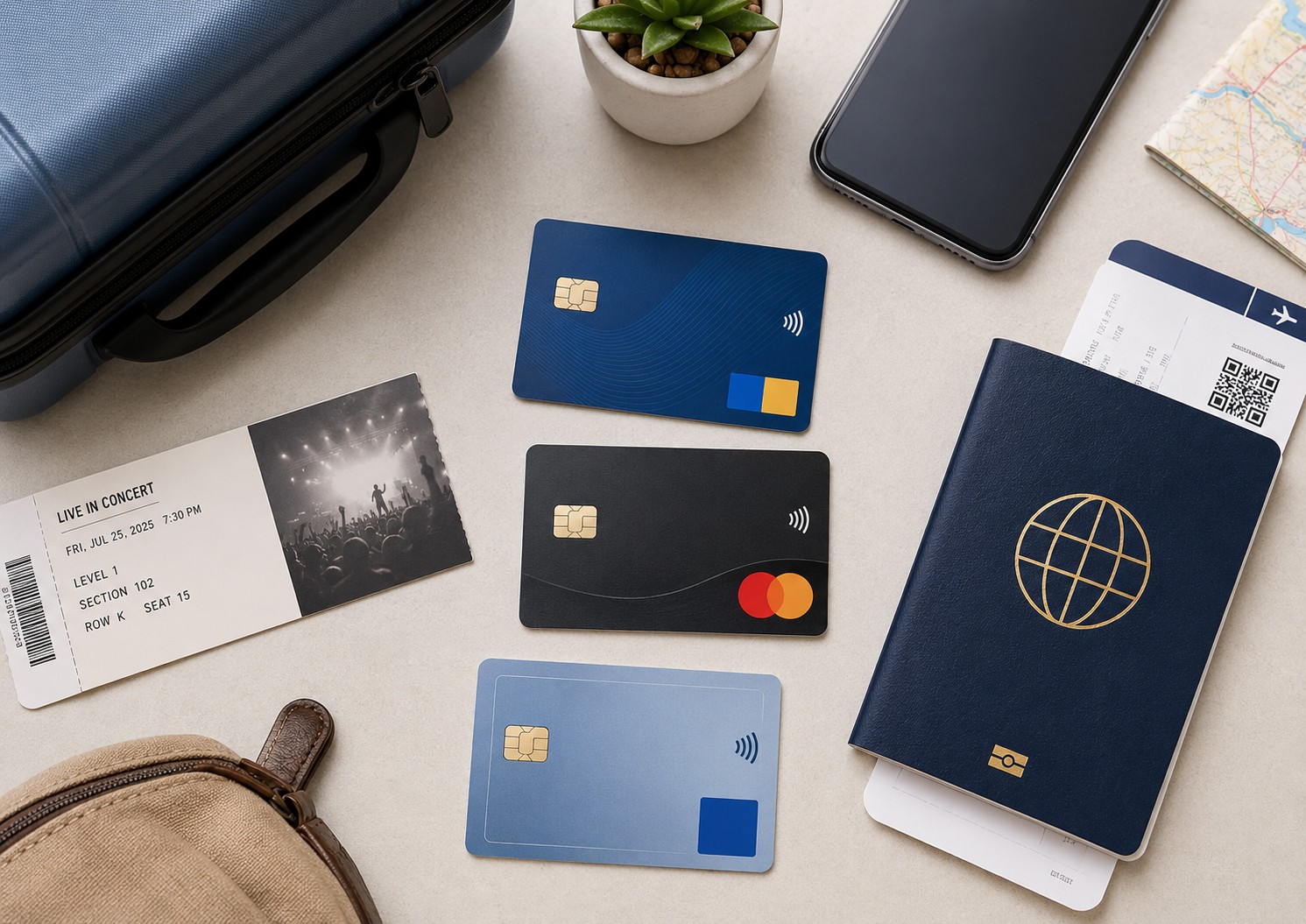
Travel Protections by Credit Card and Network: What They Really Cover
Most people think about credit cards in terms of points, cash back, lounge access, or annual fees.
But one of the most overlooked parts of a travel credit card is the protection it may provide when something goes wrong.
A delayed flight. A bag that does not show up. A rental car accident. A family emergency before a trip. A cruise, hotel, or flight you can no longer take.
These are not fun things to think about when you are planning a trip, but they matter. And in some cases, the credit card you use to book the trip can make a real difference.
The tricky part is that credit card travel protections are not as simple as saying, “I have a Visa,” or “I have an Amex,” or “I booked with a travel card.”
The actual protection usually depends on three things: the card network, the card issuer, and the specific card’s current Guide to Benefits.
That means a Visa Infinite card from one bank may not have the same protections as a Visa Infinite card from another bank. A World Elite Mastercard may include certain protections, but the issuer can still determine what applies. And an American Express card may have very different protections depending on whether it is a Platinum, Gold, airline, hotel, or another eligible card.
This article is not meant to replace reading your actual card’s benefit guide. It is meant to help you understand what those benefits usually mean in real life, which card might make sense for certain types of travel purchases, and when credit card protections may be enough to skip separate travel insurance.
Want Help Choosing the Right Card for the Right Trip?
Travel protections are one of those benefits that sound simple until you actually need them. The card you use to book a flight, cruise, hotel, or rental car can affect what is covered, what is excluded, and whether a claim has any chance of working.
Our Points & Rewards Strategy help is built around real-life travel decisions like this — not just chasing the biggest bonus or the highest points multiplier.
If you have a question, feel free to text us at 480-331-1263.
You can also visit our Planning & Consulting page if you want help comparing cards, booking options, and trip protections before you commit.
Related Reading
- Credit Card Benefits You Might Have Without Realizing It: Visa Signature, Visa Infinite, Mastercard World Elite, Amex, and More
- Chase Sapphire Reserve Has a Highest-Ever Bonus — But Is It Actually Worth the $795 Annual Fee?
- How We Decide If a Credit Card Annual Fee Is Actually Worth Paying
- Why We Don’t Follow One Credit Card Strategy — And Why You Shouldn’t Either
Important Note Before Relying on Any Credit Card Protection
Credit card travel protections change. Card issuers update benefits. Coverage limits vary. Claim rules matter. Exclusions matter even more.
Before relying on any card for a specific trip, read the current Guide to Benefits for that exact card.
More detail: Why this matters before you book
This is especially important for expensive trips, international travel, cruises, medical concerns, pre-existing conditions, adventure activities, rental cars, and anything you cannot afford to lose.
A credit card may provide valuable protection, but it is not the same thing as a full travel insurance policy. Some benefits are narrow. Some only apply to common carrier travel. Some require the entire trip to be paid with that card. Some exclude medical coverage, rental car liability, or Cancel For Any Reason protection.
That does not mean credit card protections are weak. It means they need to be understood before the trip, not after something goes wrong.
The Biggest Mistake: Assuming the Card Logo Tells the Whole Story
The Visa, Mastercard, American Express, or Discover logo on your card matters, but it does not tell the whole story.
The most important document is usually the Guide to Benefits for your exact card.
More detail: Card network versus card issuer
Visa has benefit tiers like Visa Signature and Visa Infinite. Mastercard has tiers like World Mastercard and World Elite Mastercard. American Express is both a card network and a card issuer, so benefits are often tied directly to the specific Amex card product.
But the logo or tier does not guarantee that every card has every benefit. A Visa Infinite card from Chase may have different protections than a Visa Infinite card from another bank. A World Elite Mastercard from Citi may not match a World Elite Mastercard from Capital One. Even two cards from the same issuer can have different benefit rules.
The network may provide the benefit structure, but the issuer and the specific card determine what you actually get.
That is why the first question should not be, “Is this a Visa or Mastercard?” The better question is, “What does the current Guide to Benefits for this exact card say?”
The Booking Rule: You Usually Need to Use the Right Card Upfront
Credit card travel protections usually are not automatic just because you own the card.
In most cases, you need to use the eligible card to pay for the trip, rental car, common carrier fare, or travel expense.
More detail: Why the payment method matters
Sometimes the requirement is that you pay for the entire cost with the card. Sometimes partial payment is enough. Sometimes points, miles, or rewards redemptions count. Sometimes they only count if the taxes and fees or remaining balance are charged to the eligible card.
That is why the card you use at booking matters.
If you book part of a trip with a gift card, another credit card, a travel credit, points from a different program, or a payment method that does not qualify, you may reduce or lose coverage depending on the card’s terms.
This can matter even more when you split a trip across multiple payments. A cruise deposit on one card, final payment on another card, flights with airline miles, and hotels through a travel portal can create a messy coverage picture if something goes wrong.
The safest approach is to decide which protection you care about before booking, then use the card that actually triggers that protection.
Why This Matters for Real Travel Planning
The card with the highest points multiplier is not always the best card to use.
Sometimes the smarter move is to use the card with stronger protections, even if it earns fewer points.
More detail: Matching the card to the type of trip
If you are booking a simple domestic trip with refundable hotels, the protection decision may be pretty easy. But if you are booking a cruise, international trip, prepaid resort stay, complicated flight itinerary, or rental car, the card choice matters more.
For expensive prepaid trips, you may want a card with strong trip cancellation and interruption protection.
For flights with tight connections, winter weather, or important arrival timing, you may care more about trip delay reimbursement.
For checked bags, especially before a cruise, wedding, international trip, or family vacation, baggage delay and lost luggage protection can matter.
For rental cars, we would pay close attention to whether the card provides primary rental car collision damage coverage or only secondary coverage.
The points you earn are nice. But the benefits you trigger by paying with the right card can sometimes matter more.
The Major Types of Travel Protection
Most travel cards do not cover everything. Instead, they usually offer a mix of protections that apply in different situations.
The key is understanding which benefit applies to which problem.
More detail: Common credit card travel benefits
- Trip cancellation and interruption: May reimburse prepaid, nonrefundable trip costs if you cancel or cut a trip short for a covered reason.
- Trip delay reimbursement: May reimburse meals, lodging, and certain necessary expenses when common carrier travel is delayed long enough to trigger coverage.
- Baggage delay reimbursement: May reimburse essential purchases if your checked bag is delayed.
- Lost or damaged luggage: May help if your baggage is lost, stolen, or damaged by a common carrier.
- Rental car collision damage waiver: May cover theft or collision damage to the rental vehicle when you pay with the eligible card and decline the rental company’s collision coverage.
- Travel accident insurance: May provide a benefit for certain serious accidents while traveling on a covered common carrier.
- Emergency evacuation or assistance: May provide limited help or reimbursement in certain serious emergency situations.
- Purchase protection and extended warranty: Not travel-specific, but useful for luggage, electronics, and travel gear purchased with the card.
These benefits sound broad, but each one has its own trigger, limit, exclusions, documentation requirements, and claim process.
Trip Cancellation and Interruption: What It Usually Covers
Trip cancellation and interruption coverage is the benefit people often think of first.
This is the protection that may reimburse prepaid, nonrefundable travel costs if you have to cancel before the trip or cut the trip short for a covered reason.
More detail: Covered reasons versus changing your mind
Covered reasons often include things like sickness or injury, severe weather, death of a family member, certain jury duty or legal obligations, certain transportation issues, and other specific situations listed in the benefit guide.
But the key word is covered.
Credit card trip cancellation coverage usually does not mean, “I changed my mind.” It usually does not mean, “I found a better deal.” It usually does not mean, “I am nervous about traveling.” It usually does not mean, “Work got busy,” unless the specific policy says otherwise.
That is one of the biggest gaps between credit card protections and separate travel insurance.
Some separate travel insurance policies offer optional Cancel For Any Reason coverage. Credit card protections generally do not.
This is why we would not automatically assume credit card protections are enough for every expensive trip. They can be very useful, but they are usually designed around specific covered events, not every reason life changes.
Trip Delay Reimbursement: The Benefit People May Actually Use More Often
Trip cancellation gets attention, but trip delay coverage may be one of the most practical credit card benefits.
This is the benefit that may help when your common carrier travel is delayed long enough to trigger coverage.
More detail: Six hours, twelve hours, and why the trigger matters
Trip delay reimbursement may cover reasonable expenses such as meals, lodging, transportation to and from a hotel, toiletries, and other necessary expenses related to the delay.
But the delay has to meet the card’s requirements.
Some premium cards may trigger after a delay of more than six hours or a delay requiring an overnight stay. Other cards may require more than twelve hours or an overnight stay.
That difference matters.
If your flight is delayed seven hours and you used a card with a six-hour trigger, you may have a claim. If you used a card with a twelve-hour trigger, you may not.
This is why booking flights with the right card is important. It is also why the best points-earning card may not always be the best booking card.
Baggage Delay: Small Benefit, Big Real-Life Value
Baggage delay coverage is one of those benefits you hope you never need, but when you need it, you really need it.
This can matter a lot before a cruise, wedding, international trip, or any trip where replacing essentials would be difficult.
More detail: What baggage delay may reimburse
If your checked bag does not arrive on time, baggage delay coverage may reimburse essential purchases such as toiletries, clothing, chargers, and other necessary items.
There are usually limits. Many policies cap reimbursement per day and for a certain number of days. They also usually require receipts.
You normally need documentation from the airline or common carrier showing that the bag was delayed. The benefit may also be secondary to other valid reimbursement from the airline or another source.
For cruises, this can be especially important. If your bag is delayed before boarding, you may not have easy access to shopping once the ship leaves.
A baggage delay benefit may not solve everything, but it can make a frustrating situation less expensive.
Lost or Damaged Luggage: Not the Same as Baggage Delay
Lost luggage reimbursement is different from baggage delay.
Baggage delay helps when your bag is late. Lost or damaged luggage protection may help when your baggage is lost, stolen, or damaged by the common carrier.
More detail: Why documentation matters
You usually need to report the issue to the airline, cruise line, train company, or other common carrier first. You also need documentation, receipts if possible, and proof of what was lost or damaged.
This coverage can be useful, but it is rarely unlimited.
High-value items such as jewelry, electronics, watches, cameras, designer goods, or professional equipment may have sub-limits or exclusions.
This is another case where the card may help, but you should not assume it will make you whole for everything in your bag.
Rental Car Coverage: One of the Most Valuable Card Benefits
Rental car coverage is one of the clearest examples of why the right card matters.
The biggest distinction is whether the coverage is primary or secondary.
More detail: Primary versus secondary rental car coverage
Primary coverage generally means the card benefit can respond before your personal auto insurance for covered theft or collision damage to the rental vehicle.
Secondary coverage generally means it may only pay after your personal auto insurance or another coverage source has responded.
That difference can matter because using secondary coverage may still involve your personal insurance, your deductible, and possibly future premium impacts.
Some cards, including certain premium Chase cards, are known for offering primary rental car collision damage coverage when you pay with the eligible card and decline the rental company’s collision damage waiver.
But rental car protection usually has limits. It may cover theft or collision damage to the rental vehicle, but it usually does not cover personal liability, injury, damage to another vehicle, or personal belongings inside the car.
That is a huge distinction. Credit card rental car protection can be valuable, but it is not the same thing as full rental car insurance.
The Rental Car Trap: Declining Coverage Without Understanding What You Declined
To use most credit card rental car collision benefits, you usually need to decline the rental company’s collision damage waiver or loss damage waiver.
But declining that waiver does not mean you have every kind of coverage.
More detail: What rental car benefits may not cover
Before relying on credit card rental car coverage, think about:
- Liability coverage
- Personal accident coverage
- Personal effects coverage
- Country-specific rental requirements
- Excluded vehicle types
- Long rental periods
- Peer-to-peer car sharing exclusions
- Off-road driving exclusions
- Luxury, exotic, antique, truck, van, motorcycle, or recreational vehicle exclusions
For domestic rentals, your personal auto policy may provide liability coverage. For international rentals, that may not be true.
This is one of the areas where we would check the card benefit guide before every major trip, especially outside the U.S.
American Express: Strong Benefits on Eligible Cards, but Check the Exact Product
American Express is a little different because it is both a card network and a card issuer.
Amex travel protections are tied to specific eligible cards, not just the Amex name.
More detail: Why Amex benefits vary by card
Some American Express cards offer trip cancellation and interruption insurance, baggage insurance, car rental loss and damage insurance, and other protections. But eligibility, limits, and terms vary by card.
For example, some Amex trip cancellation and interruption protections are tied to eligible round-trip purchases made entirely with the eligible card. That type of wording matters if you are booking one-way flights, partial trips, award travel, or mixed-payment travel.
Amex can be strong for travel protections, especially on premium eligible cards, but you need to check the card-specific terms.
Also, many standard Amex rental car protections are secondary by default, though Amex has offered a separate paid Premium Car Rental Protection option on eligible cards. That can be useful, but it is different from an automatic no-additional-cost benefit.
Visa Signature and Visa Infinite: Useful Network Tiers, but Not Identical Across Cards
Visa Signature and Visa Infinite are card network tiers that can include travel protections.
But they are not guarantees that every card has every benefit.
More detail: Why a Visa Infinite card is not always the same as another Visa Infinite card
Visa Signature and Visa Infinite cards may include benefits such as auto rental collision damage waiver, baggage delay reimbursement, emergency assistance, emergency evacuation, purchase protection, and other benefits.
But Visa itself typically points cardholders back to the issuer and the card’s Guide to Benefits for the actual terms.
This is why a Visa Infinite card like Chase Sapphire Reserve may have a very different travel protection package than another Visa Infinite card from another bank.
Same network tier. Different issuer. Different benefits. Different claim rules.
Mastercard World Elite and Related Premium Tiers: Same Idea, Check the Issuer
Mastercard works similarly.
A World Elite Mastercard may come with a package of benefits, but the exact benefits depend on the issuer and card product.
More detail: Why Mastercard benefits can vary
Some Mastercard products may include travel protections such as trip cancellation or interruption, trip delay, baggage protections, car rental coverage, travel assistance, purchase protection, or extended warranty benefits.
But again, the card issuer decides what applies to that specific card.
A Citi World Elite Mastercard, a Capital One World Elite Mastercard, and another bank’s World Elite Mastercard may not all provide the same travel protections.
Do not assume the network tier is enough. Check the benefit guide for the actual card.
When Credit Card Protections May Be Enough
There are times when credit card travel protections may be enough.
For a simple domestic trip with refundable hotels, flexible flights, and no major medical concerns, a strong travel card may provide enough protection for the most likely issues.
More detail: Situations where we might skip separate travel insurance
Credit card protections may be enough when:
- The trip cost is not extremely high
- Most bookings are refundable or cancellable
- You are mainly worried about flight delays
- You are traveling domestically
- You already have health insurance that applies where you are going
- You are not concerned about Cancel For Any Reason coverage
- You are renting a car and have a card with strong primary rental car collision coverage
- You can afford to self-insure smaller losses
- The card’s trip cancellation limits are high enough for your prepaid, nonrefundable costs
A good example would be a weekend trip where the hotel can be canceled, the flight is booked with a card that has trip delay coverage, and the rental car is paid with a card that provides primary collision coverage.
In that situation, separate travel insurance may not add much value unless you want medical coverage, Cancel For Any Reason coverage, or coverage for specific risks not handled by the credit card.
When We Would Strongly Consider Separate Travel Insurance
There are also times when we would not rely only on a credit card.
The bigger, more expensive, more complicated, or more medical-sensitive the trip is, the more we would compare credit card protections against a separate travel insurance policy.
More detail: Trips where separate coverage may make sense
Separate travel insurance may be worth considering when:
- The trip is expensive
- The trip has large prepaid, nonrefundable costs
- You are taking a cruise
- You are traveling internationally
- You need emergency medical coverage
- You need medical evacuation coverage
- You have pre-existing condition concerns
- You want Cancel For Any Reason coverage
- You are traveling with older family members or people with health concerns
- You are booking a complicated multi-stop trip
- You are booking independent tours, excursions, or private transfers
- You are going somewhere remote
- You are worried about supplier default or bankruptcy
- You are booking far in advance and life could change
- You are traveling during hurricane season or winter weather
- You cannot afford to lose the money you prepaid
Cruises are a major example. A cruise may include the cruise fare, taxes and fees, flights, hotels before or after the cruise, transfers, excursions, specialty dining, drink packages, travel documents, and other prepaid costs.
A credit card may cover some of that. It may not cover all of it. And medical care at sea or evacuation from a ship can be very different than a delayed domestic flight.
The Cruise Example: Why the Booking Card Matters
Cruises are one of the best examples of why this topic deserves more attention.
If you book the cruise with one card, flights with another card, and hotels with a third card, the coverage picture can get complicated quickly.
More detail: How a cruise trip can create multiple coverage questions
Let’s say you book a cruise with one card, flights with another card, and a pre-cruise hotel with a third card.
If the cruise is canceled for a covered reason, the card used for the cruise fare may matter.
If the flight is delayed and you miss embarkation, the card used for the flight may matter.
If your checked bag is delayed before boarding, the card used for the common carrier fare may matter.
If you booked a nonrefundable hotel before the cruise, the hotel may or may not be covered depending on the card and the reason for cancellation.
If you paid with points, a travel portal credit, gift card, or multiple payment methods, the claim could get even more complicated.
This is why we would rather think about protection at booking instead of after something goes wrong.
For expensive cruises, international cruises, or cruises with complicated flights, we would at least compare the credit card protections against a separate travel insurance policy.
The Flight Example: Delay Coverage Can Be More Important Than Earning Points
Flights are where trip delay protection can be very practical.
A card with stronger delay coverage may be worth using even if another card earns slightly more points.
More detail: Why flight timing matters
Imagine you are flying from Phoenix to the East Coast with a connection. Weather rolls in. Your connection is missed. The airline rebooks you the next day.
The airline may provide help, but it depends on the reason for the delay and the airline’s policies.
A credit card with trip delay reimbursement may cover unreimbursed meals, lodging, and other necessary expenses if the delay meets the required trigger.
For trips with tight connections, winter weather, cruises, weddings, business meetings, or important arrival timing, we would seriously consider using a card with stronger delay protection.
It may not feel exciting at booking, but it can matter a lot when travel starts falling apart.
The Hotel Example: Credit Card Protection May Be Weaker Than People Think
Hotels are where people can get surprised.
Some cards cover prepaid, nonrefundable hotels as part of trip cancellation and interruption coverage. Others are written more narrowly around common carrier travel.
More detail: Why nonrefundable hotel rates deserve a closer look
Some card benefits may explicitly include prepaid, nonrefundable hotels. Others may focus mainly on common carrier passenger fares, such as flights, trains, buses, ferries, or cruise transportation.
That matters if you are booking:
- Nonrefundable hotel rates
- Prepaid resort stays
- Vacation rentals
- Theme park packages
- All-inclusive resorts
- Independent tours
- Cruise pre- or post-night hotels
This is why the cheapest prepaid hotel rate is not always the best deal.
If you save $30 by booking nonrefundable but expose yourself to hundreds or thousands of dollars in risk, that might not be the best value.
The Points Booking Question: Are Award Trips Covered?
Award travel can make credit card protections more confusing.
Sometimes points bookings are covered. Sometimes they are not. Sometimes only part of the trip is covered.
More detail: Why award bookings need extra attention
Sometimes the taxes and fees need to be paid with the eligible card. Sometimes the points need to come from that same issuer’s rewards program. Sometimes coverage applies to the cash portion but not the points value.
This is a huge point for points-and-miles travelers.
Using points does not automatically mean you have no protection, but it does mean you need to understand which card is connected to the booking and what counts as an eligible payment.
Before assuming an award flight, hotel, or cruise booking is protected, check the benefit guide language for that specific card.
What Credit Card Protections Usually Do Not Cover Well
Credit card protections can be valuable, but they are not a complete substitute for travel insurance in every situation.
The biggest gaps are usually the things people assume are covered without checking.
More detail: Common gaps and exclusions
Common gaps may include:
- Cancel For Any Reason coverage
- Broad medical coverage
- Pre-existing condition waivers
- High-limit emergency medical evacuation
- Adventure sports or high-risk activities
- Supplier bankruptcy or default
- Some independently booked tours or excursions
- Some vacation rentals
- Some prepaid hotels
- Traveling against medical advice
- Fear of travel
- Changing your mind
- Certain weather concerns unless they meet the covered reason
- Rental car liability
- Personal belongings inside a rental car
- Expensive jewelry, cameras, watches, or electronics above sub-limits
This is why “my credit card has travel insurance” is not enough.
The better question is: What specific problem am I trying to protect against, and does this card actually cover that problem?
How We Would Choose Which Card to Use
We would not use the same card for every type of travel purchase just because it earns the most points.
We would match the card to the risk of that part of the trip.
More detail: A practical card-selection framework
For flights: We would prioritize trip delay, baggage delay, lost luggage, and trip cancellation or interruption coverage.
For cruises: We would look closely at trip cancellation and interruption limits, whether common carrier-only language applies, whether hotels and tours are included, and whether separate travel insurance makes sense for medical and evacuation coverage.
For hotels: We would check whether the card’s trip cancellation and interruption protection includes prepaid hotels. If not, we would be cautious with nonrefundable rates.
For rental cars: We would prioritize primary rental car collision damage coverage, but separately confirm liability coverage through personal auto insurance, the rental company, or another policy.
For international trips: We would look beyond credit card protections and seriously evaluate separate travel insurance, especially for medical coverage and evacuation.
For expensive trips: We would compare the total prepaid, nonrefundable cost against the card’s coverage limits.
For points bookings: We would check whether award travel is covered and which card needs to pay the taxes, fees, or remaining balance.
A Practical Pre-Trip Checklist
Before booking a trip, we would do a quick protection check.
This does not need to take hours, but it should happen before you pay.
More detail: Questions to ask before paying
- Which part of this trip is nonrefundable?
- What card am I using to pay for each part?
- Does that card cover trip cancellation and interruption?
- Does the coverage include hotels, tours, cruises, and prepaid packages, or only common carrier fares?
- What are the per-person, per-trip, and annual coverage limits?
- Does trip delay coverage trigger after six hours, twelve hours, or only overnight?
- Does baggage delay coverage apply, and after how many hours?
- Does rental car coverage apply as primary or secondary?
- Does rental car coverage include liability? Usually, no.
- Are award bookings covered?
- Are pre-existing conditions excluded?
- Do I need medical or evacuation coverage?
- Would I want Cancel For Any Reason coverage?
- Can I afford to lose the uncovered portion of this trip?
If the answer to that last question is no, it is time to look harder at separate travel insurance.
Useful Benefit Pages to Check Before Relying on Coverage
The most important source is always your exact card’s current Guide to Benefits, but these pages are useful starting points.
- Chase Sapphire travel insurance guide
- American Express Trip Cancellation and Interruption Insurance terms
- American Express insurance and protection benefits
- Visa Infinite benefits overview
- Visa Signature benefits overview
- Capital One credit card benefits guide page
- Citi Strata Premier card benefits page
Again, these pages are starting points. Before relying on a benefit, look up the actual benefit guide for the exact card you plan to use.
When the “Right” Card May Not Be the Highest-Earning Card
This is the part that can feel backwards.
Sometimes the best card to use is not the card that earns the most points.
More detail: Protection can be part of the value calculation
A card that earns 5x points but has weak protections may not be the best choice for an expensive prepaid trip.
A card that earns 2x points but provides stronger trip cancellation, trip delay, baggage, and rental car coverage may be a better real-life value.
This is especially true when the risk is meaningful.
We love points. We love maximizing value. But earning a few extra points is not worth giving up hundreds or thousands of dollars in potential protection when something goes wrong.
So, Can Credit Card Protections Replace Travel Insurance?
Sometimes, yes.
Often, no.
More detail: How we would make the decision
For simple trips, strong credit card protections may be enough.
For expensive, international, medical-sensitive, cruise-heavy, or complicated trips, separate travel insurance may still make sense.
The key is not to make the decision based on habit.
Do not automatically buy travel insurance every time without understanding what your card already provides.
Do not automatically skip travel insurance just because your card has benefits.
Compare the trip, the risks, the prepaid costs, and the card’s actual coverage. That is where the real value is.
Final Thoughts
Credit card travel protections are one of the most useful benefits people forget to use.
But they only help if you use the right card, understand what triggers the benefit, and know where the gaps are before something goes wrong.
The card you use to book your trip is not just about earning points. It can determine whether you have trip delay coverage, baggage protection, rental car damage coverage, cancellation reimbursement, or no meaningful protection at all.
That does not mean every trip needs a separate travel insurance policy.
It does mean every trip deserves a quick protection check before you book.
Because the best travel card is not always the one with the flashiest bonus or the highest earning rate.
Sometimes, it is the one that actually helps when travel stops going according to plan.
Latest Posts from Credit Card Strategy | All Credit Card Strategy Posts
- Travel Protections by Credit Card and Network: What They Really Cover

- Credit Card Benefits You Might Have Without Realizing It: Visa Signature, Visa Infinite, Mastercard World Elite, Amex, and More

- Points Are Not Free If You Carry a Balance

- How the Chase The Edit Hotel Credit Works — And When It Can Actually Be Useful

- Why We Still Keep the Amex Platinum — Even at $895

- Chase Sapphire Reserve Has a Highest-Ever Bonus — But Is It Actually Worth the $795 Annual Fee?