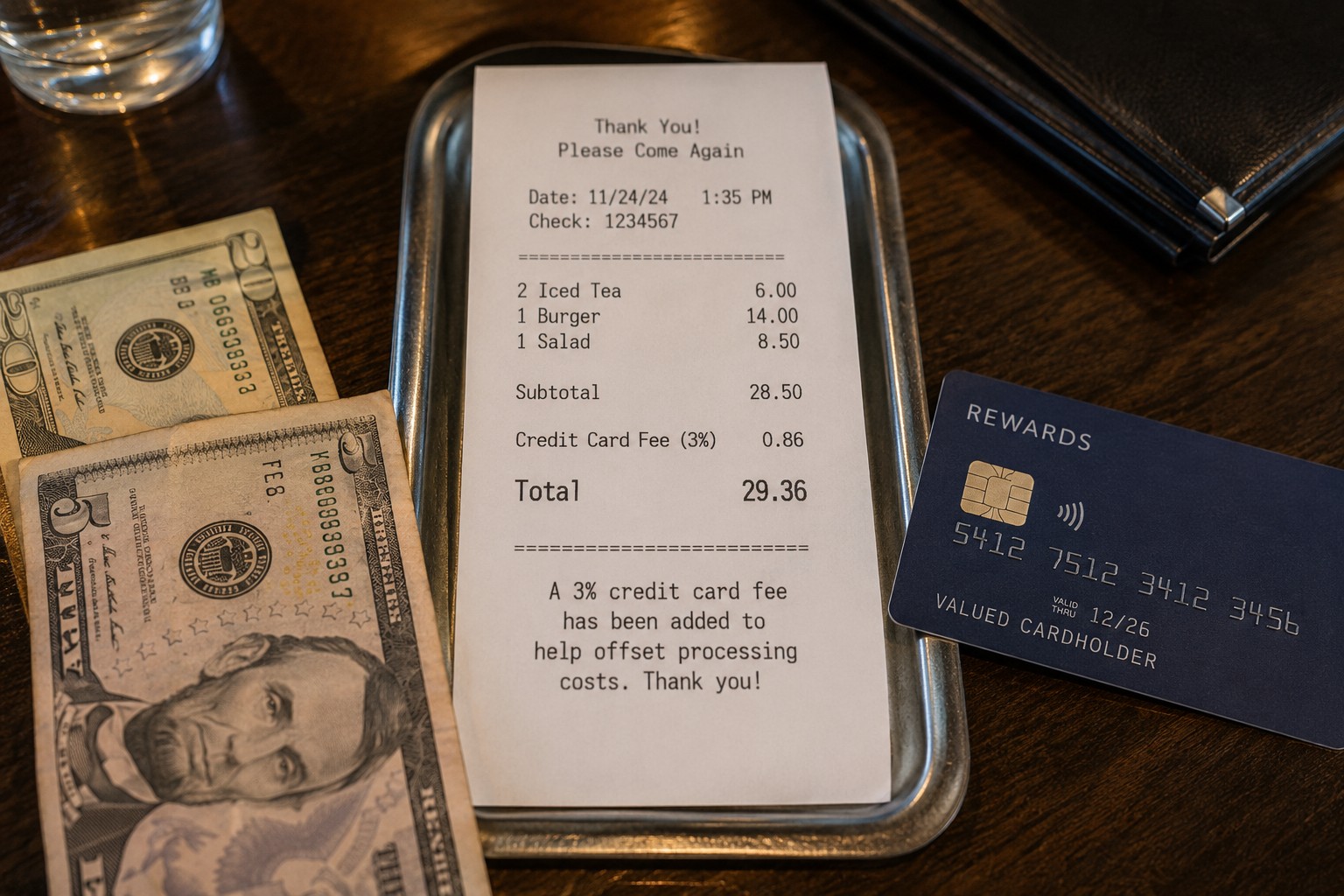
Sometimes the best rewards card in your wallet is not the best way to pay.
That is especially true when a business adds a credit card fee, a non-cash adjustment, a convenience fee, or a separate surcharge for using a card.
For years, a lot of card processing costs were quietly built into prices. Everyone paid the same price, whether they used cash, debit, or a rewards credit card. That is part of why rewards cards can make sense when used responsibly — if the cost is already baked into the price, you might as well earn something back.
That connects to a bigger issue we covered in Cash, Cards, and the Reward Game: Are You Paying for Someone Else’s Points? — when card processing costs are built into prices, cash and debit users may still be helping fund rewards they are not earning.
But when a business adds a separate fee for credit cards or offers a lower cash price, the math changes.
Now the question is not just, “What rewards do I earn?”
The better question is: Do the rewards, protections, and convenience outweigh the fee?
Want Help Making Your Points and Rewards Strategy Make Sense?
Credit card rewards can be valuable, but only when they fit your real spending, your travel goals, and your ability to pay the balance in full. We help people think through cards, points, travel credits, and everyday spending in a practical way — without pushing cards that do not make sense.
If you have a question, feel free to text us at 480-331-1263.
Credit Card Fees Are Becoming Harder to Ignore
We are seeing card fees more often than we used to. Sometimes they are clear. Sometimes they show up at the end, and that changes how the whole purchase feels.
More detail: Why the disclosure matters
Sometimes it is at restaurants. Sometimes it is at small businesses. Sometimes it shows up as a “non-cash adjustment,” a “service fee,” a “technology fee,” or a “convenience fee.”
We understand that businesses pay processing fees. We also understand that small businesses have to make hard decisions about pricing. But as customers, we also get to decide whether the final price still feels fair.
A clearly posted fee is one thing. A surprise fee at the end of the transaction feels different.
We have stopped visiting a few places when the added card fee felt too high, too poorly disclosed, or just not worth it when we had other options nearby.
That does not mean we refuse every place that charges a fee. It means we do the math.
A Cash Discount and a Credit Card Fee Are Basically the Same Decision
A cash discount and a credit card surcharge can feel different, but from the customer side they often create the same choice: pay less with cash, or pay more with a card and earn rewards, protections, or convenience.
More detail: How to compare the total cost
If a restaurant menu says the listed prices are cash prices and card payments cost 3% more, that is functionally similar to saying card prices are normal and cash gets a 3% discount.
Either way, you need to compare the total out-of-pocket cost.
- If cash saves you more than the card rewards are worth, cash may be the better choice.
- If the card rewards are worth as much as or more than the fee, using the card may still make sense.
- If the difference is tiny, convenience may decide it.
The best answer is not automatically cash or credit. The best answer is the payment method that gives you the best total value for that purchase.
The Simple Math: 3% Fee vs. 3x Points
A 3% fee is not automatically a dealbreaker. It depends on what card you are using and how much value you realistically get from the rewards.
More detail: Why realistic point value matters
Let’s say you are paying a $100 restaurant bill and the business adds a 3% credit card fee.
Your total becomes $103.
If your card earns 1% cash back, you would earn about $1.03 in rewards while paying $3 extra. That is probably not worth it.
If your card earns 3x points at restaurants, you would earn 309 points on the $103 charge. If you value those points at about 1 cent each, that is roughly $3.09 in value. That is close to break-even.
If you can consistently use those points for more than 1 cent each through travel partners, the card could come out ahead.
But that only works if you are being realistic.
Do not value points at some inflated number just to justify a bad fee.
If you normally redeem points for cash back, statement credits, gift cards, or low-value travel redemptions, use that value in your math. If you use transferable points well for flights or hotels, then a higher valuation may be reasonable.
The goal is not to win a spreadsheet argument. The goal is to make a smart real-life decision.
When Paying the Card Fee May Still Make Sense
There are times when we may still use a credit card even with a fee. The rewards are only part of the decision.
More detail: When the fee can still be worth it
The rewards are equal to or better than the fee.
If a card earns strong bonus rewards in that category, the math may still work. A 3% fee on a card earning 3x transferable points might be close enough, especially if those points are useful for future travel.
The purchase needs extra protection.
Some cards include purchase protection, extended warranty, travel protections, rental car coverage, or other benefits. Those protections vary by card, but they can matter on the right purchase.
The convenience is worth the small cost.
Sometimes we do not have cash. Sometimes we want the clean record of a credit card transaction. Sometimes the fee is small enough that convenience wins.
The business is still worth supporting.
A small local business with great food, great service, and clear pricing may still be worth visiting, even with a reasonable card fee.
We were going there anyway.
Rewards should not talk you into spending money. But if we were already going to make the purchase, then we compare the payment options and choose the one that gives us the best overall value.
When We Would Rather Pay Cash
Cash can absolutely be the better choice. If a business offers a meaningful cash discount, it may beat the rewards.
More detail: When cash or debit may win
If the card fee is higher than what we earn back, cash may be the smarter move.
- A 4% card fee on a 2% cash back card is usually bad math.
- A 5% cash discount may beat most everyday rewards cards.
- A flat fee on a small purchase can be worse than it looks.
- A poorly disclosed fee may make us less likely to return, even if the math is not terrible.
Gas stations are a good example. If the cash price is meaningfully lower than the credit price, we compare the savings against the card rewards. Sometimes the cash price wins.
Restaurants are another common example. If there is a clear 3% card fee and we only have a 1% or 2% earning card for that meal, cash or debit may make more sense.
The best answer is not always “use the card.”
The best answer is use the payment method that gives you the best total value.
Disclosure Matters More Than the Fee Itself
The biggest issue for us is usually not the fee. It is how the fee is presented.
More detail: Why surprise fees change the experience
If a business clearly posts the cash price, the card price, or the surcharge before we order, we can decide whether we are comfortable with it.
If the fee shows up only after the meal, at checkout, or buried on a tiny sign, it feels different.
We are much more forgiving of a clearly posted 3% card fee than a surprise fee that appears after the fact.
Good disclosure lets customers make a decision.
Bad disclosure makes customers feel trapped.
That is not good for trust, even when the fee itself is technically small.
Debit Cards Are Not the Same as Credit Cards
One detail that often gets overlooked is that debit cards and credit cards are not always treated the same way.
More detail: Questions worth asking at checkout
Many card-network surcharge rules distinguish between credit cards and debit cards. State rules can also vary, so this is one of those areas where blanket statements can get messy quickly.
As a customer, we are not trying to become payment-processing attorneys at the register. But it is fair to expect businesses to apply their fees correctly and explain them clearly.
If something seems off, it is reasonable to ask:
- “Is this fee for all cards, or just credit cards?”
- “Is there a cash discount?”
- “Is debit charged the same way?”
A business may have a clear answer. If they do, great.
If they do not, that tells you something too.
Our Real-Life Rule
Our rule is simple: if the fee is clearly disclosed, reasonable, and the rewards or convenience still make sense, we may pay with a card.
This is where Credit Card Strategy becomes less about chasing rewards and more about choosing the right payment method for the purchase.
More detail: When we walk away
If the fee is too high, hidden until the end, or not worth it compared with other options, we are willing to walk away.
That does not have to be dramatic.
We do not need to argue with the cashier or make a scene. We can simply decide that a business is no longer the best fit for how we spend.
That is part of travel and everyday spending strategy too.
We look for value. We compare options. We decide what is worth it.
Sometimes that means using the card.
Sometimes that means paying cash.
Sometimes that means choosing a different restaurant, hotel, store, or service altogether.
A Quick Decision Checklist
Before paying a credit card fee, it helps to pause for a few seconds and compare the real cost against the real value.
More detail: Questions we would ask before paying the fee
- How much is the fee?
- Was it disclosed clearly before I decided to buy?
- What would I earn by using this card?
- Are the points or cash back worth more than the fee?
- Does this card add protections that matter for this purchase?
- Is there a meaningful cash discount?
- Would I still make this purchase without the rewards?
- Do I have another business nearby that offers better value?
That last question matters.
A fee may be acceptable if the business is still the best option. But if you have another place nearby with similar quality and better pricing, the fee may push you somewhere else.
Final Thoughts
Credit card fees do not automatically make a business bad, and cash discounts do not automatically make cash the right answer.
The real answer depends on the math.
If a fee is 3% and your card earns weak rewards, paying with a card may not make sense. If a fee is 3% and your card earns valuable bonus points you will actually use, the card may still be worth it.
The key is to stop treating rewards as free money.
Compare the total cost. Know what your points are really worth. Pay the balance in full. Watch for poor disclosure. And do not be afraid to choose another business when the fee makes the value feel wrong.
That is the practical side of points and rewards.
Not chasing every point.
Not avoiding every fee.
Just making the payment method work for you.
Latest Posts from Credit Card Strategy
- When Credit Card Credits Create Bonus Travel

- Credit Card Surcharges and Cash Discounts: When Paying the Fee Still Makes Sense
- Cash, Cards, and the Reward Game: Are You Paying for Someone Else’s Points?

- Travel Protections by Credit Card and Network: What They Really Cover

- Credit Card Benefits You Might Have Without Realizing It: Visa Signature, Visa Infinite, Mastercard World Elite, Amex, and More

- Points Are Not Free If You Carry a Balance