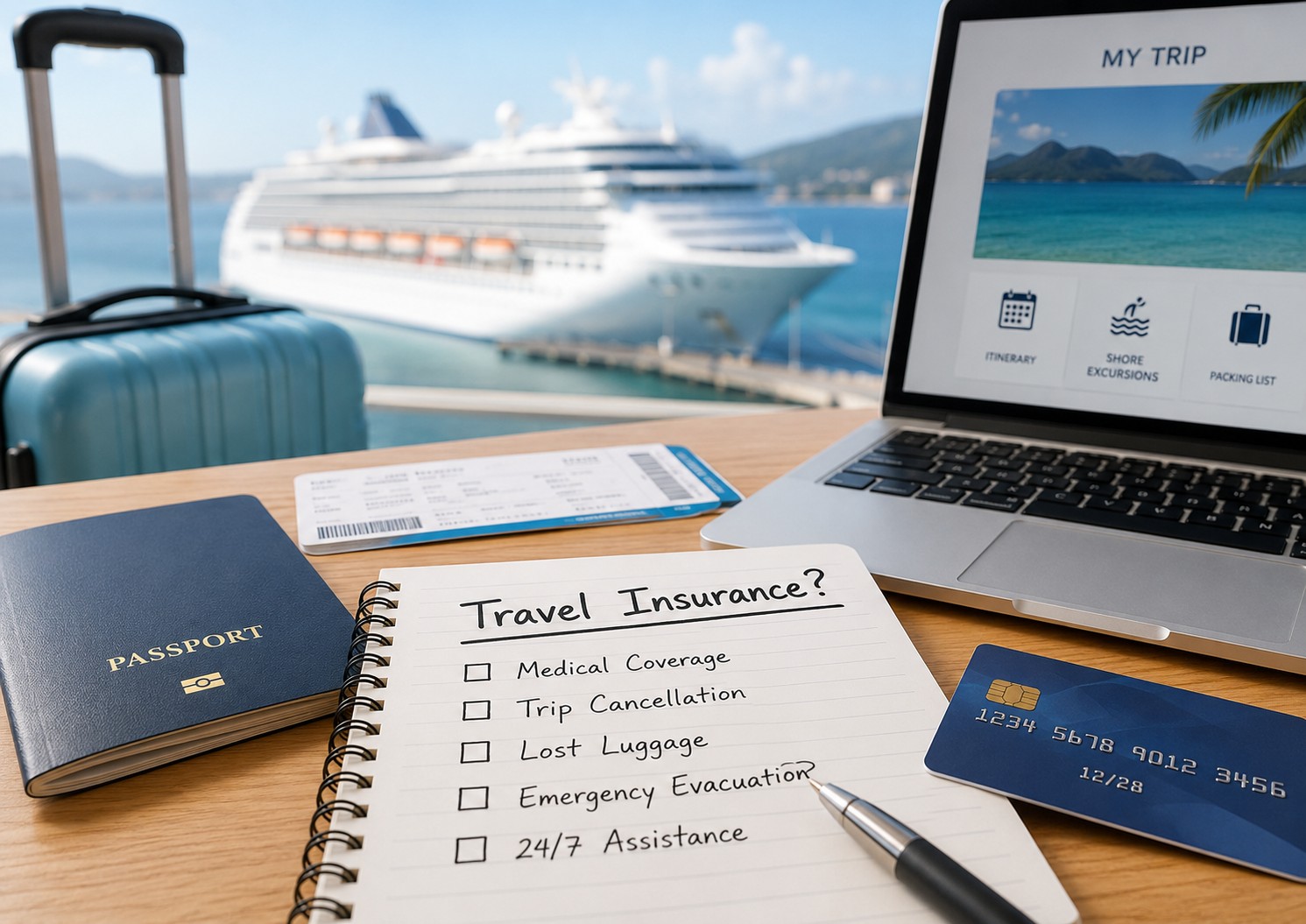
Travel Insurance: When It Makes Sense, When It Doesn’t, And What You Might Already Have
Travel insurance is one of those travel topics that sounds simple until you actually start comparing options.
Do you buy the insurance offered by the cruise line?
Do you add coverage when booking a flight or hotel?
Do you buy a separate trip insurance policy?
Do you rely on your credit card?
Or do you skip it entirely and assume the risk yourself?
There is not one perfect answer for every trip. Like most travel decisions, the right choice depends on what you are booking, how much money is at risk, where you are going, who is traveling, and how comfortable you are handling a worst-case scenario.
We do not think travel insurance should be an automatic yes or an automatic no.
But we do think it should be a conscious decision.
Because the biggest mistake is not skipping travel insurance.
The biggest mistake is assuming you are covered when you have never actually checked.
Travel Planning Help That Looks at The Whole Picture
If you are trying to plan a cruise, vacation, or bigger trip and want help thinking through the real costs, risks, booking options, and value trade-offs, our Planning & Consulting services can help.
Travel insurance is one of those decisions that should fit the trip — not just get added at checkout because a button popped up.
If you have a question, feel free to text us at 480-331-1263.
Related Reading
- Travel Protections By Credit Card And Network: What They Really Cover
- Credit Card Benefits You Might Have Without Realizing It: Visa Signature, Visa Infinite, Mastercard World Elite, Amex, And More
- Do You Know What Perks You Already Have?
Why Travel Insurance Matters More On Some Trips Than Others
Not every trip carries the same level of risk. A one-night hotel stay with free cancellation is very different from a cruise, international flights, prepaid excursions, and multiple people traveling together.
More detail: Why the trip itself changes the decision
For us, travel insurance is not just about whether a trip is expensive. It is about what could actually go wrong and how much of that risk we are willing to handle ourselves.
A cheap domestic weekend trip may not need much protection if most of the trip is refundable or easy to change. But a cruise can involve nonrefundable cruise fare, flights, hotels, transfers, excursions, missed connection risk, medical costs, and the possibility of needing care in another country.
That is why we try to think about travel insurance in layers:
- How much money is prepaid and nonrefundable?
- What happens if we have to cancel before the trip?
- What happens if the trip is interrupted after it starts?
- What happens if baggage is delayed or lost?
- What happens if someone gets sick or injured while traveling?
- What happens if emergency transportation or medical evacuation is needed?
- What benefits do we already have through a credit card?
- What are we comfortable self-insuring?
For cruises especially, the medical side matters. Medical care onboard, treatment in a foreign port, and emergency transportation can be very different from getting sick during a normal domestic hotel stay.
That does not mean everyone needs the most expensive travel insurance policy available.
But it does mean cruise travelers should understand what is and is not covered before they sail.
Buying Travel Insurance Through A Cruise Line
Cruise-line travel protection is usually the easiest option to add. That convenience can be valuable, but it does not automatically mean it is the best or most complete coverage.
More detail: When cruise-line coverage can make sense
Cruise lines usually make travel protection easy to add during the booking process.
You are already booking the cruise. The cruise line offers a plan. You click a button. It gets added to your total.
For many travelers, that simplicity is appealing.
Cruise-line coverage may include things like trip cancellation, trip interruption, travel delay, baggage protection, emergency medical coverage, or emergency evacuation coverage. But the details vary by cruise line and by policy.
The important thing is that cruise-line travel protection is not automatically the best or most complete option just because it is offered by the cruise line.
Sometimes cruise-line plans are more limited than third-party plans. Sometimes cancellation benefits may come in the form of future cruise credit rather than cash reimbursement, depending on the plan and situation. Sometimes medical coverage may not be as strong as what you could buy separately.
That does not make cruise-line insurance bad.
It just means you should read what it actually covers.
Where cruise-line insurance can make sense:
- You want something simple and easy to add.
- You are mainly worried about protecting the cruise fare.
- You prefer dealing with the cruise line or its insurance partner.
- You are not looking to comparison shop.
- The coverage limits are enough for your situation.
Where it may not be enough:
- You want higher medical or evacuation coverage.
- You are also protecting independently booked flights, hotels, or excursions.
- You want more flexibility around cancellation reasons.
- You want to compare pricing and coverage levels.
- You are taking a bigger international trip where medical risk matters more.
For cruises, we would pay especially close attention to medical and evacuation limits.
Those are the parts of the policy that can matter most if something serious happens away from home.
Buying Insurance Through An Airline, Hotel, Or Travel Booking Site
Insurance offered during checkout can be useful, but it can also be easy to misunderstand. The policy may only cover the specific booking you are making.
More detail: Why checkout insurance may not cover the full trip
Airlines, hotels, and online travel agencies often offer travel protection during checkout.
This can be useful, but it can also be easy to misunderstand.
When you are booking a flight and an insurance option appears, that policy may mostly be focused on that flight purchase. When you are booking a hotel, it may be tied to that hotel stay. When you are using a travel site, the coverage may apply to the booking you are making through that site.
That can be fine for a simple trip.
But it may not cover the entire vacation the way you assume it does.
For example, if you book a cruise directly with the cruise line, flights with an airline, a pre-cruise hotel separately, and excursions through another provider, buying insurance during one checkout flow may not protect everything.
That is where people get into trouble.
They remember clicking “yes” on insurance somewhere, but later realize the policy only covered one piece of the trip.
This type of coverage may make sense when:
- The trip is simple.
- You are only trying to protect one specific booking.
- The terms are clear.
- The cost is reasonable.
- You are not relying on it for full-trip protection.
Be careful when:
- Your trip has multiple separately booked pieces.
- You need medical coverage.
- You need evacuation coverage.
- You are assuming all prepaid costs are covered.
- You have not read the policy terms.
The point is not to scare people.
The point is to read before relying on it.
Buying A Separate Trip Insurance Policy
A separate travel insurance policy is often where you get the most control. Instead of accepting whatever appears at checkout, you can shop for coverage that fits the full trip.
More detail: Why a trip-specific policy may fit bigger trips better
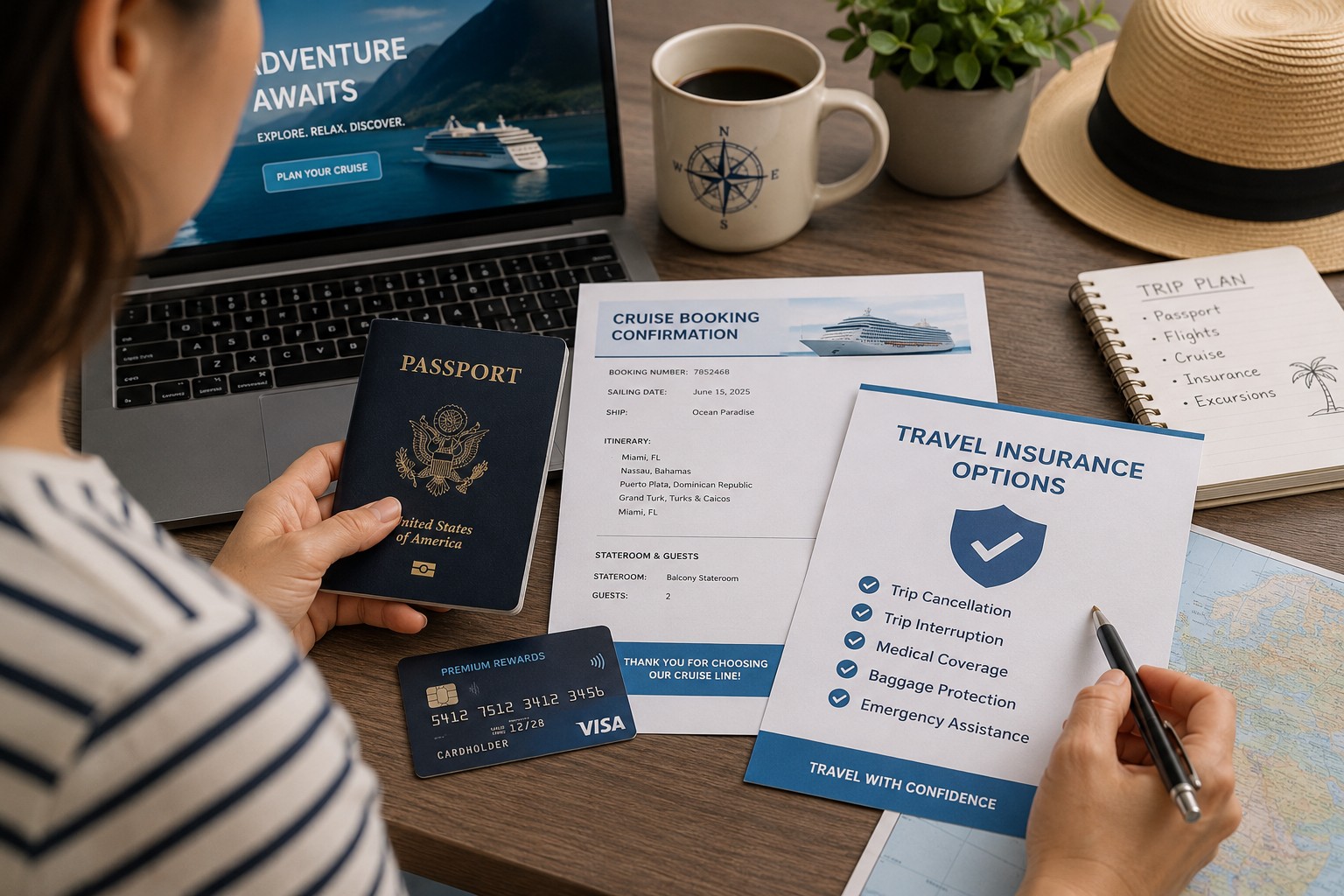
A separate travel insurance policy may be especially useful when you have multiple prepaid pieces, such as:
- Cruise fare
- Flights
- Hotels
- Excursions
- Tours
- Rental cars
- Train tickets
- Transfers
- Nonrefundable deposits
A separate trip policy can often be customized around the total insured trip cost, your destination, traveler ages, medical needs, and the level of protection you want.
It may include trip cancellation, trip interruption, travel delay, baggage delay, lost baggage, emergency medical, emergency dental, and medical evacuation coverage.
Some policies also offer optional Cancel For Any Reason coverage, usually at an added cost and with specific purchase timing rules.
That can matter if your biggest concern is something that may not be a standard covered reason.
Separate trip insurance may make sense when:
- The trip is expensive.
- The trip is international.
- You are cruising.
- You have multiple nonrefundable pieces.
- You want stronger medical or evacuation coverage.
- You want to insure the whole trip, not just one booking.
- You want to compare policies.
The downside:
It takes more work.
You have to compare coverage, limits, exclusions, and timing rules. You also have to understand what documentation may be needed if you ever file a claim.
But for bigger trips, that extra effort may be worth it.
Annual Travel Insurance Plans
An annual travel insurance plan can make sense for people who travel often. But annual coverage is not always a complete replacement for a trip-specific policy.
More detail: When an annual plan may be worth comparing
An annual travel insurance plan can make sense for people who travel several times per year.
Instead of buying a separate policy for each trip, an annual plan may provide coverage across multiple trips during the year.
That sounds great — and for some travelers, it can be.
But annual plans are not all the same.
Some annual plans are strongest for emergency medical and evacuation coverage. Others may include limited trip cancellation or interruption coverage. Some may have per-trip limits that are much lower than what you would buy for one expensive vacation.
That means an annual plan may be a good fit for frequent travelers, but not necessarily a complete replacement for insuring a large, expensive trip.
Annual plans may make sense when:
- You travel several times per year.
- You take multiple smaller trips.
- You want ongoing medical or evacuation coverage.
- You do not want to buy a separate policy every time.
- You are comfortable with the plan limits.
Annual plans may not be enough when:
- You have one very expensive trip.
- Your trip cancellation exposure is high.
- The annual plan has low per-trip reimbursement limits.
- You assume it covers every trip cost automatically.
- You have not checked whether cruises are covered the way you need.
For us, this is the kind of option that becomes more interesting as travel frequency increases.
If someone takes one big trip every few years, a trip-specific policy may be easier to match to that vacation.
If someone travels repeatedly throughout the year, an annual plan may become part of the bigger strategy.
Credit Card Travel Insurance: Valuable, But Not A Full Plan By Default
Some credit cards include travel protections, and those benefits can be genuinely useful. But “my credit card has travel insurance” is not specific enough.
More detail: Why card benefits need to be checked before the trip
Depending on the card, benefits may include trip cancellation, trip interruption, trip delay, baggage delay, lost luggage reimbursement, rental car coverage, travel accident coverage, or emergency assistance.
But credit card coverage varies a lot.
It depends on the card, the issuer, the payment requirements, the trip type, the covered reason, the benefit limits, and the fine print.
Some cards may require you to pay for all or part of the trip with that card. Some may cover award bookings if taxes and fees are paid with the card. Some may cover immediate family members. Others may be more restrictive.
That last part is important.
The network name or card type does not automatically tell the full story.
You need the actual benefits guide for your specific card.
Credit card travel protections can be great for:
- Trip delays
- Baggage delays
- Lost luggage
- Rental car coverage
- Some trip cancellation or interruption situations
- Smaller trips where your exposure is limited
- Layering protection with other coverage
Credit card protections may fall short for:
- Emergency medical coverage
- Medical evacuation
- High-cost cruises or international trips
- Cancel For Any Reason situations
- Trips where you did not pay with the covered card
- Claims that do not fit the card’s covered reasons
This is why we do not think “my credit card has travel insurance” is specific enough.
A better question is:
What exactly does this card cover, for this specific trip, if something goes wrong?
The Self-Insured Approach
Some travelers intentionally skip travel insurance because they are comfortable being self-insured. That can be reasonable for smaller risks, but it has limits.
More detail: Why self-insuring is not just about skipping the premium
This is where the conversation gets interesting.
Some people intentionally skip travel insurance because they are comfortable being self-insured.
That means instead of paying insurance premiums for every trip, they accept the risk and keep the money themselves.
In theory, this can make sense.
If you skip a $200 travel insurance policy on one trip, that is $200 you still have. If you skip travel insurance on ten trips, maybe you have avoided $2,000 in premiums.
In a way, you have built your own little travel emergency fund.
That money could be used if you need to cancel a hotel, rebook a flight, replace delayed luggage, or walk away from a nonrefundable booking.
For smaller risks, self-insuring can be reasonable.
If the worst-case scenario is losing a $150 hotel deposit, paying $100 for insurance may not make sense.
But the self-insured approach has limits.
It works better when the possible loss is predictable and manageable.
It works worse when the possible loss is huge.
That is the key difference.
Self-insuring a nonrefundable hotel night is one thing.
Self-insuring a medical evacuation from a cruise ship or remote destination is something else entirely.
Most people are not casually building a self-insurance fund big enough for that.
The Peace Of Mind Question
Travel insurance is not just math. Sometimes the value is the peace of mind of knowing you have a plan if something serious happens.
More detail: Why peace of mind can be part of the value
Travel insurance is not just math.
It is also peace of mind.
That does not mean peace of mind is always worth the price. Sometimes insurance is overpriced for the actual risk. Sometimes coverage is too limited to justify the cost. Sometimes a traveler is financially comfortable taking the risk.
But sometimes peace of mind is the point.
Especially on a cruise.
If someone gets sick onboard, has to be treated in the ship medical center, needs care in a foreign port, misses the rest of the cruise, or requires emergency transportation, the cost can escalate quickly.
Even if the odds are low, the consequence can be high.
That is where insurance starts to feel different.
We may be comfortable self-insuring some trip costs.
We may not be comfortable self-insuring a medical emergency at sea.
And those are two very different decisions.
A Practical Way To Think About It
Instead of asking, “Should I buy travel insurance?” the better question is, “What risks am I trying to cover?”
More detail: How to break down the decision before you buy
Instead of asking, “Should I buy travel insurance?” we think the better question is:
What risks am I trying to cover?
Then break the trip into categories.
Money already paid
How much is prepaid and nonrefundable?
Cancellation risk
What would happen if you had to cancel before leaving?
Trip interruption risk
What would happen if you had to come home early?
Medical risk
Would your regular health insurance cover you where you are going?
Evacuation risk
What would happen if you needed to be transported to a better hospital or back home?
Existing benefits
What does your credit card already cover?
Comfort level
What loss are you willing and able to absorb yourself?
This makes the decision more specific.
You may decide you do not need to insure a cheap domestic weekend trip.
You may decide you do want coverage for a cruise.
You may decide your credit card protections are enough for one trip but not another.
You may decide to buy a separate medical evacuation plan but skip full trip cancellation coverage.
The goal is not to buy the most insurance possible.
The goal is to avoid assuming you are protected when you are not.
Cruise-Specific Travel Insurance Considerations
Cruises deserve their own section because they are different from many land-based trips. You are traveling by ship, often through multiple ports, countries, and moving pieces.
More detail: Why cruises create different insurance questions
Cruises deserve their own section because they are different from many land-based trips.
You are not just staying in one city with easy access to familiar medical care.
You are on a ship.
You may be visiting multiple countries.
You may be far from a major hospital.
You may have flights, hotels, transfers, excursions, and the cruise itself all tied together.
That creates several layers of risk.
For cruises, we would pay close attention to:
- Emergency medical coverage
- Emergency evacuation coverage
- Trip interruption coverage
- Missed connection coverage
- Pre-existing condition rules
- Whether privately booked excursions are covered
- Whether independently booked flights and hotels are included
- Whether coverage applies if the cruise line changes the itinerary
- Whether the policy provides cash reimbursement or future travel credit
That does not mean every cruiser needs the same policy.
But it does mean cruises are not the place where we would casually assume everything is fine.
What We Would Not Do
We would not treat travel insurance as a random checkout add-on. We would also not assume we are covered just because a cruise line, booking site, or credit card uses the word “protection.”
More detail: The assumptions we would try to avoid
We would not blindly click the insurance box during checkout without reading what it covers.
We would not assume the cruise line plan is automatically better because it came from the cruise line.
We would not assume a third-party plan is better just because it came from a separate insurance company.
We would not assume our credit card covers everything.
We would not assume our regular health insurance works internationally.
We would not assume medical evacuation is included.
And we would not treat self-insuring as a smart strategy unless we are actually prepared to absorb the possible loss.
Self-insuring only works when the risk is one you can truly afford.
Final Thoughts
Travel insurance is not exciting.
It is not the fun part of planning a trip.
But it can be one of the most important decisions you make, especially for cruises, international travel, expensive trips, or trips with multiple nonrefundable pieces.
Sometimes the right answer may be buying coverage through the cruise line.
Sometimes it may be a separate trip policy.
Sometimes an annual plan may make sense.
Sometimes your credit card benefits may be enough.
And sometimes you may choose to self-insure part of the risk.
The key is knowing which decision you are making.
Because skipping travel insurance is not automatically wrong.
Buying travel insurance is not automatically right.
But assuming you are covered without checking?
That is where travel insurance mistakes can get expensive.
Latest Posts from Travel Essentials | All Travel Essentials Posts
- Amazon Free Trials Ahead of Prime Day: Audible, Kindle Unlimited, and Amazon Music for Travel

- When Travel Insurance Is Worth It — and When You Might Be Self-Insured

- Travel Insurance: When It Makes Sense, When It Doesn’t, and What You Might Already Have

- AAA Travel Benefits You Might Be Overlooking

- What to Pack in Your Personal Item and Carry-On for a Smoother Flight

- Our Favorite Travel Essentials