Basic Economy can look like a great deal when you are booking a flight.
The price is lower.
The flight time is the same.
The destination is the same.
And at first glance, it feels like an easy way to save money.
But Basic Economy is one of those travel decisions where the cheapest price is not always the best value.
Sometimes it works. Sometimes it is perfectly fine. And sometimes it backfires in a way that costs more money, creates more stress, or limits your options when life happens.
We were reminded of this recently when our niece booked a flight to go back home and visit friends. She booked a United Basic Economy ticket, not realizing it did not include a carry-on bag and came with more restrictive rules if she needed to change or cancel.
Unfortunately, a few days before the trip, she got the flu and could not go.
Cancelling the ticket came with a hefty fee, and while she was able to salvage something, it was a frustrating lesson: Basic Economy often is not worth it if there is any chance your plans might change.
Need Help Booking the Right Flight the First Time?
This is exactly the kind of thing we help with through our Trip Planning support — not just finding the cheapest flight, but helping you understand what you are actually buying before you click purchase.
A cheap fare is not always a bad choice, but it should be an informed choice. If you are deciding between Basic Economy, Main Cabin, checked bags, carry-ons, points, or cash fares, we can help you compare the real cost and choose the option that fits your actual trip.
If you have a question, feel free to text us at 480-331-1263.
Related Reading
- How We Compare Travel Options Before We Book
- What to Pack in Your Personal Item and Carry-On for a Smoother Flight
- Travel Doesn’t Have to Be Fancy to Be Worth It
What Is Basic Economy?
Basic Economy is the lowest-priced fare class offered by many airlines. It usually gets you a seat on the plane, but it often comes with trade-offs.
More detail: What Basic Economy usually means
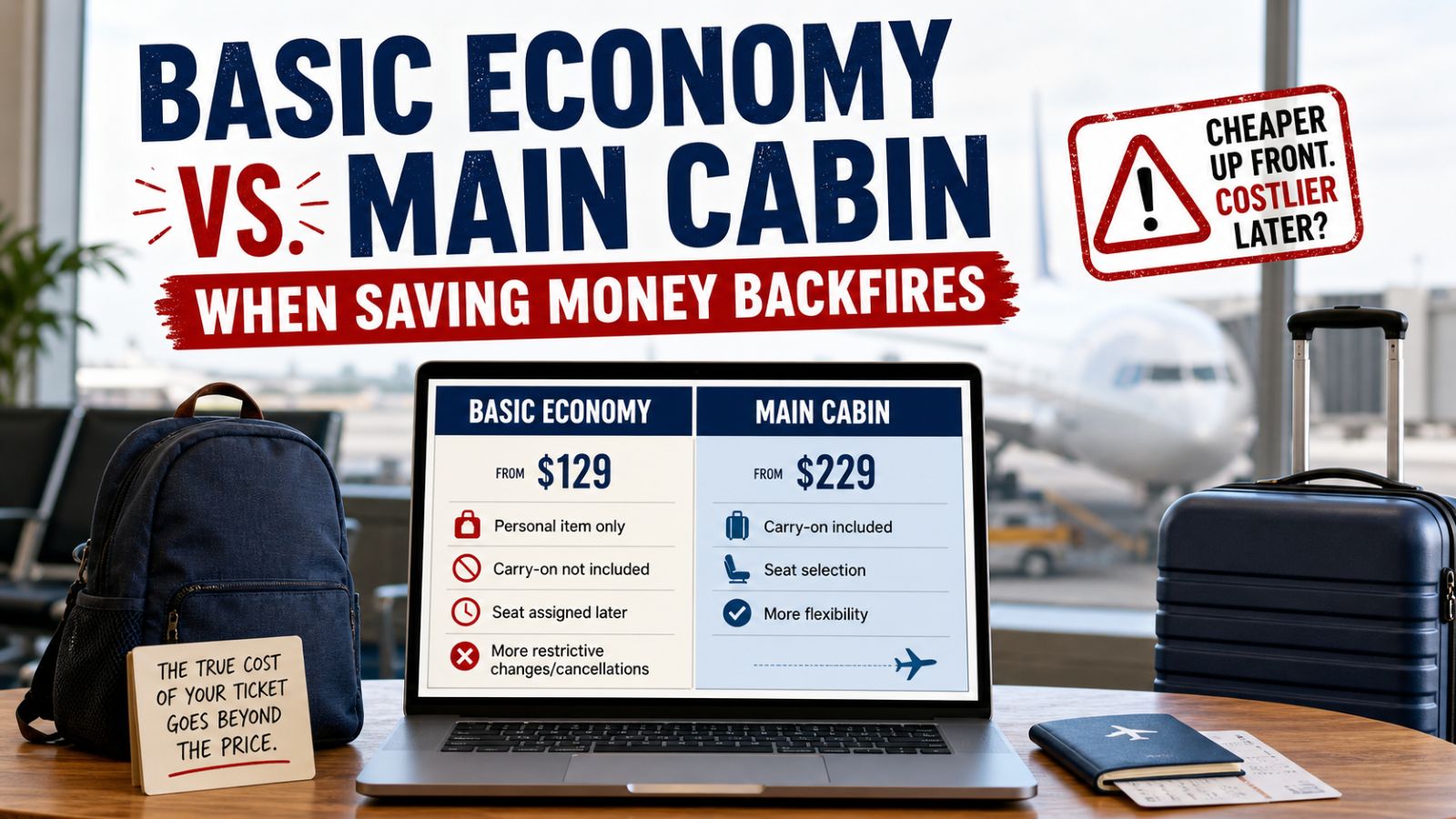
Depending on the airline and route, Basic Economy trade-offs may include:
- No full-size carry-on bag
- Limited or no seat selection
- Boarding in the last group
- More restrictive change or cancellation rules
- Less flexibility if your plans change
- Fewer upgrade options
- Less control over where you sit
That does not automatically make Basic Economy bad.
It just means you need to understand what you are giving up.
If you are taking a quick trip, packing light, and you are 100% sure you are going, Basic Economy may be fine. But if you need flexibility, care about your seat, want a carry-on, or are booking a trip where things could change, Basic Economy can become a problem quickly.
The Carry-On Bag Problem
One of the biggest Basic Economy traps is the carry-on rule. A lot of travelers assume every flight includes a personal item and a carry-on bag, but that is not always true.
More detail: Why the bag rules matter
With some airlines and routes, Basic Economy may only include a personal item that fits under the seat in front of you. That means no roller bag in the overhead bin unless you pay extra, qualify through status or a credit card benefit, or are flying on a route where the rule is different.
That is where the savings can start to disappear.
A fare may look cheaper by $40, $60, or $80, but if you later need to pay for a carry-on, check a bag, or repack into a much smaller personal item, the Basic Economy fare may not actually save you much.
And worse, it can create stress.
Nobody wants to get to the airport and realize the “cheap” ticket does not include the bag they planned to bring.
When Plans Change, Basic Economy Can Hurt
The bigger issue with Basic Economy is not always the bag. It is the lack of flexibility.
More detail: What happened with our niece’s flight
That is what happened with our niece.
She booked the cheapest ticket because she was going home to visit friends. It seemed simple enough. But then she got the flu a few days before the trip and could not travel.
That is when the fare rules mattered.
With a Main Cabin ticket, there may have been more flexibility or a better path to a travel credit. With Basic Economy, cancelling came with a hefty fee and a much more frustrating experience.
The lesson was not that she made a terrible mistake.
The lesson was that the lowest price did not match the risk of the trip.
Life happens. People get sick. Work schedules change. Family plans shift. Weather causes issues. Sometimes you need options.
And when your ticket gives you fewer options, the original savings can disappear fast.
Basic Economy Can Still Make Sense Sometimes
We do not think Basic Economy should always be avoided. There are times when it can make sense, especially if the savings are meaningful and the restrictions fit the trip.
More detail: When Basic Economy might be okay
Basic Economy may be a reasonable choice when:
- The price difference is significant
- You are taking a short trip
- You can pack in a personal item
- You do not care where you sit
- You are traveling alone
- Your plans are very unlikely to change
- You fully understand the restrictions before booking
For example, if you are taking a quick overnight trip, flying solo, and can fit everything into a backpack, Basic Economy might be worth considering.
But that is the key phrase: worth considering.
Not automatically booking.
The problem is not Basic Economy itself. The problem is booking it without understanding what you are giving up.
When Main Cabin Is Usually Worth Paying More
Main Cabin usually costs more than Basic Economy, but sometimes that extra cost buys peace of mind. When the price difference is small, Main Cabin can be the smarter value.
More detail: When the upgrade is worth it
Main Cabin may be worth it when:
- You need a carry-on bag
- You want seat selection
- You are traveling with someone and want to sit together
- You might need to change or cancel
- You are booking around work, school, illness, or family plans
- The price difference is small
- You are not 100% sure the trip will happen
- You do not want to deal with airport surprises
This is where the math matters.
If Basic Economy is $40 cheaper but a carry-on costs extra, cancellation is more restrictive, and you lose flexibility, the “savings” may not be real.
Sometimes paying a little more upfront prevents a bigger headache later.
And that is especially true when you are booking for younger travelers, family members, or anyone who may not fully understand the fare restrictions.
The Real Lesson From Our Niece’s Flight
This was not an expensive international trip. It was a simple flight home to visit friends. But that is exactly why it is such a good reminder.
More detail: Why this small mistake mattered
Travel mistakes do not only happen on big luxury trips, complicated cruises, or international vacations. They can happen on a basic domestic flight when the fare rules are easy to overlook.
Our niece learned that Basic Economy is not just a cheaper version of the same ticket.
It is a different type of ticket.
And the difference matters.
Had she asked us before booking, we would have helped her look at:
- Whether she needed a carry-on
- How much more Main Cabin would cost
- What the cancellation rules were
- Whether the savings were actually worth the restrictions
- Whether the trip had enough uncertainty to justify a more flexible fare
That is exactly why we keep telling friends and family: Use our free advice while it is still free.
We would much rather help someone avoid a bad booking than help them untangle it after the fact.
Questions to Ask Before Booking Basic Economy
Before you book Basic Economy, slow down and ask a few questions. The goal is not to scare you away from the cheapest fare. The goal is to make sure you know what you are buying.
More detail: The questions we would ask first
- Am I absolutely sure I am taking this trip?
- Could work, school, family plans, weather, or illness change things?
- Do I need a full-size carry-on?
- Am I okay sitting wherever the airline assigns me?
- Am I traveling with someone I want to sit next to?
- How much more is Main Cabin?
- What would happen if I needed to cancel?
- Am I actually saving enough to justify the restrictions?
That last question is the big one.
Because saving $30 may not be worth losing flexibility.
Saving $100 might be worth it in the right situation.
But you should know the trade-off before you book.
Final Thought: Cheap Flights Are Only Good Deals When They Fit the Trip
We love saving money on travel.
But we do not love saving money in a way that creates stress, limits options, or backfires later.
Basic Economy can be useful, but it is not automatically the best deal. Sometimes Main Cabin is the smarter choice. Sometimes paying more upfront protects you from paying more later.
Our niece’s United flight was a real-world reminder that the cheapest fare is not always the best fare.
The better question is: Which ticket fits the trip?
That is the kind of decision that can save money, avoid frustration, and make travel feel a lot smoother.
Latest Posts from Airlines & Flights | All Posts