Credit card credits can be useful.
A travel credit, hotel credit, dining credit, airline credit, or statement credit can help offset the cost of a card and make certain trips feel more affordable. Used well, those benefits can support trips we already wanted to take.
But sometimes credit card credits do something different.
They do not just save us money on travel we were already planning. They create travel we probably would not have booked otherwise.
That is not automatically a bad thing. Some of our favorite travel experiences come from using credits, perks, and card benefits in ways that let us try something nicer, easier, or more memorable than we normally would.
But we try to label that correctly.
Sometimes a credit saves money. Sometimes a credit creates bonus travel. And sometimes a credit helps us justify spending more than we would have otherwise.
Those are three very different things.
Want Help Thinking Through Points, Credits, and Card Benefits?
Credit card benefits can be valuable, but they work best when they fit your real life instead of pushing you into spending you would not normally choose. If you are trying to decide whether a card, travel credit, hotel benefit, or points strategy makes sense, our Points & Rewards Strategy page is a good place to start.
If you have a question, feel free to text us at 480-331-1263.
Annual Fees Are Part of the Travel Cost
This is one of the biggest reminders we come back to. Annual fees are not separate from the travel strategy; they are part of the cost of making some of that travel possible.
More detail: How we count annual fees
My cousin always reminds me that annual fees on credit cards are a cost of the travel.
That does not mean annual fees are bad. We have cards with annual fees because some of the benefits genuinely support how we travel. But the fee still has to be counted somewhere.
It is easy to look at a card benefit and say, “The card paid for itself.” Sometimes that may be true. Other times, it is only true if we count every benefit at full value, ignore the ways it changed our spending, and pretend the annual fee was not part of the equation.
If we pay a $395 annual fee and use a $300 travel credit, we do not automatically say the card only costs us $95. We still ask what else we received, whether we would have used those benefits naturally, and whether the card helped us take trips we genuinely valued.
The annual fee may still be worth it. But it is not invisible.
If a card gives us travel protections, hotel perks, lounge access, statement credits, or booking benefits that genuinely improve the way we travel, that can be part of the value. We just do not want to treat the fee like it lives in a separate category from the travel it helps create.
This is why we think annual fees belong in the same conversation as personal finance and points rewards, not just card perks.
The Difference Between Saving Money and Creating Travel
A credit can reduce the cost of something we were already going to do. Or it can encourage us to book something we would not normally book.
More detail: Why that distinction matters
If we already planned to book a hotel and a credit lowers the out-of-pocket cost, that feels like more direct savings.
But a credit can also encourage us to book something we would not normally book. That might still be a great experience. It might be worth doing. It might be one of the reasons we keep the card.
But it is not the same as saving money on a trip we already planned.
That is what we mean by bonus travel.
Bonus travel is travel that exists because the credit, perk, or card benefit made it feel possible or more reasonable.
That can be fun. It can be valuable. It can even be a great use of the card. But we still want to be honest about what it is.
This is closely related to the difference between saving money and justifying spending. A credit can be helpful, but it can also make a purchase feel easier to rationalize.
Amex FHR and Chase The Edit Are Good Examples
Programs like Amex Fine Hotels & Resorts and Chase The Edit can create real value. They can also lead us toward stays we would not normally book without the credit or perk.
More detail: Why we call this bonus travel
For us, programs like Amex Fine Hotels & Resorts and Chase The Edit are good examples of this.
These types of programs can make nicer hotel stays feel more reasonable because the booking may include credits, perks, or added benefits depending on the property, card, and reservation.
That can be valuable.
But those are not always stays we would normally book if the credit or program did not exist.
Sometimes the credit gives us a reason to try a nicer hotel, a different location, or a more luxury-feeling stay than we would usually choose with cash alone.
We may enjoy it. We may decide it was worth it. We may even say, “That was a great use of the benefit.”
But we still consider it bonus travel.
The card did not necessarily make our normal travel cheaper. It may have helped us choose a nicer experience than we normally would have chosen.
That distinction matters.
- “We used a credit to lower the cost of a hotel we already needed.”
- “We booked a nicer hotel because the credit made it feel more reasonable.”
- “We spent more than planned because we did not want the credit to go unused.”
All three can happen. Only one of them is a clean savings.
If you want a real-world comparison, our The Edit vs. FHR Comparison in Las Vegas is a good example of how these programs can look valuable while still requiring honest math.
Credits Can Make Spending Feel Easier
One of the tricky things about credits is that they can make spending feel less expensive than it really is.
More detail: The questions we ask before counting a credit as savings
If a hotel stay costs more than we would normally spend, but a credit knocks part of the price down, it may feel like a deal.
And it might be.
But we still need to look at the full picture.
- Are we paying more out of pocket than we would have otherwise?
- Are we choosing a property because it fits the trip, or because we are trying to use the credit?
- Are there resort fees, parking fees, taxes, transportation costs, or dining costs that make the stay more expensive than it first appeared?
- Are we excited about the experience itself, or mainly excited that we found a way to use a benefit?
Those questions do not mean the answer has to be no.
They just help us understand whether the credit is truly saving money or quietly creating more spending.
The “Use It or Lose It” Problem
Some credits create pressure because they expire. That can make spending feel urgent, even when the purchase itself was not important.
More detail: Why unused credits are not always a loss
If a benefit expires monthly, quarterly, annually, or by the end of a cardmember year, it can start to feel like we have to use it.
That is where the mental math can get messy.
We may start looking for a way to spend money because we do not want to “waste” a credit.
But spending money we were not planning to spend is not always better than letting a credit go unused.
That is not an easy lesson, because nobody likes leaving value on the table.
But there is a difference between using a benefit naturally and forcing a purchase so the benefit does not expire.
Sometimes we are okay with that. If the credit creates a fun bonus experience and we choose it intentionally, that can be fine.
But we do not want to pretend it was pure savings.
When Bonus Travel Is Worth It
Bonus travel is not a problem by itself. There are times we are completely fine using a card benefit to do something we would not normally do.
More detail: Why the answer is not always “spend less”
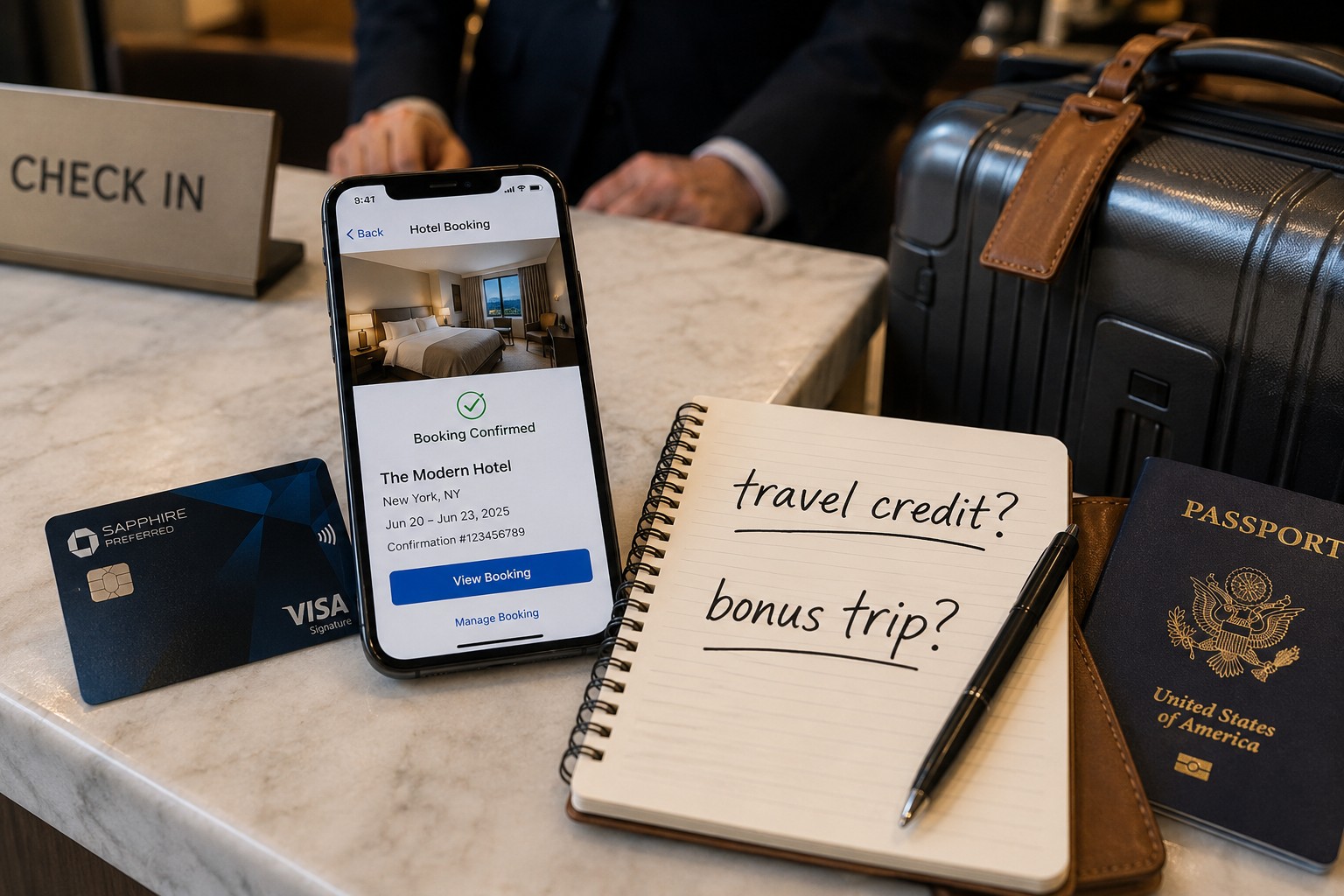
Maybe a credit gives us a nicer hotel before a cruise. Maybe it lets us try a more comfortable stay in Las Vegas. Maybe it gives us a reason to enjoy a quick getaway, a better location, or a more relaxed travel day.
Sometimes the whole point of the card benefit is that it helps us do something extra.
That can be worth it if we are choosing it on purpose.
The key is not whether the experience is technically necessary. A lot of travel is not necessary.
The key is whether we understand the cost, value the experience, and are comfortable with the tradeoff.
If a credit helps us turn a normal trip into something more memorable without creating budget stress, that can be a win.
That is also why we try to think in terms of real value, not just the cheapest possible trip. Sometimes the better location, easier timing, or more comfortable stay is worth paying for if it supports the trip we actually want.
When Bonus Travel Becomes Spending Justification
The problem starts when we use credits to justify spending that does not really fit.
More detail: How credits can quietly drive the decision
That can happen quietly.
- A hotel credit can make a high room rate feel reasonable.
- A dining credit can encourage us to choose a restaurant we would not have picked.
- A travel credit can make us book something sooner than we otherwise would have.
- A shopping credit can turn into buying something just because the offer exists.
The issue is not the credit itself.
The issue is whether the credit is driving the decision.
If we would not have wanted the trip, stay, or purchase without the credit, we need to pause and ask whether this is still a good use of money.
Sometimes the answer will be yes.
Sometimes the answer will be, “This is fun, but it is bonus travel.”
And sometimes the answer should be, “We are only considering this because the credit exists.”
That last one is where we try to be careful.
We Do Not Need Every Credit to Be Perfect
Not every credit has to be used perfectly. Not every redemption has to be maximized. Not every benefit has to produce a dramatic online-worthy value.
More detail: Why awareness matters more than perfection
Real life is not a spreadsheet.
Sometimes a credit is useful because it lowers the cost of something we already wanted. Sometimes it creates a fun bonus experience. Sometimes it gets used imperfectly, but still helps.
That is okay.
The goal is not perfection.
The goal is awareness.
We want to know whether a benefit is helping our travel strategy or pushing us into spending that does not really fit.
This is also why basic money habits make travel rewards work better. The stronger the spending plan is before the credit shows up, the easier it is to tell whether the credit is actually helping.
How This Connects to “Free” Travel
This article is the companion to The Hidden Costs That Can Make “Free” Travel Expensive.
More detail: The hidden costs on the card-benefit side
That article looks at the broader travel costs that can show up even when flights, hotels, cruises, or other pieces are covered by points or rewards.
This one looks specifically at the card-benefit side.
Because sometimes the hidden cost is not just taxes, fees, meals, parking, or excursions.
Sometimes the hidden cost is the annual fee we paid to access the benefit.
Sometimes it is the extra spending that came from trying to use a credit.
Sometimes it is the nicer hotel, upgraded experience, or bonus trip we would not have booked otherwise.
Again, that does not make it wrong.
It just means we need to count it.
It is the same reason points are not automatically free if the spending behind them creates a cost somewhere else. We talked about that more directly in Points Are Not Free If You Carry a Balance.
The Questions We Ask Before Using a Credit
Before we use a travel credit, hotel credit, or card benefit, we try to slow down and ask whether the credit fits the trip or is creating the trip.
More detail: Our quick credit check
- Were we already planning to spend money on this?
- Is this lowering the cost of something we already wanted?
- Is this creating bonus travel?
- Would we still book this if the credit did not exist?
- Are we spending more out of pocket than we normally would?
- Are there extra costs attached, like parking, resort fees, taxes, meals, or transportation?
- Is this benefit worth the annual fee we are paying?
- Are we using the credit naturally, or forcing it because it expires?
- Will we feel good about this after the statement closes?
That last question is important.
A credit can feel great in the moment. But if we feel annoyed later because the “free” benefit led to more spending than expected, that is worth paying attention to.
Annual Fees Need a Real Plan
A card can have valuable benefits and still be the wrong fit. A card can have a high annual fee and still make sense.
More detail: Why the benefits have to fit real life
A travel credit can be useful and still not be worth full face value to us.
A hotel benefit can create an amazing experience and still be bonus travel, not true savings.
We want to avoid both extremes.
We do not want to dismiss every annual fee as bad.
But we also do not want to keep a card just because it technically has enough credits on paper to offset the fee.
The better question is whether the card supports how we actually live and travel.
If the benefits fit naturally, that is different from rearranging our spending just to make the card make sense.
That is the same mindset we use when looking at cards like the Chase Sapphire Reserve, the Amex Platinum, or any card where the annual fee only makes sense if the benefits match your actual travel habits.
This is also why we like having a broader credit card strategy instead of judging each credit in isolation.
Final Thoughts
Credit card credits can be valuable.
They can help lower travel costs, create better experiences, and make certain trips feel more possible. We use them, and we are not against them.
But we try to be clear about what they are doing.
Sometimes a credit saves us money. Sometimes it creates bonus travel. Sometimes it encourages spending we would not have done otherwise.
The goal is not to avoid every upgrade, skip every nice hotel, or ignore every card benefit. The goal is to know the difference between saving money and justifying spending.
For us, that is where points, rewards, and personal finance have to work together.
The best card benefits are not the ones that make us feel like we beat the system for a weekend and then regret the bill later.
They are the ones that fit the way we already live, help us travel better, and still make sense after the excitement of the credit wears off.
Latest Posts from Credit Card Strategy
- When Credit Card Credits Create Bonus Travel

- Credit Card Surcharges and Cash Discounts: When Paying the Fee Still Makes Sense

- Cash, Cards, and the Reward Game: Are You Paying for Someone Else’s Points?

- Travel Protections by Credit Card and Network: What They Really Cover

- Credit Card Benefits You Might Have Without Realizing It: Visa Signature, Visa Infinite, Mastercard World Elite, Amex, and More

- Points Are Not Free If You Carry a Balance