When people first get into points and miles, it is easy to assume the goal is simple:
Use points whenever possible.
After all, “free flights” sound better than paying cash.
But in real life, that is not always the best decision.
Sometimes using points for a flight is a great move. Sometimes paying cash is smarter. And sometimes the right answer depends less on what looks best in a headline and more on the actual cash price, the points required, your travel plans, and what those points could be worth somewhere else.
The goal is not to use points just because you have them.
The goal is to compare your options and make the choice that gives you the best real-life value.
Need Help Deciding Whether to Use Points or Pay Cash?
This is exactly the kind of decision we help with through our Points Strategy Support.
If you are trying to decide whether to pay cash, use points, transfer rewards, or save your points for a bigger trip, we can help you compare the real numbers and the real trade-offs.
If you have a question, feel free to text us at 480-331-1263.
Start With the Cash Price
The first thing we look at is the cash price of the flight.
If the cash price is already low, using points may not be the best move.
More detail: Why cheap flights can be a poor use of points
A $98, $129, or $180 flight may be better paid in cash, especially if using points would require a large redemption.
That does not mean cheap flights should never be booked with points. Sometimes using points still makes sense if you need to preserve cash, use a specific travel credit, or keep a trip budget under control.
But as a general rule, low cash prices make us pause before using points.
We want to know what we are giving up by spending those points today instead of saving them for a more expensive trip later.
Compare the Points Price to the Cash Price
This is the main step.
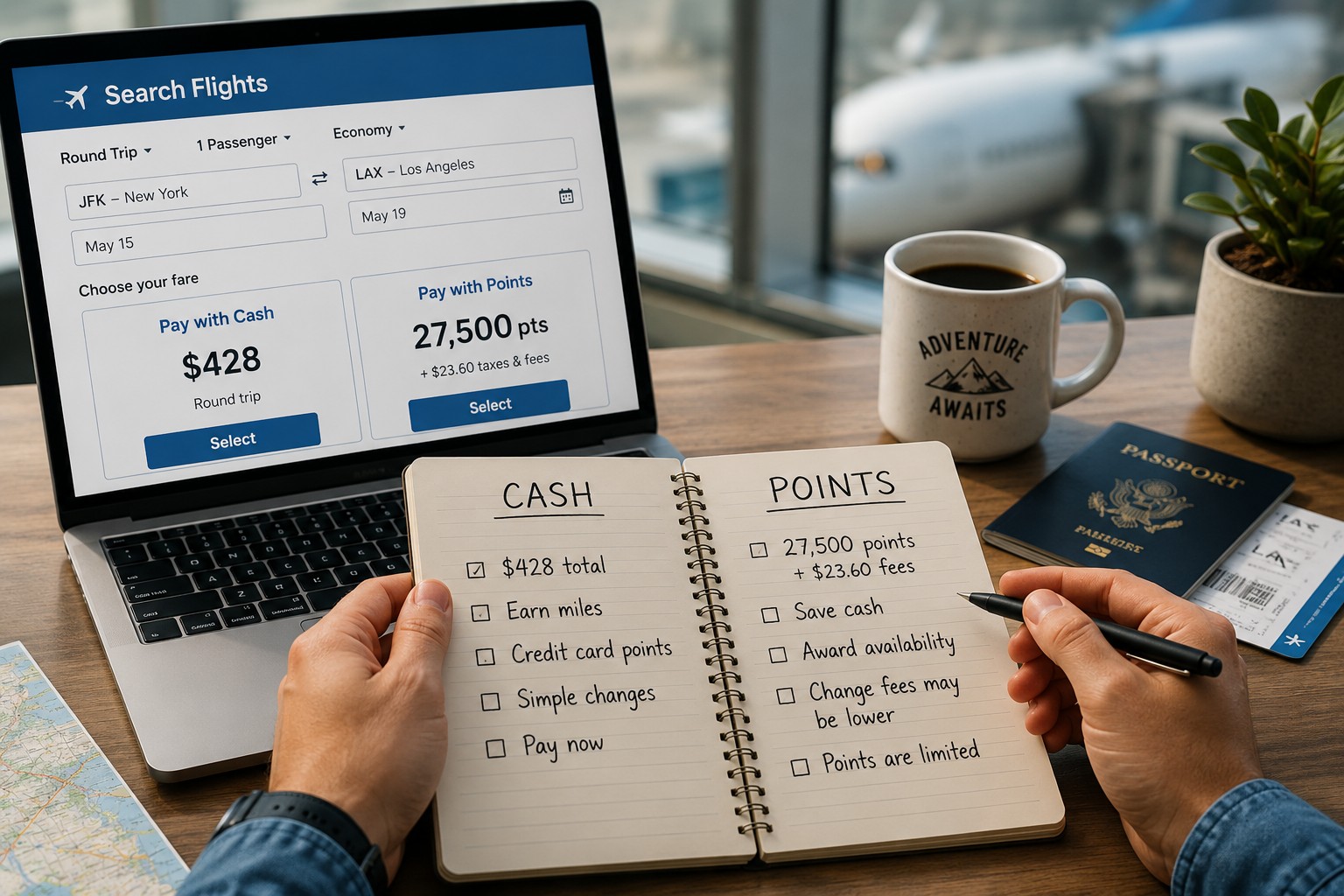
Before using points, compare the number of points required against the cash price of the same flight.
More detail: The simple points value calculation
The basic formula is:
Cash price ÷ points required = value per point
For example:
- A $300 flight that costs 30,000 points gives you about 1 cent per point
- A $300 flight that costs 15,000 points gives you about 2 cents per point
- A $600 flight that costs 30,000 points gives you about 2 cents per point
- A $600 flight that costs 60,000 points gives you about 1 cent per point
Same cash price. Very different value.
This is why comparing points to the cash price matters so much.
A flight being expensive does not automatically make it a good points redemption. And a flight being cheap does not automatically mean cash is better. You have to compare both sides.
Do Not Treat Points Like They Are Free
Points can make travel feel less expensive, but they still have value.
Every time you use points for one flight, you are choosing not to use them for something else.
More detail: Why opportunity cost matters
We do not think every traveler needs to obsess over exact cents-per-point calculations.
But you should have a general sense of whether your points are saving you a meaningful amount of cash.
If a flight costs $500 and you can book it for 20,000 points plus low taxes and fees, that may be a strong redemption.
If that same $500 flight costs 50,000 or 60,000 points, the value may not be as strong.
That does not mean you should never book it. Maybe the trip matters. Maybe cash flow matters. Maybe the schedule is perfect. Maybe you need flexibility.
But you should at least know what kind of value you are getting before you spend the points.
When Paying Cash Usually Makes More Sense
Paying cash often makes sense when the fare is already low and the points price does not give you strong value.
This is especially true for short domestic flights, sale fares, budget airline fares, or routes where cash prices are reasonable.
More detail: Situations where cash may be the better choice
Paying cash may make sense when:
- The cash price is low
- The points price is unusually high
- You would rather save your points for a larger trip
- You have a travel credit or airline credit to use
- You want to earn miles or loyalty credit on the flight
- You are booking a fare where points do not create much extra flexibility
- The taxes and fees on the award booking are high
- You are using points that could be more valuable somewhere else
This is one of the hardest lessons with points and miles.
Just because you can use points does not mean you should.
If a cheap cash fare gets you where you need to go without draining your points balance, that can be a smart decision.
When Using Points Usually Makes More Sense
Points can be incredibly useful when cash prices are high and the points price is reasonable.
This is where they can really shine.
More detail: Situations where points may be the better choice
Using points may make sense when:
- Cash prices are high
- The points price is reasonable
- You are getting strong value compared with the cash price
- You are booking last minute
- You need flexibility
- You are traveling during holidays or peak seasons
- You are booking international flights
- You are using a strong airline transfer partner
- You are trying to reduce the cash cost of a larger trip
- The flight would otherwise make the trip feel too expensive
This is one reason we like having points available even when we are not planning luxury travel.
Points can help with business class flights, international trips, and once-in-a-lifetime redemptions.
But they can also help with very practical travel — getting to a cruise port, visiting family, attending a wedding, or making a trip possible when flights are more expensive than expected.
Expensive Flights Are Not Automatically Good Points Redemptions
A flight may be expensive in cash, but that does not automatically mean points are the better option.
You still need to compare the points price to the cash price.
More detail: Why high cash prices can still be poor redemptions
Airlines increasingly use dynamic pricing, which means the points price may rise along with the cash price. In those cases, you may not be getting much extra value by using points.
A $700 flight that costs 70,000 points may not be a better deal than a $200 flight that costs 20,000 points. In both cases, you are getting about 1 cent per point.
The cash price is higher, but the value of the redemption is similar.
That is why we try to avoid looking only at the cash price.
We want to know whether the points price is actually giving us better value.
Cheap Flights Are Not Automatically Cash Bookings Either
Even though we often pay cash for cheap flights, there are exceptions.
Sometimes using points for a cheap flight can still be reasonable.
More detail: When using points for a cheaper flight can still make sense
Using points for a cheaper flight may still make sense when:
- You need to reduce cash spending
- The points are not useful to you elsewhere
- You are using airline miles that may be difficult to use later
- You need flexibility that the award ticket provides
- You are booking several tickets and the total cash cost adds up
- You are trying to protect your travel budget for hotels, food, cruises, or activities
This is why we do not like blanket rules.
A $150 flight may be worth paying cash for on one trip and worth using points for on another.
The right answer depends on the full situation.
Transferable Points Make the Decision More Important
The decision gets more important when you are using flexible points.
Flexible points can often be used in more than one way, which means spending them should be a little more intentional.
More detail: Why flexible points should be compared carefully
Points like Chase Ultimate Rewards, American Express Membership Rewards, Capital One Miles, Citi ThankYou Points, and Bilt Rewards may be usable through travel portals, airline transfer partners, hotel transfer partners, or future trips.
That flexibility is valuable.
But it also means you should be more careful before spending them.
For flights, we like to compare:
- The cash price
- The travel portal price
- The airline award price
- Taxes and fees
- Change and cancellation rules
- Availability through transfer partners
- What else those points could be used for
Sometimes transferring points to an airline partner is clearly better.
Sometimes the travel portal is easier and still reasonable.
Sometimes paying cash is the smartest move.
The key is not to do what sounds most advanced. The key is to compare the actual options for the actual trip.
Flexibility Can Change the Decision
One of the biggest reasons we may use points for flights is flexibility.
Depending on the airline or program, award flights can sometimes be easier to change or cancel than certain paid fares.
More detail: Why flexibility can be worth giving up a little value
Flexibility can matter a lot when plans are uncertain.
This is especially helpful when you are planning around a cruise, event, family schedule, school calendar, work trip, or complicated itinerary.
Sometimes the cents-per-point value may not look amazing, but the flexibility makes the redemption worthwhile.
Maybe you are booking early and want to lock something in. Maybe you are not completely sure the dates will work. Maybe you are watching for a better flight to open later.
In those situations, using points may give you peace of mind, even if the redemption is not perfect on paper.
That does not mean the math no longer matters. It just means the math is not the only thing that matters.
Cash Flow Is Part of the Decision
Sometimes using points makes sense because you do not want to spend the cash right now.
That may not be the highest mathematical redemption, but it can still be the right personal decision.
More detail: Why the best redemption is not always the highest-value redemption
If using points helps you take a trip without stressing your budget, that has value.
This is especially true for families, bigger trips, cruises, holiday travel, or situations where flights are only one piece of the total cost.
The points and miles world can make people feel like every redemption has to be maximized.
We do not think that is realistic.
Yes, you should understand the value you are getting.
Yes, you should compare points to the cash price.
Yes, you should avoid wasting valuable points when there is a better option.
But your travel life is not a contest.
Sometimes the best redemption is the one that makes the trip work.
Our Real-Life Rule of Thumb
Our rule of thumb is pretty simple:
Pay cash when the fare is low and the points price does not offer strong value.
Use points when the cash price is high, the points price is reasonable, flexibility matters, or the redemption helps make the trip possible.
More detail: Why we compare every option before booking
We do not want to drain points just because they are sitting there.
But we also do not want to hoard points forever and never use them.
Points are a tool.
Cash is a tool.
Travel credits, airline miles, companion certificates, gift cards, and flexible rewards are tools too.
The goal is not to use one every time.
The goal is to use the right one for the trip in front of you.
A Simple Cash vs. Points Checklist
Before booking your next flight, run through the main questions.
You do not need to overcomplicate every booking, but a quick comparison can save you from wasting points.
More detail: Questions to ask before you book
- What is the cash price?
- How many points are required?
- What value am I getting per point?
- Are taxes and fees reasonable?
- Would I rather save these points for another trip?
- Are these airline miles or flexible points?
- Could these points be more valuable through a transfer partner?
- Do I need flexibility?
- Would paying cash help me earn miles, status credit, or credit card rewards?
- Do I have travel credits, airline credits, or gift cards to use?
- Does using points make the trip easier financially?
- Would paying cash preserve points for a better opportunity later?
Taking a few minutes to compare the cash price against the points price can help you avoid wasting points and make better travel decisions.
Final Thoughts
Using points for flights can be one of the most satisfying parts of a travel strategy.
But points are not automatically better than cash.
Sometimes paying cash is smarter. Sometimes using points is the obvious choice. And sometimes either option can be reasonable depending on your priorities.
The key is to compare the value of the points against the cash price of the flight.
If the cash price is low and the points price is high, paying cash may be better.
If the cash price is high and the points price is reasonable, using points may be a great move.
And if the decision helps make a real trip possible, that matters too.
The goal is not just to spend fewer dollars or fewer points.
The goal is to travel in a way that makes sense for your budget, your plans, and your life.
Latest Posts from Airline Points, Miles, & Loyalty
- When It Makes Sense to Pay Cash vs. Use Points for Flights

- Using Points for “Normal” Trips — Not Just Luxury Travel

- Points in Real Life (Episode 4): What Alaska Miles Can Actually Do (Using American Airlines)

- Points in Real Life (Episode 2): What 25,000 (or Less) Airline Points Could Do

- The Hidden Superpower of Airline Points: Flexibility

- A Real-World Story of Buying — and Actually Using — the Frontier GoWild Pass