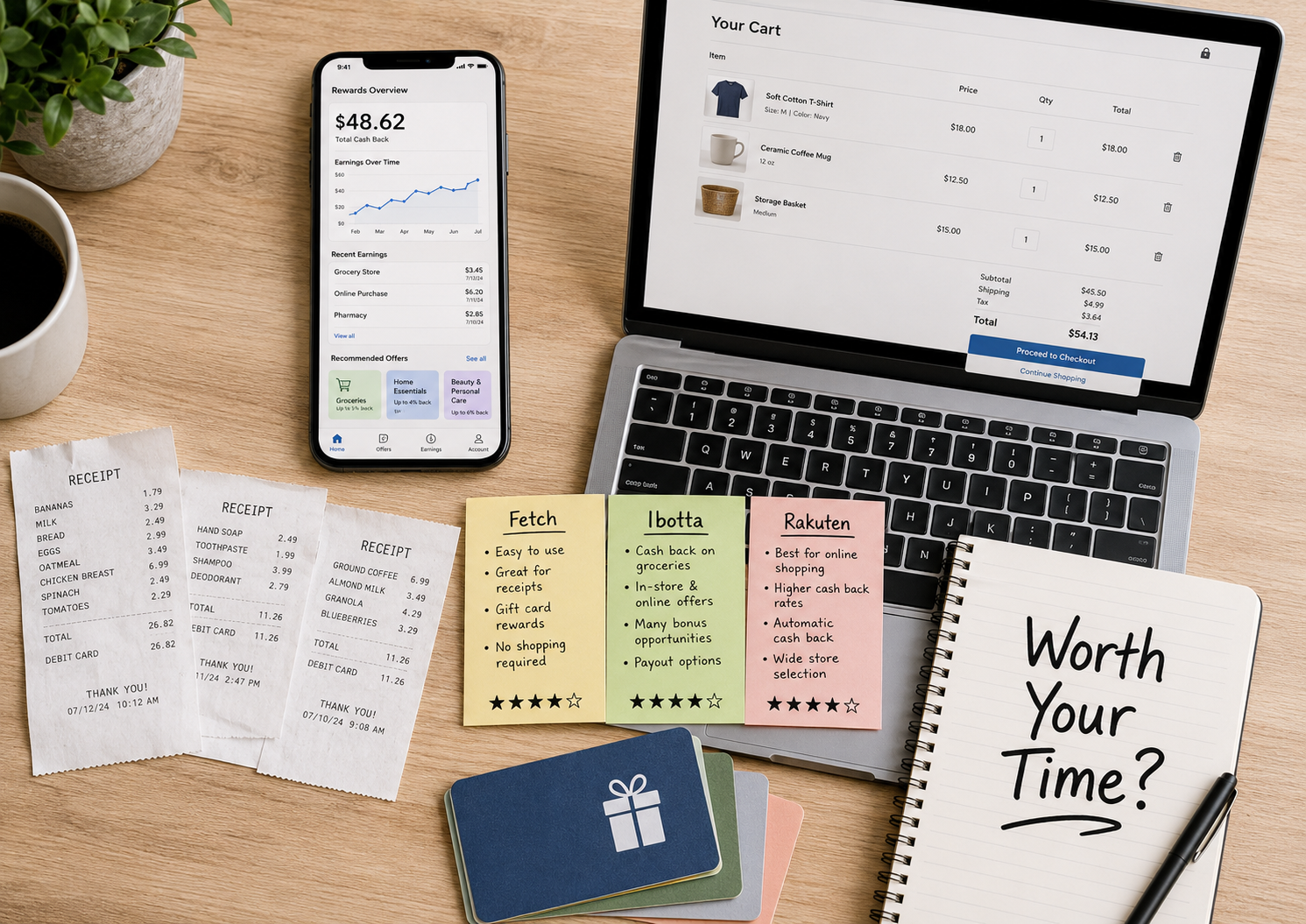
There are a lot of apps that promise to help you “earn free money” on things you are already buying.
Fetch. Ibotta. Rakuten.
They all sound easy enough. Scan a receipt. Add an offer. Click through a shopping portal. Earn rewards.
But the real question is not whether they work.
The real question is this: Which ones are actually worth your time?
Because not all “free money” is really free. Sometimes you are trading time, attention, planning, and extra steps for a very small return.
We have used all three, but not in a perfect, spreadsheet-tracking, coupon-extreme kind of way. We use them the way most normal people probably would — when they fit naturally into what we are already doing.
Here is how Fetch, Ibotta, and Rakuten compare in real life.
Want Help Making Your Points And Rewards Strategy Actually Make Sense?
Apps like Fetch, Ibotta, and Rakuten can be useful, but they are only one small part of getting more value from the spending you are already doing. If you want help figuring out which rewards, points, perks, and travel tools are actually worth your attention, our Points & Rewards Strategy support can help you build a more practical plan around the trips and purchases that actually matter to you.
If you have a question, feel free to text us at 480-331-1263.
Related Reading
- Everyday Rewards 101: How We Earn Points Without Changing How We Spend
- Dining & Restaurants: The Easiest Way to Earn Rewards on Spending You Already Do
- When the Costco Executive Membership Is Worth It (A Simple Math-Based Breakdown)
- Gas Rewards Explained: How to Pay Less at the Pump
The Real Question: How Much Effort Does It Take?
Before comparing the apps, this is the filter we think matters most: Does the reward justify the effort?
More detail: Why time matters with cash-back apps
A few cents here and there can feel productive. Watching points add up can feel rewarding. Getting a gift card can feel like a win.
But if an app makes you change what you buy, spend more than you planned, or waste time chasing small rewards, it may not actually be helping.
That is why we look at these apps differently:
- Fetch is the easiest.
- Ibotta can pay more, but takes more effort.
- Rakuten is often the most valuable, especially for online shopping.
They are not all the same tool. And they should not all be judged the same way.
Fetch: The Easiest App To Use, But Usually The Slowest To Build
Fetch is probably the simplest of the three. You shop, snap receipts, and earn points that can be redeemed for gift cards.
More detail: Where Fetch works best
Fetch has expanded beyond just in-store receipt scanning. You can also earn through online shopping, linked accounts, and some app-based activities. But the core behavior most people know it for is still simple: scan the receipt and move on.
That simplicity is the main reason we still like it.
You do not have to think too hard. You do not have to activate a bunch of offers before shopping. You do not have to buy a specific product every time.
You just scan the receipt and move on.
That makes Fetch a great “background habit” app.
But the downside is that the rewards are usually small unless you hit a bonus offer.
Most ordinary receipts do not turn into meaningful rewards quickly. The real value comes when you buy something that has a strong bonus offer attached — especially if it was something you were already going to buy anyway.
Where Fetch works best:
- You want something easy.
- You are willing to scan receipts consistently.
- You like earning occasional gift cards.
- You do not want to spend time planning your shopping around offers.
- You occasionally buy items that qualify for bigger bonuses.
Where Fetch falls short:
- It can take a long time to build meaningful rewards.
- The return on normal receipts is usually small.
- It can feel more valuable than it really is because points are not the same as cash.
- You may be tempted to chase bonus items you did not actually need.
Our take: Fetch is worth using if you keep it simple. Scan receipts you already have. Take the easy points. Do not build your shopping around it unless the bonus is truly worth it.
Ibotta: Better Potential Value, But More Work
Ibotta is more offer-driven. Instead of simply scanning every receipt, you usually need to add offers before you shop.
More detail: Why Ibotta takes more attention
Instead of scanning any receipt for small points, Ibotta generally asks you to add cash-back offers, buy the qualifying items, and then submit your receipt or use a linked account.
That makes Ibotta more powerful, but also more annoying.
When it works, it can be a much better return than Fetch.
You may find offers like:
- $1 back on a grocery item
- $3 back on a household product
- $5 back on something you were already going to buy
- Bonus rewards for completing a certain number of offers
That can add up faster than scanning random receipts.
But Ibotta requires more attention.
You have to check the app before shopping. You have to add the offer. You have to make sure you buy the right size, brand, variety, and quantity. Then you have to make sure it tracks correctly.
That is where the value question gets tricky.
If you already enjoy deal hunting, Ibotta can be very useful.
If you do not, it can become one more app you forget to use.
Ibotta pays out actual cash rather than points, which is a plus. That does not automatically make it better for everyone, but it does make the value easier to understand.
Where Ibotta works best:
- You are willing to check offers before shopping.
- You buy a lot of groceries or household items.
- You are organized enough to match offers correctly.
- You enjoy stacking deals.
- You are disciplined enough not to buy things just because there is cash back.
Where Ibotta falls short:
- It takes more effort than Fetch.
- Offers can be very specific.
- You may need to plan ahead.
- It is easy to forget to use.
- It can encourage buying items you would not normally buy.
Our take: Ibotta can be worth it, but only if you use it intentionally. It is not the easiest app, but it may be the best grocery-focused option when the offers line up with things you already buy.
Rakuten: The One That Can Add Up Fastest
Rakuten is different from both Fetch and Ibotta. It is not really a receipt app — it is a shopping portal.
More detail: Why Rakuten can be more valuable
With Rakuten, you start at Rakuten, choose a store, activate the cash back, and then shop like normal.
This is where the value can get much more meaningful.
Why?
Because Rakuten often applies to larger online purchases.
A few examples:
- A $100 purchase at 5% cash back = $5 back
- A $300 purchase at 10% cash back = $30 back
- A $1,000 travel, furniture, appliance, or holiday purchase at 10% cash back = $100 back
That can be more than months of scanning small receipts.
Rakuten is also low effort if you build the habit. You can use the website, app, or browser extension. The browser extension is especially helpful because it can remind you when cash back is available instead of relying on you to remember.
Rakuten also has several payout options depending on eligibility and account settings. That may include cash back, gift cards, or points with certain partners. For people who already care about points and rewards, that flexibility can make Rakuten more interesting than a basic coupon app.
Where Rakuten works best:
- You shop online regularly.
- You make larger purchases.
- You are willing to click through before buying.
- You use a browser extension or make Rakuten part of your shopping routine.
- You like the option of cash back or points where eligible.
Where Rakuten falls short:
- You have to remember to activate it.
- Some purchases may not track properly.
- Cash back may not apply to every category or item.
- You should still compare prices, because cash back does not help if the item costs more through that retailer.
- Payout is not always immediate.
Our take: Rakuten is probably the most worthwhile of the three for most people, especially if you shop online. The effort is low, and the upside can be much higher.
The Biggest Mistake: Letting The App Change Your Spending
This is the part that matters more than the comparison itself. None of these apps are worth it if they cause you to spend more.
More detail: Why rewards should be the bonus, not the reason
This applies to all three:
- Do not buy random products just because Fetch has a bonus.
- Do not add extra grocery items just because Ibotta has an offer.
- Do not choose a more expensive online store just because Rakuten has cash back.
Rewards are only valuable when they are attached to spending you were already going to do.
That is the same way we think about credit card points, hotel credits, airline miles, and travel perks.
The reward is not the win.
The right purchase at the right price is the win.
The reward is just a bonus.
Side-By-Side: Fetch Vs. Ibotta Vs. Rakuten
Each app has a different role. The best one depends on whether you care more about ease, grocery offers, or online shopping value.
More detail: The practical comparison
Fetch
- Best for: Easy receipt scanning
- Effort level: Very low
- Reward type: Points toward gift cards
- Biggest strength: Simple and easy to keep using
- Biggest weakness: Usually slow to build meaningful rewards
Ibotta
- Best for: Grocery and household cash-back offers
- Effort level: Medium
- Reward type: Cash back
- Biggest strength: Better value when offers match your normal shopping
- Biggest weakness: Requires planning and offer activation
Rakuten
- Best for: Online shopping
- Effort level: Low
- Reward type: Cash back, gift cards, or points depending on payout option
- Biggest strength: Highest potential return on larger purchases
- Biggest weakness: You have to remember to click through or activate the offer
So Which One Is Actually Worth Your Time?
For us, the answer is not one app. It is using each one for what it does best.
More detail: How we would prioritize them
Use Rakuten first for online shopping.
This is the one we think most people should prioritize. It has the best combination of low effort and meaningful upside, especially on larger purchases.
Use Fetch as an easy background habit.
If you are willing to scan receipts without overthinking it, Fetch is fine. Just do not expect it to be a major savings strategy.
Use Ibotta only when it fits what you are already buying.
Ibotta can be great, but it is more active. It makes the most sense when you are already buying the exact items that have offers.
That is the practical answer.
Rakuten is the best value for most people. Fetch is the easiest. Ibotta is the most situational.
How We Would Actually Use Them
The best system is the one you will actually use. For us, that means keeping it simple.
More detail: A simple routine that does not become homework
Here is the simple version:
- Before buying online, check Rakuten.
- After shopping, scan the receipt with Fetch.
- Before grocery shopping, check Ibotta only if you have time and energy.
That is it.
No complicated system. No spending extra to chase rewards. No turning every shopping trip into homework.
The goal is not to maximize every penny.
The goal is to capture easy value without making life more complicated.
Final Thoughts
Fetch, Ibotta, and Rakuten can all be useful.
But they are not equally useful.
Rakuten is the one with the most upside for the least effort, especially if you shop online. Fetch is easy enough to keep using in the background. Ibotta can be valuable, but only when you are willing to be more intentional.
The best app is not the one with the biggest promises.
It is the one you will actually use without changing your spending in a bad way.
For us, that means:
Rakuten first. Fetch casually. Ibotta selectively.
That is the version that feels most realistic — and most worth the time.
Latest Posts from Everyday Spending | All Everyday Spending Posts
- Cash Back vs. Points for Everyday Spending: Which One Fits Your Life Better?

- How Much Are You Actually Earning on Dining? (Quick Self-Check)

- Shopping Portals 101: The Simple Habit That Can Add Up Over Time
- Fetch vs. Ibotta vs. Rakuten: Which Is Actually Worth Your Time?
- Grocery Rewards 101: How to Earn More From Spending You Already Do
- Dining vs. Groceries: Where Should You Focus First?