Everyday spending is where a lot of people first start paying attention to rewards.
Groceries. Gas. Dining. Online shopping. Bills. Subscriptions. Coffee. Household purchases.
The question is not whether those purchases can earn rewards. They usually can.
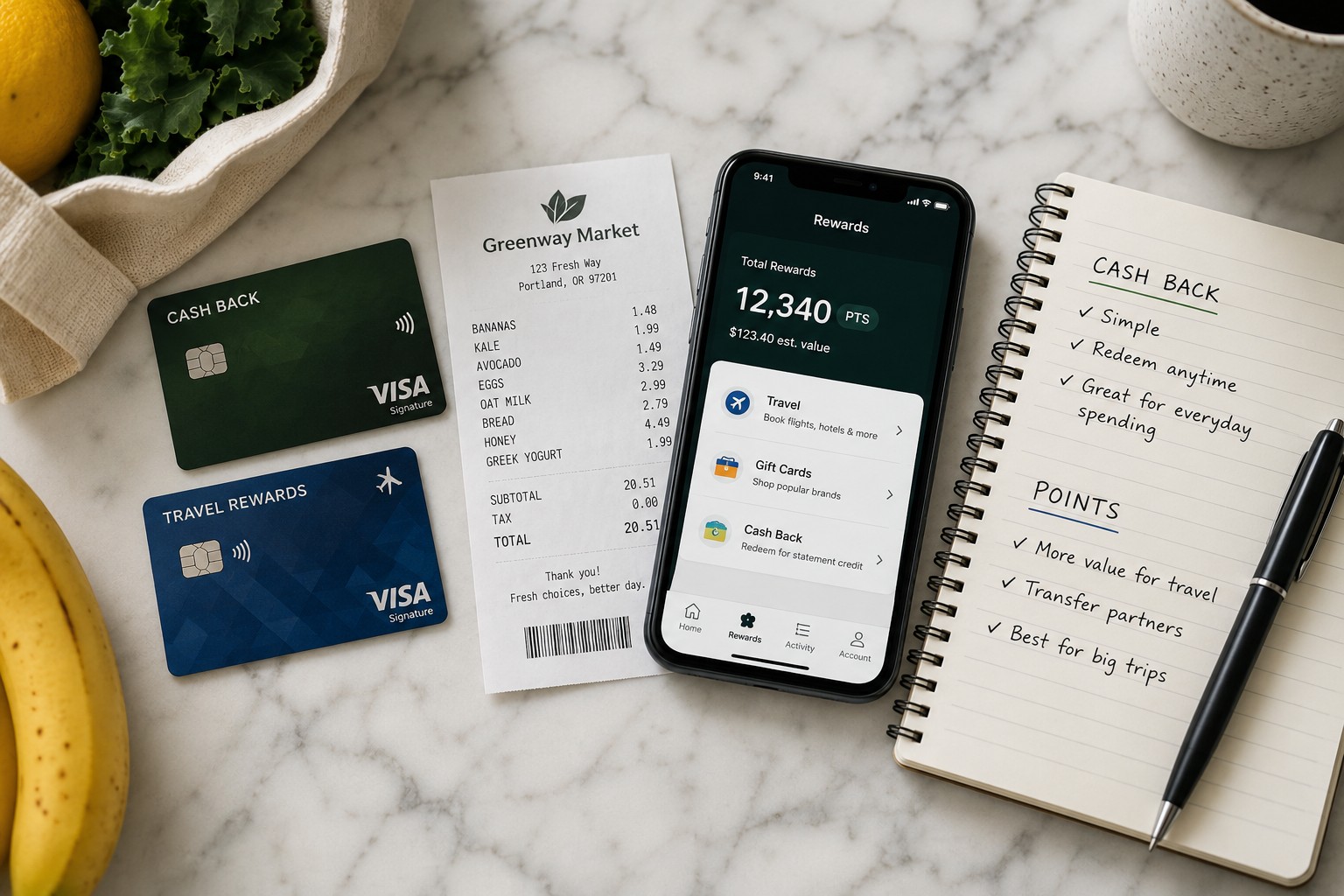
The better question is what kind of rewards actually fit your life better: cash back or points?
Cash back is simple. Points can be more powerful. But the best choice is not always the one that looks best on paper.
It depends on how you spend, how you travel, how much effort you want to put in, and whether you will actually use the rewards you earn.
For us, we stick almost entirely to points earning instead of cash back.
That is not because cash back is bad. It is because we tend to get higher value from points and miles, and we are able to actually use them for travel. Flights, hotels, and better trips are where we usually see the most value.
But we still keep cash back in mind.
A few of our cards offer a cash back option, and when we are making a larger purchase, we will at least think through whether the cash back value might be better than earning points. The answer is not always automatic.
That is really the point of this article.
Cash back vs. points is not about which one is “best” in general.
It is about which one fits your life better.
Want Help Thinking Through Your Points and Rewards Strategy?
If you are trying to decide whether cash back, travel points, shopping portals, dining apps, or credit card rewards make the most sense for your everyday spending, we can help you think through the options.
A good rewards strategy should support your real life, not make every purchase feel like a math problem.
If you have a question, feel free to text us at 480-331-1263.
Why This Choice Matters
Cash back and points can both be useful, but they work differently.
That difference matters because the best reward is not always the one with the highest possible value. It is the one you will actually use well.
More detail: Why cash back and points feel so different
Cash back usually gives you a clear, easy-to-understand return. If you earn $20 back, you know exactly what that means.
Points can be harder to value because their usefulness depends on how you redeem them. The same number of points might be worth more for travel, less for gift cards, or somewhere in between depending on the program.
That is where people can get stuck.
They hear that travel points can be “worth more,” but then they have to figure out where to use them, how to redeem them, whether award availability exists, and whether they even want the type of trip those points are best for.
Cash back is less exciting, but it is easier.
Points can create bigger travel opportunities, but they usually require more intention.
Neither one is automatically better.
The better choice is the one you will actually use well.
Why We Usually Choose Points
Most of the time, we would rather earn points than cash back.
That is because our rewards strategy is built around travel, and we know we can use points and miles for real trips.
More detail: Why points fit the way we travel
Flights, hotels, and better trips are where we usually see the most value.
Hyatt is still one of our go-to hotel programs because the points can be very useful for hotel stays. Alaska miles are especially valuable for us because we live in an American Airlines hub and can use Alaska miles to book certain American flights for very low points.
That kind of real use case matters.
A point is not valuable just because a blog or calculator says it is. It becomes valuable when it helps you book something you were actually going to use.
That is why we are comfortable focusing on points.
We are not collecting random points with no plan. We are earning rewards that connect to trips we can actually take.
This is also why we think it is worth knowing What Points Do You Actually Have? (And How to Find Them All in 10 Minutes). A scattered pile of points can feel overwhelming. A few useful balances connected to real travel goals can be much more powerful.
Cash Back Is Usually the Simpler Choice
Cash back is easy to understand because the value is obvious.
That simplicity can make it the better fit for people who want rewards that reduce costs without adding another thing to track.
More detail: When simple value matters most
If a card, app, or shopping portal gives you cash back, you do not have to guess what it is worth. You can usually apply it toward a statement balance, transfer it to a bank account, redeem it through an app, or use it toward future purchases.
Cash back may be a better fit if you want rewards that help with everyday costs, reduce your bill, or give you flexibility without needing to plan a trip.
It is also useful if you do not travel often, do not want to learn airline or hotel programs, or do not want rewards sitting around waiting for the “perfect” redemption.
Cash back may not always create the biggest headline value.
But simple rewards you actually use are often better than complicated rewards you never touch.
Points Can Be Better When Travel Is the Goal
Points can be valuable when you have a specific travel use in mind.
They work best when they connect to trips, flights, hotels, or experiences you actually want.
More detail: Why points need a plan
Points may help cover flights, hotel stays, or other travel costs that would otherwise be expensive in cash. In some cases, using points can let you take a better trip, stay longer, or spend less out of pocket.
That is why points can be so appealing.
But points work best when they match a real travel goal.
If you are earning airline miles but rarely fly, hotel points but do not stay in hotels, or flexible travel points without any plan to use them, the value can become theoretical.
Points are not valuable just because they exist.
They are valuable when they help you do something you actually wanted to do.
For us, that is why transferable points are so useful. We like having options. We like being able to move points to travel partners that fit a specific trip instead of being locked into one narrow redemption path.
That flexibility is one reason we often lean toward points over cash back.
The Everyday Spending Question: What Will You Actually Use?
The most important question is not “Which reward is worth more?”
It is: which reward will you actually use in a way that improves your life?
More detail: Matching the reward to your real life
For some people, the best reward is cash back because it lowers costs and keeps things simple.
For others, the best reward is points because they are already planning trips and want everyday spending to help pay for flights or hotels.
For many people, the answer is both.
You might use cash back for everyday categories where simplicity matters and earn travel points in places where the rewards clearly support an upcoming trip.
That is close to how we think about it, even though we lean heavily toward points.
We mostly want points because travel is our goal. But if a larger purchase gives us a meaningful cash back opportunity, we still compare it. We do not want to ignore real cash value just because points are usually our preference.
The mistake is assuming every purchase has to earn the “best” possible reward.
Sometimes the best reward is the one that is easiest to use. Sometimes it is the one that helps with the next trip. Sometimes it is the one that gives you the clearest value today.
Where Shopping Portals Fit In
Shopping portals are one of the easiest examples of this decision.
The habit can be simple: before buying something online, check the portal. The reward choice depends on your goals.
More detail: Why we mostly use Rakuten
We mostly use Rakuten for consistency and simplicity. We like that Rakuten can earn cash back, but we also like the option to earn Amex Membership Rewards points or Bilt points, which is how we currently use it.
That flexibility makes a difference.
If you are someone who wants cash back, Rakuten can be simple. If you are someone who wants travel points, the Membership Rewards or Bilt option may be more valuable.
We do not click through every portal every time or try to squeeze every last fraction of value out of every purchase. We try to keep the habit simple enough that we will actually do it.
That is the key with everyday rewards.
A perfect system you never use is not better than a simple system you use consistently.
For a broader look at simple everyday reward habits, start with Everyday Rewards 101: How We Earn Points Without Changing How We Spend.
Where Credit Cards Fit In
Credit cards are another place where the cash back vs. points decision shows up.
The right answer depends on whether you want simplicity, travel value, a welcome bonus, or a card that fits your everyday spending categories.
More detail: Why the best card is not always obvious
Some cards are clearly cash back cards. Some are clearly travel rewards cards. Others give you options.
For us, the decision is usually shaped by what else we are working on at the time.
If we are working on a welcome bonus, most of our spending usually goes on that card because the bonus can be more valuable than optimizing every individual purchase category.
When we are not working on a bonus, we try to use cards that fit our actual spending. Dining and groceries are usually two of our higher everyday categories, so we like having a card that earns well in those areas without making us carry a pile of cards.
That is one reason the Bilt card has become part of our current strategy. Even though it may not always have the highest earning rate in every category, the transferable points, the ability to earn from our mortgage payment when we meet the requirements, and the ability to transfer to programs like Alaska and Hyatt make it valuable for the way we travel.
That is also why the “best” everyday spending card is not always obvious.
A cash back card might win if you want simplicity. A points card might win if the points fit your travel. A bonus might win if you are working toward a larger welcome offer.
If you are thinking more broadly about card choices, our Credit Card Strategy page is a good next step.
When Cash Back May Fit Better
Cash back may be the better choice when you want simplicity, flexibility, or immediate value.
It can also be helpful during seasons when maximizing points is not realistic.
More detail: Signs cash back may fit your life better
- You do not travel often right now
- You want rewards that help with normal expenses
- You do not want to track airline or hotel programs
- You prefer clear value over possible higher value
- You are focused on budgeting or lowering costs
- You do not want rewards sitting unused
- You want a low-maintenance setup
Cash back can also be helpful when life is busy.
There are seasons when maximizing points is not realistic. Work, family, schedules, and other priorities may make simple rewards more useful than a complicated travel strategy.
That is not a failure.
That is matching the strategy to your life.
When Points May Fit Better
Points may be the better choice when travel is a real priority and you are willing to put in a little extra effort.
They can be especially useful when they help with bigger travel expenses like flights and hotels.
More detail: Signs points may fit your life better
- You have a trip in mind
- You travel often enough to use the rewards
- You understand where your points can be redeemed
- You are willing to compare points vs. cash pricing
- You value travel more than simple statement credits
- You want to lower the cash cost of flights or hotels
- You are comfortable learning a few basic program rules
Points can be especially useful when they help with bigger travel expenses.
Flights and hotels can be some of the most expensive parts of a trip. If everyday spending helps reduce those costs, points may create more value than straight cash back.
But the key is having a plan.
Points without a plan can become clutter.
The Interest Rate Rule Comes First
Rewards should never be the reason to carry a balance.
This matters whether you prefer cash back or points.
More detail: Why interest wipes out rewards
If you are paying credit card interest, the rewards are almost always wiped out by the cost of that interest. A few percent back, a shopping portal bonus, or a pile of points will not make up for carrying expensive debt.
That does not mean rewards are bad.
It means rewards work best when they are built on spending you were already going to do and balances you can pay responsibly.
Before deciding between cash back and points, make sure the rewards are not encouraging spending that works against your bigger financial picture.
Points and cash back should support your life.
They should not become a reason to spend more.
For more on that bigger picture, visit Personal Finance.
A Simple Middle Ground: Use Both
You do not have to choose one strategy forever.
A lot of people are better off using both cash back and points in different ways.
More detail: How a mixed strategy can work
- Use cash back for categories where you want simple value
- Use points for travel-related spending or cards tied to a specific trip
- Use shopping portals when they are easy and the payout makes sense
- Use dining apps or rewards programs only when you would eat there anyway
- Use hotel or airline points when they clearly reduce the cost of a trip
- Use cash when the points redemption is not a good value
This approach takes pressure off every decision.
You are not trying to force every purchase into one system. You are choosing the reward that fits the situation.
That is usually more sustainable.
Even though we personally lean toward points, we still think about cash value. That is especially true for larger purchases, where the difference between a cash back option and a points option can actually matter.
It does not need to be complicated.
It just needs to be intentional.
A Quick Way to Decide
When you are deciding between cash back and points for everyday spending, ask a few practical questions.
The goal is not to win the rewards game. The goal is to make rewards useful.
More detail: Questions that point you in the right direction
Do I have a specific trip coming up?
If yes, points may be worth focusing on if they help with flights, hotels, or travel costs.
Do I know how I would use the points?
If not, cash back may be better until you have a clearer plan.
Do I want simplicity right now?
If yes, cash back is hard to beat.
Am I willing to learn a little and compare options?
If yes, points may be worth the effort.
Will this reward change my spending behavior?
If it encourages you to spend more than planned, it is probably not a good strategy.
Would I rather lower my current costs or save toward travel?
That answer usually points you in the right direction.
Is this a larger purchase where the reward difference is meaningful?
If yes, it may be worth comparing the cash back option against the points option before deciding.
Where Everyday Spending Fits In
Everyday spending is often the foundation of a rewards strategy.
Start with what you already spend. Then decide whether cash back, points, or a mix of both gives you the most useful value.
More detail: How this shows up in real life
Before you worry about advanced redemptions, transfer partners, elite status, or complicated card setups, it helps to understand what your normal spending can already do.
That might mean earning cash back on groceries.
It might mean using a shopping portal before ordering something online.
It might mean stacking dining rewards with a credit card that earns well at restaurants.
It might mean using InKind or another dining app when it actually fits where you wanted to eat anyway.
It might mean choosing points because you have a trip coming up and want your regular purchases to help cover part of it.
It might mean doing the math on a Costco Executive Membership to see whether the extra rewards actually outweigh the added membership cost for your real spending.
The right everyday strategy is not about chasing every possible deal. It is about making your normal spending work a little harder in a way that still fits your life.
For more beginner-friendly everyday rewards guides, visit Everyday Spending.
Final Thoughts
Cash back is not boring if it helps your budget.
Points are not better just because they sound more exciting.
For us, points usually win because we travel often enough, know where we want to use them, and can get strong value from programs like Hyatt, Alaska, and transferable points.
But that does not mean cash back is wrong.
If cash back is simpler, clearer, and more useful for your life right now, that may be the better strategy. If points help you travel more, travel better, or reduce the cost of trips you actually want to take, points may be worth the extra effort.
And if both serve a purpose, use both.
The best everyday spending strategy is the one that fits your real life, supports your goals, and helps you make better decisions without adding unnecessary pressure.
Rewards should make life a little easier, not more complicated.
Start there.
Latest Posts from Everyday Spending
- Cash Back vs. Points for Everyday Spending: Which One Fits Your Life Better?

- How Much Are You Actually Earning on Dining? (Quick Self-Check)

- Shopping Portals 101: The Simple Habit That Can Add Up Over Time

- Fetch vs. Ibotta vs. Rakuten: Which Is Actually Worth Your Time?

- Grocery Rewards 101: How to Earn More From Spending You Already Do
- Dining vs. Groceries: Where Should You Focus First?