Booking a trip is not as simple as finding the lowest price and clicking the button.
Sometimes booking direct is best. Sometimes a credit card travel portal makes sense. Sometimes Costco Travel has a strong package. And sometimes working with an advisor can save you time, help you compare options, or give you access to the same price with more guidance.
The right answer depends on the trip, the price, the perks, the points, the support, and how much time you want to spend figuring it all out.
That’s why we do not think there is one “best” way to book every trip. We think there is a best way to book that specific trip.
Want Help Comparing Your Booking Options?
If you are looking at a cruise, hotel, package, or points booking and you are not sure which route makes the most sense, this is exactly the kind of thing we can help you sort through.
We can compare booking direct, using a travel portal, booking through Costco Travel, or working with us through our Travel Booking & Advising services so you can see the real trade-offs before you decide.
If you have a question, feel free to text us at 480-331-1263.
Related Reading
- What Travel Booking & Advising Actually Means (And When You Need It)
- The Trip That Looks Good vs. The Trip That Feels Good: How to Plan for the Right Experience
- How to Choose the Right Type of Trip (Based on Your Budget, Time, and Energy)
The Best Booking Option Depends on the Trip
A cruise, a hotel stay, a vacation package, and a points redemption are not the same kind of decision. The best booking method changes depending on what you are buying, what benefits matter, and what support you may need after booking.
More detail: Why there is no one-size-fits-all answer
This is where travel planning gets messy.
People often ask whether they should book through Costco Travel, use Chase Travel, book directly with the cruise line or hotel, work with a travel advisor, or use points.
Those are all fair questions. But the answer depends on what you are actually booking.
Costco Travel may be very competitive for certain vacation packages, rental cars, and cruises. A credit card travel portal may make sense if you are using points, earning bonus points, or accessing special hotel benefits. Booking direct may be the cleanest option when you care about loyalty benefits, elite status, direct customer service, or flexibility. An advisor may be helpful when you want someone to compare the options, explain the trade-offs, and help manage the details.
The issue is that each option can look “best” from one angle.
Lowest price does not always mean best value.
Most points earned does not always mean best booking. The biggest onboard credit does not always mean the best cruise deal. And the easiest booking option is not always the one that gives you the most support later.
That is why we usually start with a simple question:
What are you trying to accomplish with this trip?
Are you trying to spend the least out of pocket? Use points? Get the best room or cabin? Have the most flexibility? Get help if something changes? Maximize perks? Keep everything simple?
Once you know that, the best booking path becomes a lot clearer.
Booking Direct Can Be the Cleanest Option
Booking direct often gives you the most straightforward relationship with the airline, hotel, cruise line, or tour provider. It can also be the easiest option if you want direct support, loyalty benefits, or fewer layers between you and the company actually providing the trip.
More detail: When booking direct makes sense
Booking direct is often the simplest path.
That does not always mean it is the cheapest. It means the booking is directly with the company providing the service.
For flights, booking direct with the airline can make changes, cancellations, schedule issues, seat assignments, and credits easier to manage.
For hotels, booking direct may matter if you want to earn hotel points, use elite benefits, qualify for status perks, or have the hotel recognize your loyalty account properly.
For cruises, booking direct with the cruise line can feel simple because you are dealing directly with the cruise company. You can see current pricing, promotions, cabin options, and add-ons in one place.
The downside is that direct booking usually puts the full comparison work on you.
You may see one version of the price, but not always know whether another channel has a better package, extra onboard credit, better payment terms, card-linked credits, or a different value angle.
Booking direct can be a great option when:
- You already know exactly what you want
- You value direct control
- You are using loyalty benefits
- You want the cleanest service relationship
- You are comfortable comparing prices yourself
- You do not need much help after booking
Where people can get tripped up is assuming direct is always best just because it feels simpler.
Sometimes it is. Sometimes it is not.
Costco Travel Can Be Strong, Especially for Packages
Costco Travel can be a very good option for certain trips, especially when the package price, included extras, rental car rates, or Costco Shop Card value make the total offer stronger. The important thing is to compare the full package, not just the headline price.
More detail: Where Costco Travel can shine
Costco Travel has a loyal following for a reason.
For some trips, it can be very competitive.
We especially see people look at Costco Travel for:
- Vacation packages
- Rental cars
- Cruises
- Theme park packages
- All-inclusive resorts
- Hotel and car bundles
One of the reasons Costco Travel can look appealing is that the value is often packaged together. You may see things like a Costco Shop Card, included extras, resort credits, or bundled pricing that makes the total trip easier to compare.
That can be a great thing. But you still have to look closely.
The price may not always be lower than booking direct. The package may have different cancellation terms. The room type or cabin category may not be exactly the same. The included extras may or may not be valuable to you. And if something goes wrong, you may need to work through Costco Travel instead of directly with the supplier.
That does not make Costco Travel bad. It just means you need to compare the actual trip you are buying.
For example, a Costco cruise offer might look stronger because it includes a Costco Shop Card. But another booking path may include onboard credit, a better cabin option, a lower refundable deposit, or advisor support that matters more to you.
For a hotel package, Costco Travel may be great if the rate, extras, and total cost beat other options. But if you are giving up hotel loyalty benefits, elite perks, or flexible cancellation terms, you need to decide whether the savings are worth it.
Costco Travel can be a strong option when:
- The total package price is clearly better
- The included Costco Shop Card or extras are useful to you
- You are comfortable booking through a third party
- You do not need hotel elite benefits
- The cancellation terms work for your trip
- You like simple bundled pricing
We would not ignore Costco Travel. We also would not assume it automatically wins.
Credit Card Travel Portals Can Be Useful, But Not Always
Travel portals can make sense when you are using points, earning extra points, accessing card-linked hotel programs, or using statement credits. But they add another layer between you and the travel provider, which can matter if plans change.
More detail: When portals are worth considering
Credit card travel portals can be very useful in the right situation.
This includes portals like Chase Travel, Capital One Travel, American Express Travel, and others tied to specific rewards programs.
The biggest reasons people use travel portals are:
- Redeeming points toward travel
- Earning bonus points
- Using card travel credits
- Accessing special hotel programs
- Booking when cash prices are high but points can offset the cost
- Keeping things inside one rewards ecosystem
If you have points sitting unused, a travel portal can turn those points into a real trip. Even if it is not the mathematically perfect redemption, it may still be a good use of points if it helps you travel without spending as much cash.
We are not fans of letting points sit forever because you are waiting for the “perfect” redemption.
But portals also have trade-offs.
When you book through a travel portal, you are often booking through a third-party platform. That can affect changes, cancellations, hotel loyalty benefits, room recognition, or how quickly problems get solved.
With hotels, this is especially important. Some portal bookings may not earn hotel points or qualify for elite benefits. Other portal bookings, like certain premium hotel programs, may offer their own valuable perks that can outweigh booking direct.
That is why the portal question is not simply:
Can I use points?
It is:
What am I giving up, and what am I getting in return?
A portal may make sense when:
- You want to use points to reduce out-of-pocket cost
- You have a travel credit that only works through the portal
- The portal price matches or beats direct
- The earning rate is meaningfully better
- You are booking a premium hotel program with useful perks
- You understand the cancellation and change rules
A portal may not make sense when:
- The price is higher
- You need hotel elite benefits
- You expect changes
- You want the easiest customer service path
- The booking terms are worse
- The points value is poor and you have better options
Travel portals are tools. They are useful when the math and the trip details line up.
Booking Through an Advisor Is About More Than the Price
A travel advisor is not always about finding a secret lower price. Sometimes the value is in comparing options, understanding trade-offs, watching for details, helping with changes, and giving you another person in your corner before and after you book.
More detail: What an advisor can actually change
This is where we think people sometimes misunderstand what travel advising means.
A good advisor is not just there to click a booking button for you. And a good advisor should not pressure you into the option that benefits them the most.
At least, that is not how we want to do this.
For us, the goal is to help you look at the full picture.
That may include:
- Booking direct
- Booking through a cruise line
- Booking through us as your advisor
- Using Costco Travel
- Using a credit card portal
- Using points
- Using a hotel program
- Booking a package
- Waiting for a better fit
- Choosing a simpler option even if it earns us nothing
That last part matters.
The best advice is not always the option that pays a commission.
There may be times when booking through Costco Travel makes more sense. There may be times when your points are the better play. There may be times when booking direct gives you better control. And there may be times when we can book the same trip for you while helping with the details along the way.
That is the kind of comparison we think people actually need.
An advisor can be especially helpful when:
- You are comparing multiple booking paths
- You do not know which perks matter
- You are booking a cruise or package
- You are planning for a family or group
- You want help understanding the total cost
- You want a second set of eyes before paying
- You do not want to spend hours researching
- You want support after booking
Does that mean every trip needs an advisor? No.
Some trips are easy. Some bookings are obvious. Some people love doing every bit of the research themselves.
That is perfectly fine.
But if you are staring at multiple tabs wondering why the same trip has four different prices, three different perks, and two different cancellation policies, getting help can make a lot of sense.
The Price Is Only One Part of the Decision
The cheapest option is not always the best option if it comes with worse terms, fewer benefits, less flexibility, or no support. The better question is what you are actually getting for the price you are paying.
More detail: What to compare besides the headline price
When comparing booking options, we like to look beyond the first number.
A lower price is great. But only if it is truly the same trip.
Before deciding where to book, compare:
- Room type or cabin category
- Taxes and fees
- Resort fees or port fees
- Included meals or drinks
- Onboard credit or property credits
- Shop cards or rebates
- Points earned
- Points redeemed
- Cancellation terms
- Final payment dates
- Change rules
- Deposit rules
- Travel protection options
- Loyalty benefits
- Customer service path
- Support after booking
This is where two prices that look close can actually be very different.
A cruise fare might be slightly higher through one channel but include onboard credit, advisor support, or a better cabin location.
A hotel rate might be higher through a premium card program but include breakfast, late checkout, and a property credit that you would actually use.
A portal booking might earn more points, but a direct booking might protect hotel loyalty benefits.
A Costco package might include a Shop Card, but another path might offer better flexibility.
The goal is not to make this complicated. The goal is to avoid comparing apples to oranges.
If one option is $100 cheaper but gives up $200 in value, it is not really cheaper.
If one option earns more points but creates a headache if you need to change the trip, that may not be worth it.
If one option pays an advisor but gives the traveler no extra cost and more support, that may be a win.
The “best” booking is the one where the price, perks, flexibility, and support match what you actually need.
Cruises Are a Perfect Example of Why This Gets Complicated
Cruises can have different prices, promotions, onboard credits, certificates, payment terms, room categories, and booking incentives depending on where you book. That is why cruise comparisons need more than a quick glance.
More detail: Why cruise booking deserves a closer look
Cruises are one of the best examples of why booking method matters.
The same sailing can look different depending on where you price it.
You may see:
- Cruise line promotions
- Travel advisor offers
- Costco Shop Cards
- Credit card portal options
- CruiseNext or future cruise certificates
- Onboard credit
- Different cabin categories
- Different perks
- Different deposit rules
- Different final payment timing
- Different cancellation terms
And that is before you even add gratuities, Wi-Fi, drink packages, specialty dining, excursions, hotels, flights, and transportation.
This is why we do not like comparing cruises based only on the advertised fare.
The advertised fare is just the beginning.
For a cruise, we would want to know:
- What is the real total for two people?
- Are taxes and port fees included in the displayed price?
- Are gratuities included or extra?
- Are drink package gratuities included or extra?
- Is there onboard credit?
- Is there a certificate or promo being used?
- Is the cabin location acceptable?
- Are flights needed?
- Are points useful for flights or hotels?
- Is the deposit refundable?
- What happens if the price drops?
- Who helps if something changes?
This does not mean every cruise booking has to be complicated. But when people ask whether they should book direct, through Costco, through a portal, or through an advisor, cruises are exactly where the answer can vary.
Sometimes the cruise line direct offer is great. Sometimes Costco Travel may be strong. Sometimes an advisor can provide the same price and help manage the details. Sometimes points are better used for the flights and hotel around the cruise instead of the cruise itself.
The right choice depends on the whole trip.
Hotels Can Be Tricky Too
Hotel bookings can change dramatically depending on whether you book direct, through a portal, through a premium hotel program, as part of a package, or with points. The right choice often comes down to perks, loyalty benefits, and whether the extras are things you will actually use.
More detail: Why the hotel booking path matters
Hotels are another area where the booking method can matter a lot.
With hotels, you may be comparing:
- Booking direct with the hotel
- Booking through a credit card portal
- Using points
- Booking through a premium hotel program
- Booking through Costco Travel as part of a package
- Booking through an advisor
- Booking through a discount travel site
Each path can have a different result.
Booking direct may help with hotel loyalty points, elite night credits, upgrades, and direct customer service.
A premium hotel program may include breakfast, property credits, late checkout, or room upgrades that make a higher rate worth it.
A portal booking may help you use points or trigger a credit card travel credit.
A package booking may lower the total cost when flights, hotels, or rental cars are bundled together.
But the key is whether the benefits match the trip.
Breakfast for two is valuable if you would actually eat breakfast at the hotel. A property credit is valuable if you would use it without forcing extra spending. Late checkout is valuable if your flight is later in the day. A room upgrade is nice, but it is not guaranteed in many cases.
Hotel perks are great when they improve the trip. They are less useful when they cause you to overpay for things you did not need.
That is why we like to compare the real cost after useful benefits.
Not imaginary benefits. Useful benefits.
Points Can Change the Answer
If you have travel points, the best booking option may not be the cheapest cash price. Sometimes points make a portal useful, sometimes transferring points is better, and sometimes cash is still the smarter move.
More detail: How points affect the booking decision
Points add another layer to the decision.
That can be good. It can also be confusing.
If you have credit card points, airline miles, hotel points, or travel credits, you may have options that someone paying cash does not have.
You might be able to:
- Book flights with airline miles
- Use credit card points through a travel portal
- Transfer points to a hotel or airline partner
- Book a hotel with points
- Use points to reduce the cost of a cruise
- Use cash for the trip and save points for a better use
There is no single right answer.
We generally like using points where they create real flexibility or meaningful savings.
For example, using points for flights can be incredibly useful when cruise ports, school schedules, work schedules, or last-minute plans make cash airfare expensive.
Using points for hotels can also be valuable, especially when hotel rates are high or when a transfer partner gives you better value.
Using points through a portal may not always give the highest theoretical value, but it can still be useful if it helps reduce the cash cost of a real trip.
We do not believe every redemption needs to be perfect. But we do believe you should understand the trade-off.
If using points through a portal saves you $800 on a trip you actually want to take, that may be a good decision even if someone online says there was a more “optimal” redemption.
On the other hand, if transferring those same points could cover flights or hotels at a much better value, you may want to preserve the points and pay cash for the booking instead.
The question is not just:
Can I use points?
The better question is:
Is this a good use of my points for this trip?
Support After Booking Matters More Than People Think
Most people focus on where to book before the trip. But support after booking can matter just as much, especially if prices change, plans shift, flights move, policies change, or questions come up.
More detail: Why the after-booking experience matters
Booking is only one part of the trip.
After you book, things can still happen.
- Prices can change
- Flights can move
- Hotels can adjust policies
- Cruise lines can update itineraries
- Promotions can shift
- Final payment dates can sneak up
- Questions can come up that you did not think to ask before booking
This is one reason we think the booking channel matters.
When you book direct, you usually go directly to the supplier for help. When you book through a portal, you may need to work through the portal. When you book through Costco Travel, you may need to work through Costco Travel. When you book through an advisor, the advisor may be able to help with questions, updates, and next steps.
That support is not always necessary.
For a simple one-night hotel stay, you may not care. For a more expensive trip, cruise, family vacation, international trip, or complicated itinerary, support can be worth a lot more.
This is especially true if you are not someone who wants to call, wait on hold, compare policies, or keep track of every detail yourself.
Sometimes the best booking option is not just the one that looks good on booking day. It is the one that still feels good if something changes later.
Our Simple Comparison Framework
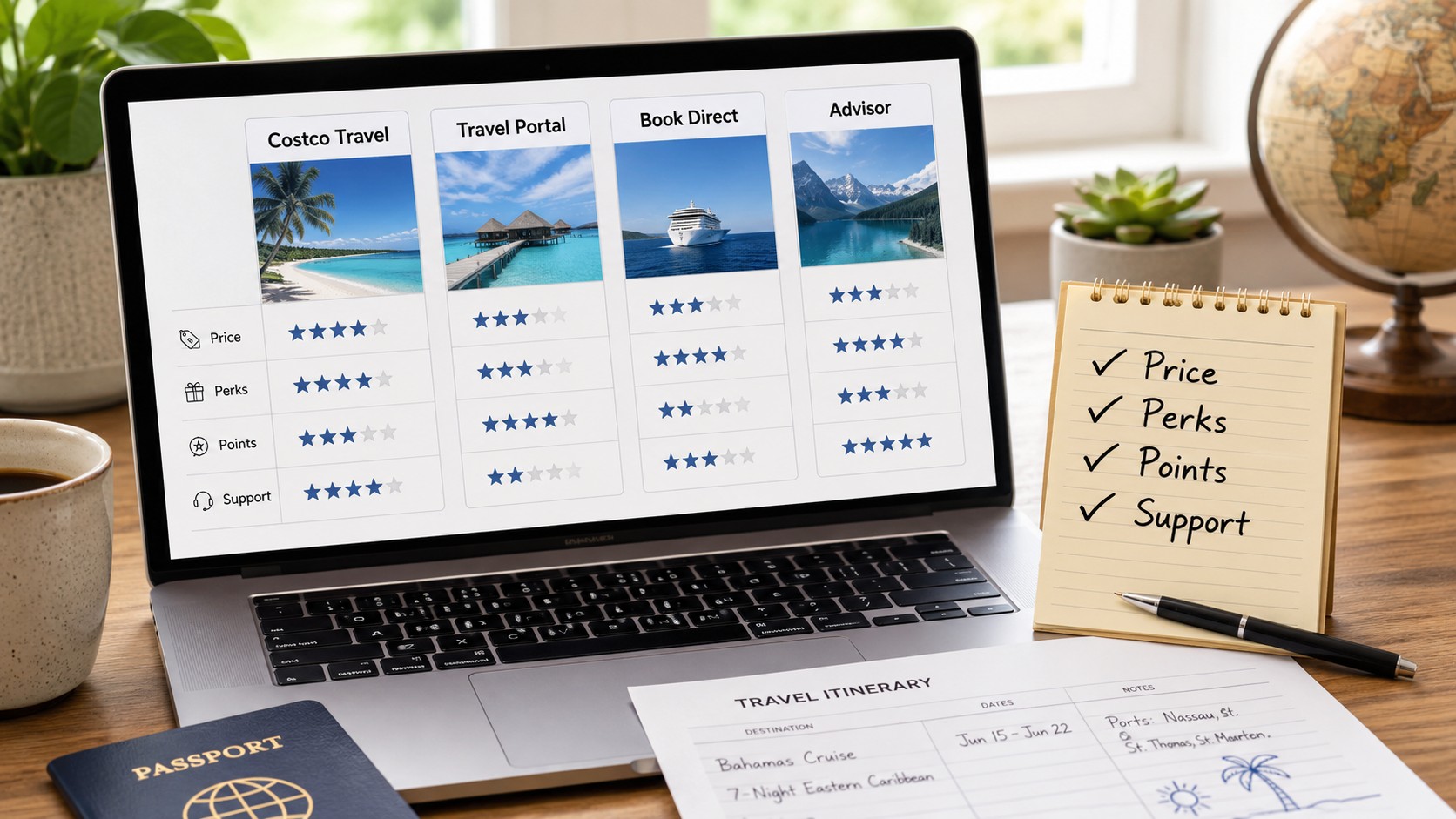
When we compare booking options, we look at price, perks, points, flexibility, support, and fit. The winner is not always the same, and that is exactly why slowing down before booking can pay off.
More detail: The questions we would ask before choosing where to book
When deciding whether to book through Costco Travel, a portal, direct, or an advisor, we would walk through questions like these:
- What is the true total cost?
- Are we comparing the exact same room, cabin, or package?
- What is included?
- What is not included?
- Are taxes, fees, gratuities, or resort fees handled the same way?
- Are there credits, rebates, or Shop Cards?
- Will those extras actually be used?
- Are points being earned?
- Are points being redeemed?
- Is this a good use of those points?
- Are loyalty benefits being lost?
- Are cancellation terms the same?
- Who handles changes or problems?
- Is there support after booking?
- Does one option save time?
- Does one option reduce stress?
- Does one option give up too much flexibility?
That is the real comparison.
Not just:
Which site is cheapest?
A cheaper option can be worse if the terms are worse. A more expensive option can be better if the perks are real. A points option can be smart if it reduces cash cost. A direct booking can be best if loyalty or simplicity matters. A Costco booking can be great if the package value is strong. An advisor booking can be great if the price is competitive and the added support helps.
The answer is not automatic.
That is why we like doing the comparison before booking.
Final Thoughts
We do not think travelers need to be loyal to one booking method.
You do not always need to book direct. You do not always need to use Costco Travel. You do not always need to use a credit card portal. You do not always need an advisor. And you definitely do not need to make every trip more complicated than it needs to be.
But you should know what you are choosing.
For some trips, direct booking is clean and simple. For some trips, Costco Travel may offer a strong package. For some trips, a credit card portal may help you use points or unlock benefits. For some trips, working with an advisor may give you the guidance and support you need.
The best option is the one that gives you the right balance of price, perks, flexibility, points, and peace of mind.
That is the part worth comparing.
Because booking the trip is not just about where you click.
It is about making sure the trip you book actually makes sense for you.
Latest Posts from Trip Planning | All Trip Planning Posts
- Should You Book Through Costco Travel, a Travel Portal, Direct, or an Advisor?

- Basic Economy vs. Main Cabin: When Saving Money Backfires

- Why Most “Free” Travel Advice Breaks Down in Real Life

- How We Compare Travel Options Before We Book

- The Most Common Booking Mistakes We See (And How to Avoid Them)

- Why the Cheapest Price Isn’t Always the Best Deal