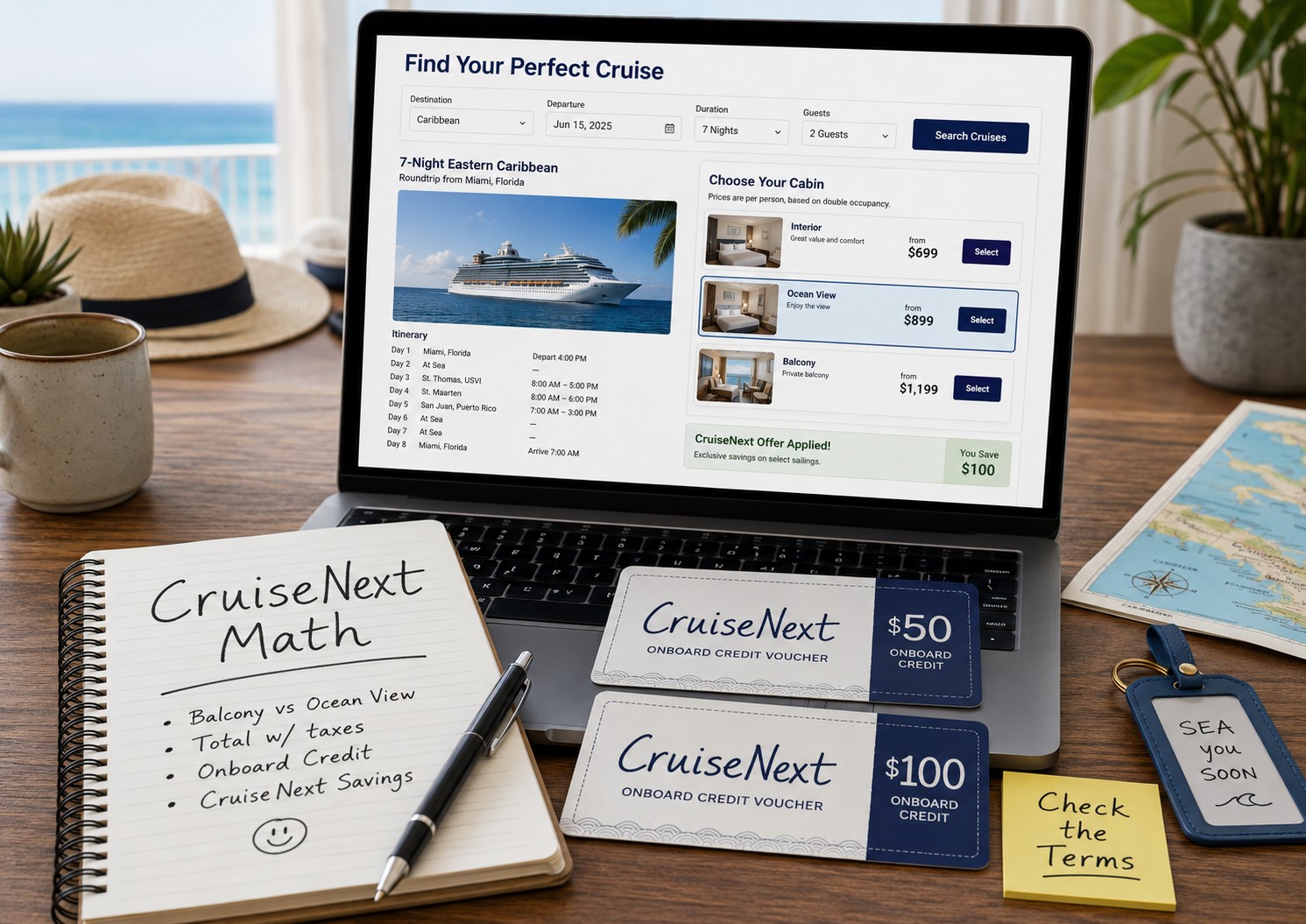
Norwegian Cruise Line has two future cruise credit-style programs that can create real savings if you understand how they work: CruiseNext and CruiseFirst.
They sound similar. They both involve paying money now to reduce the cost of a future Norwegian cruise. And they both can make a booking feel like a much better deal.
But they are not the same thing. The biggest mistake is assuming they can be used interchangeably — or stacked together. CruiseFirst and CruiseNext cannot be used on the same booking, so the right choice depends on when you are buying, how far out you are booking, how long the cruise is, and which promotion is available at the time.
We have used both CruiseNext and CruiseFirst, and while they can be valuable, they are not automatic wins. They work best when they help reduce the cost of a cruise you already wanted to book.
Want Help Comparing Cruise Deals Before You Book?
Cruise certificates can make a good Norwegian deal even better — but only if the cruise itself makes sense first.
If you want help comparing the cruise fare, promotions, onboard credits, certificates, travel portals, direct booking, or advisor options, visit our Cruise Planning page.
We can help you look at the full picture before you lock in a booking.
If you have a question, feel free to text us at 480-331-1263.
Related Reading
- Norwegian Cruise Line Shareholder Benefit: How NCLH Stock Can Earn You Free Onboard Credit
- Norwegian Cruise Line’s Last-Minute Deals: How They Work
- Booking It Yourself Vs. Getting Help: What Actually Changes?
What CruiseNext Is
CruiseNext is Norwegian’s onboard future cruise credit program. You buy the credits while you are already on a Norwegian cruise and use them toward a future Norwegian sailing.
More detail: Why CruiseNext can feel confusing
You buy CruiseNext credits while you are already on a Norwegian cruise, usually through the CruiseNext desk or onboard sales team. The basic idea is simple: you are prepaying toward a future Norwegian cruise, and Norwegian gives you an incentive for doing that while you are still onboard.
The offers can vary, but the common onboard pitch is that you buy CruiseNext credits and receive an onboard credit-style discount back on your current sailing, which effectively lowers your net cost.
CruiseNext is one of those programs that sounds complicated because of how it is presented onboard.
You may hear it explained as “buy two, get two,” “buy four, get onboard credit back,” or some version of getting future cruise credits at a discount.
The actual math matters, because what you are really trying to figure out is this:
- How much money are you paying today?
- How much future cruise value are you receiving?
- How many credits can you realistically use?
- Are you likely to sail Norwegian again before the credits expire?
That last question matters.
CruiseNext can be a strong value if you already know you will cruise Norwegian again. But if you are not sure, it is still money you are committing to one cruise line.
Our Real CruiseNext Example
On one of our Norwegian cruises in January, we purchased 8 CruiseNext certificates. The net cost was $1,000, but the certificates had $2,000 in future cruise value.
More detail: Why it worked for us
That was not a tiny commitment. It was a bit of a flyer.
At the time, we knew we liked Norwegian. We knew we were probably going to cruise with them again. But buying 8 certificates still meant tying $1,000 to future Norwegian cruises.
That only works if you actually use them.
So far, we have managed to use 7 of the 8 CruiseNext certificates.
We used them in a few different ways:
- We transferred some to others to help lower the cost of their cruises.
- We used one on a fairly last-minute cruise booking.
- We used 3 during an NCL TripleUp promotion for our Canada/New England cruise later this year.
That is the kind of outcome that makes CruiseNext valuable.
We did not just buy certificates and hope something would work out someday. We had enough Norwegian cruise plans, enough flexibility, and enough people around us booking cruises that the certificates became useful quickly.
But that is also the caution.
If we had only taken one Norwegian cruise every few years, buying 8 certificates would have been a lot harder to justify.
For us, it worked because we were already in a phase where Norwegian fit our travel style and future plans.
What CruiseFirst Is
CruiseFirst is different because it can be purchased without being onboard a Norwegian ship. Common offers include paying $250 for a $500 credit or $150 for a $300 credit, depending on the promotion available at the time.
More detail: The buy early and hold it strategy
CruiseFirst credits are usually offered online through Norwegian promotions. That can be a very clean value proposition: pay less now, receive more value toward an eligible future Norwegian cruise.
But there are rules.
CruiseFirst is generally designed for future bookings, and the timing matters. If you buy one too close to the sailing you want, it may not be usable for that trip.
We bought a CruiseFirst certificate earlier this year when the offer was $250 for a $500 value.
The important thing to understand is that you can buy CruiseFirst without immediately booking a cruise.
That can be useful because CruiseFirst certificates are typically only good on sailings that are far enough out from the purchase date. In our case, we were thinking about the rule that the sailing needed to be at least 90 days from the purchase date.
That means you need to keep timing in mind.
If you wait until you find a great closer-in cruise deal and then buy CruiseFirst, you may be too late for that certificate to help. But if you buy the certificate earlier when the value is strong, you can hold it until the right booking opportunity comes along.
That opportunity came up for us, and we were able to use it.
That is the tactic we like: buy it when the value is higher, let it sit until it is eligible, and then use it when a cruise you actually want makes sense.
The Biggest Rule: You Cannot Use CruiseFirst And CruiseNext Together
This is the rule people need to know before they start doing the math. CruiseFirst and CruiseNext cannot be used on the same booking.
More detail: Why this changes the decision
That means you are not stacking a CruiseFirst credit on top of a CruiseNext credit to reduce the same cruise.
Because they cannot be combined, the question is not:
“How do I use all of these together?”
The better question is:
“Which one gives me the better value on this specific booking?”
Sometimes that may be CruiseNext.
Sometimes that may be CruiseFirst.
Sometimes the answer may depend on whether Norwegian is running a DoubleUp or TripleUp promotion that allows more than one CruiseNext credit on an eligible sailing.
Sometimes it may depend on whether the cruise is far enough out for CruiseFirst.
And sometimes it may depend on which certificate you already have sitting in your account.
This is why we would not treat these as automatic discounts. They are tools. The value depends on the cruise you are booking.
When CruiseNext May Be The Better Choice
CruiseNext can be especially useful if you cruise Norwegian regularly and buy the credits onboard at a strong promotion. It can be even better when DoubleUp or TripleUp offers apply.
More detail: Where CruiseNext may shine
If you are already on a Norwegian cruise and you know you are likely to sail Norwegian again, CruiseNext can make sense. You are essentially locking in future cruise value while receiving a benefit on your current sailing.
CruiseNext can be even more interesting when Norwegian runs a DoubleUp or TripleUp promotion, because eligible bookings may allow you to apply more than one CruiseNext credit instead of just one.
CruiseNext can be a good fit when:
- You already cruise Norwegian often.
- You are buying credits onboard at a strong effective discount.
- You have future Norwegian cruises in mind.
- You can use the credits before they expire.
- You find a sailing where DoubleUp or TripleUp applies.
- You are booking a cruise where the certificate meaningfully reduces what you owe.
For us, this is where CruiseNext fits best: as part of a broader Norwegian cruise strategy.
It works especially well when paired with good cruise pricing, the right itinerary, a ship we actually want, and realistic expectations for the full cost of the trip.
The certificate should improve a good booking. It should not be the reason you force a cruise that does not otherwise make sense.
When CruiseFirst May Be The Better Choice
CruiseFirst may be the better fit if you are not currently onboard a Norwegian ship but still want to pre-buy savings for a future cruise.
More detail: Where CruiseFirst may shine
You do not need to be on a Norwegian cruise to buy CruiseFirst when Norwegian is offering it. You can purchase it during an eligible promotion, let the required waiting period pass, and then have it available when the right future sailing comes up.
This can be especially useful for people who are considering Norwegian but do not already have CruiseNext credits.
CruiseFirst can be a good fit when:
- You see a strong CruiseFirst offer, such as paying $250 for a $500 value.
- You are confident you will book a Norwegian cruise later.
- You are willing to plan around the timing rule.
- You want a certificate ready for future deals.
- You are not currently onboard a Norwegian ship and cannot buy CruiseNext.
- You do not already have a CruiseNext certificate that would be a better fit for that booking.
The key is buying it early enough.
If you only buy CruiseFirst once you find a cruise, the 90-day rule may limit you. But if you buy it ahead of time, the credit can sit there until you are ready to use it.
That is why CruiseFirst can be a good future planning tool.
It is not ideal for everyone. But for someone who knows they will likely cruise Norwegian again, it can create a simple future discount.
The Timing Difference Matters
CruiseNext is usually tied to being onboard. CruiseFirst is tied to buying ahead and waiting before use.
More detail: Why timing can make or break the value
That timing difference is one of the biggest ways to decide which one fits your situation.
CruiseNext makes the most sense when you are already cruising Norwegian and thinking ahead.
CruiseFirst makes the most sense when you are not onboard, see a good offer, and want to set yourself up for a future booking.
Many cruise deals are time-sensitive.
- A fare drops.
- A cabin category opens.
- A last-minute sailing suddenly makes sense.
- A repositioning cruise gets cheap.
- A casino offer appears.
- A family trip starts to come together.
If your certificate is not eligible yet, it may not help with that specific deal.
That is why CruiseFirst can be more useful if purchased before you need it. You are giving the credit time to become usable so it is ready when a better booking opportunity appears.
CruiseNext is different. If you already have CruiseNext credits in your account, you may be able to apply them to a future booking if the sailing qualifies. And if Norwegian is running a DoubleUp or TripleUp promotion, the math may get more attractive.
Either way, the certificate is only useful if the sailing meets the rules.
Do Not Buy Either One Just Because It Sounds Like Free Money
CruiseNext and CruiseFirst can both be valuable, but they are not free money. You are prepaying toward a future Norwegian cruise.
More detail: Questions to ask before buying
Prepaying can be smart if you are going to use the credit. It can be wasteful if you buy it without a realistic plan.
This is where the onboard sales pitch can be dangerous. When you are having a great cruise, it is easy to imagine booking another one.
And maybe you will.
But before buying multiple credits, it is worth thinking through how often you actually cruise Norwegian, whether you are flexible on dates, whether you tend to book eligible sailings, and whether you are comfortable having money tied to one cruise line.
Before buying CruiseNext or CruiseFirst, we would ask:
- Are we likely to sail Norwegian again?
- Are we likely to book before the credit expires?
- Do we usually book cruises that qualify?
- Would we still book Norwegian if we did not have this certificate?
- Are we buying this because it fits our travel plans, or because the offer sounds good?
- Could this money be better used somewhere else?
That last question matters.
A discount is only useful if it helps you book something you actually want.
If the certificate pushes you into a cruise you would not otherwise take, it may not be real savings.
The Cruise Fare Still Matters More Than The Certificate
A CruiseNext or CruiseFirst credit does not automatically make a cruise a good deal. The cruise price, itinerary, ship, cabin, and total trip cost still matter.
More detail: Why the full cruise math matters
The total cost includes taxes, port fees, gratuities, drink package gratuities, specialty dining costs, Wi-Fi, excursions, flights, hotels, transfers, parking, travel insurance, and anything else attached to the trip.
This is where people can get distracted by the certificate.
Saving $250 or $500 sounds great. But if the cruise fare is inflated, the flights are expensive, the itinerary is not what you want, or the timing creates extra hotel nights, the certificate may not matter as much as it feels like it does.
We like cruise certificates best when they improve a booking that already makes sense.
For example:
- A repositioning cruise that is already priced well.
- A Norwegian sailing you were already planning to book.
- A family trip where the itinerary and timing work.
- A cruise where you can use the certificate without giving up a better offer.
- A sailing where the total trip cost still fits your budget.
The certificate should be part of the decision.
It should not be the whole decision.
How CruiseNext Can Work With Real-Life Norwegian Cruise Strategy
CruiseNext can be especially useful for people who watch Norwegian deals and sail the line more than once. That is where it fits our style.
More detail: How we would think about using it
We are not usually trying to book the most expensive cabin on the newest ship at peak pricing. We are often looking at value-driven cruises, repositioning sailings, timing advantages, or trips where the total cost makes sense.
When a CruiseNext credit lowers the out-of-pocket cost on a cruise we already like, that is a win.
For us, the value question would look something like this:
- Do we already like the cruise?
- Is the fare good?
- Is the ship a fit for how we travel?
- Does the itinerary make sense?
- Are the flights or pre-cruise costs reasonable?
- Can we use one or more CruiseNext credits under the current rules?
- Would we book this cruise even without the certificate?
That last question is the filter.
If the answer is yes, then CruiseNext can make the booking better.
If the answer is no, we would slow down.
A certificate should not talk us into a cruise we do not actually want.
How CruiseFirst Can Work For Future Planning
CruiseFirst is more of a buy-ahead, use-later tool. If you buy it before you need it, it may be ready when the right Norwegian cruise deal appears.
More detail: Why buying early may help
If Norwegian is offering CruiseFirst at a strong value, and you are fairly sure you will book a qualifying Norwegian cruise in the future, buying one ahead of time can be a useful move.
The important part is understanding that the credit generally needs to age before it can be used.
If you buy a CruiseFirst credit today and then immediately try to book a cruise that leaves too soon, it may not work.
But if you buy one months before you need it, that same credit may be ready when a closer-in deal appears.
That can matter for value-focused travelers.
Sometimes the best cruise deal is not the one you planned a year ago.
Sometimes it is the sailing that becomes attractive because the price drops, the dates line up, or the itinerary suddenly works.
Having a matured CruiseFirst credit available can give you another way to reduce the cost when that happens.
But again, only if the sailing qualifies.
CruiseFirst Vs. CruiseNext: Which One Is Better?
Neither one is automatically better. The better option depends on the booking, the promotion, the timing, and which certificate you already have available.
More detail: A simple way to compare them
CruiseNext may be better if you bought credits onboard at a strong value and can use them on an eligible sailing, especially during a DoubleUp or TripleUp promotion.
CruiseFirst may be better if you are not onboard a Norwegian ship, see a strong online offer, and want to prepare for a future qualifying cruise.
The right answer depends on the math.
When comparing CruiseNext and CruiseFirst, look at:
- How much you paid for the certificate.
- How much value it gives you toward the cruise.
- Whether the sailing qualifies.
- Whether you can use one certificate or more than one.
- Whether another promotion gives you better value.
- Whether the cruise is already priced well.
- Whether you would book the cruise without the certificate.
That comparison matters because these programs are not identical.
CruiseFirst may give a larger single-credit discount in certain situations.
CruiseNext may be more useful if DoubleUp or TripleUp applies.
CruiseNext may be more convenient if you already purchased credits onboard.
CruiseFirst may be easier to buy if you are not currently cruising.
The best choice is the one that lowers the cost of the cruise you actually want to take.
Watch For Promotion Language And Changing Terms
Norwegian promotions change, so the details should always be checked before purchase and before booking. The exact rules matter.
More detail: What to verify before booking
This is not a set-it-and-forget-it situation.
The purchase price, certificate value, eligible sailing length, booking window, departure window, DoubleUp availability, TripleUp availability, and combinability rules can all matter.
Before buying CruiseFirst or applying CruiseNext, read the current terms.
Before finalizing a booking, confirm the certificate actually applies.
Before you rely on a certificate, verify:
- The sailing length requirement.
- The departure date requirement.
- Whether the booking is new or existing.
- Whether the cabin category qualifies.
- Whether the fare type qualifies.
- Whether a DoubleUp or TripleUp promotion applies.
- Whether the certificate can be combined with the other discounts on your booking.
- Whether the deposit requirement is satisfied.
- Whether the credit is refundable, transferable, or subject to expiration.
- Whether using the certificate affects any other offer.
This is especially important when promotions overlap.
A deal may look great on the surface, but the terms decide what actually works.
Our Practical Take
CruiseNext and CruiseFirst can both be good tools, but they work best when they support a smart booking decision.
More detail: How we would summarize it
We would not buy either one just because Norwegian is offering it.
We would buy one because we have a realistic plan to use it, understand the rules, and expect it to reduce the cost of a cruise we would actually want to book.
That is the difference between chasing a promotion and using a promotion strategically.
CruiseNext is best understood as an onboard future cruise strategy.
CruiseFirst is best understood as a buy-ahead future cruise discount.
CruiseNext may be better for repeat Norwegian cruisers who already know they will be back.
CruiseFirst may be better for someone who wants to prepare for a future Norwegian booking without being onboard.
Neither one should replace comparing the full cruise cost.
And because they cannot be used together, the real strategy is not stacking everything.
The real strategy is choosing the certificate that makes the most sense for the cruise in front of you.
Final Thoughts
CruiseNext and CruiseFirst are both designed to encourage you to book another Norwegian cruise.
That does not make them bad. It just means you should understand what you are buying.
For us, both have worked.
Our CruiseNext purchase was a bigger swing: $1,000 net cost for $2,000 in future value. But because we have already used 7 of the 8 certificates through transfers, a last-minute booking, and a TripleUp promotion, that purchase has paid off in real travel savings.
Our CruiseFirst purchase was simpler: $250 for a $500 value. The key was buying it before we needed it, letting the timing rule pass, and then using it when the right booking opportunity came up.
That is the real lesson.
These certificates are not magic. They are planning tools.
If you already enjoy Norwegian, watch for good cruise fares, and understand the timing rules, these credits can help lower your real cost. But if you buy them without a plan, they can become one more travel “deal” that only saves money if you force yourself to use it later.
For us, the best use is simple:
Find the cruise first.
Run the full trip math.
Then use the right certificate if it makes an already-good booking even better.
Latest Posts from Cruise Booking Strategy | All Cruise Booking Strategy Posts
- CruiseNext Vs. CruiseFirst: How Norwegian’s Future Cruise Credits Actually Work

- NCL’s DoubleUp + Up to $500 Off Offer: When This Deal Could Actually Be Worth a Look

- Using Points for Cruises: When It Makes Sense — and When It Doesn’t

- Norwegian Cruise Line Shareholder Benefit: How NCLH Stock Can Earn You Free Onboard Credit