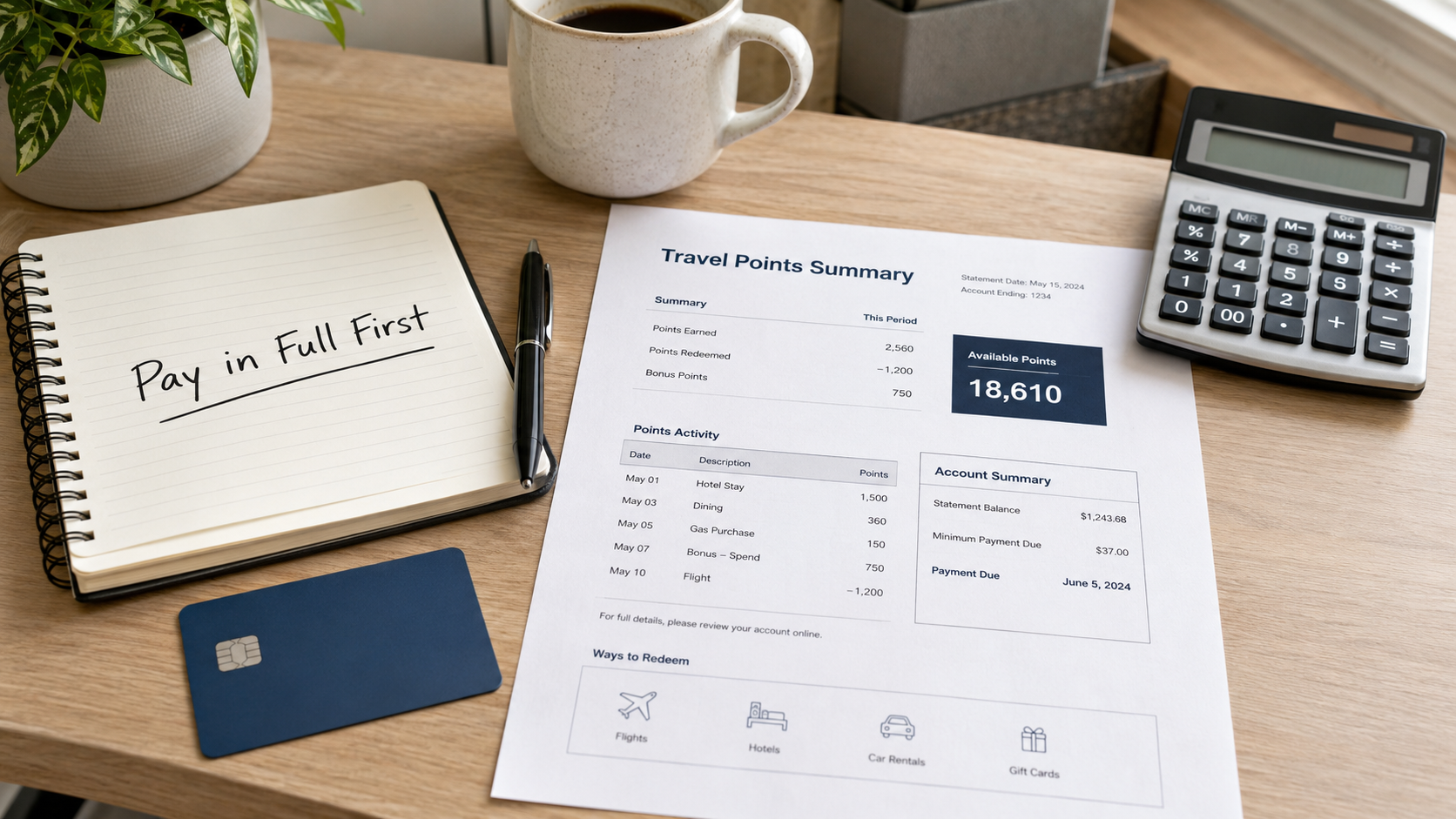
Points and miles can be incredibly useful.
They can help reduce travel costs, unlock trips that may have felt out of reach, and make everyday spending feel a little more rewarding.
But there’s one rule that matters more than almost everything else in the points and rewards world:
Points are not free if you carry a balance.
If you are paying credit card interest, the math changes quickly. The points may still show up in your account, but they are no longer a “reward.” They are being paid for — often at a very high cost.
Before You Chase Points, Make Sure the Math Works
If you’re trying to figure out whether points, credit cards, or travel rewards actually make sense for your situation, we can help you think through it in a practical way.
This is exactly what our Points & Rewards Strategy planning is designed for — helping you use rewards as a tool, not a trap.
If you have a question, feel free to text us at 480-331-1263.
Related Reading
- Why Personal Finance Matters for Points & Rewards
- The Simplest Points Strategy That Still Gets You Real Trips
- Why We Don’t Follow One Credit Card Strategy — And Why You Shouldn’t Either
- Chase Sapphire Reserve Has a Highest-Ever Bonus — But Is It Actually Worth the Annual Fee?
The Rewards Are Real — But So Is the Interest
Credit card points can feel exciting because they show up as something extra. You buy groceries, pay bills, book travel, or cover normal expenses, and suddenly you are earning points that can later turn into flights, hotel stays, statement credits, or other travel value.
That part is real. But the rewards only work if you are not paying interest to earn them.
More detail: Why this matters
A common mistake is looking only at the points earned and not the full cost of earning them.
For example, earning 2x points on a purchase can sound great. Maybe those points are eventually worth a few cents, a few dollars, or even more if used well.
But if that purchase turns into a balance that sits on the card and accrues interest, the cost of that interest can wipe out the value of the rewards very quickly.
That does not mean credit cards are bad.
It means they need to be used carefully.
For us, points and miles work best when they are earned on spending that was already planned, already affordable, and paid off in full.
That is when the rewards can actually feel like a bonus.
Points Should Come From Normal Spending, Not Extra Spending
One of the biggest traps in the points world is spending more than you normally would because you want the rewards.
A slightly bigger online order. An extra dinner out. A purchase you justify because it earns points or helps with a sign-up bonus. None of those things are automatically bad, but they only make sense if they fit your real budget.
More detail: The best rewards strategy starts with what you already spend
A good points strategy should fit into your normal life.
It should not require you to buy things you do not need, upgrade everything, or justify purchases just because they earn points.
When we first started getting deeper into this hobby, we were accumulating more credit cards, using different cards to maximize points, and occasionally chasing sign-up bonuses.
That could have made our finances feel scattered, so we created a habit that helped us stay on track.
We treated our credit cards more like debit cards.
Every Friday, we would sit down and pay off every credit card.
Even though payday was every two weeks, paying weekly helped us avoid one of the biggest mental traps with credit cards: looking at our checking account and feeling like there was more money available than there actually was.
Because if you have charged groceries, gas, travel, bills, or everyday expenses to credit cards, some of the money in your bank account is already spoken for.
Paying the cards down regularly kept that clear.
These days, for the most part, we pay everything off every payday. Sometimes we pay more often. Occasionally, we may let a balance sit until closer to the statement due date.
But the rule is still the same:
We pay our balances in full at least every month — and usually more often.
That is what makes the points strategy work.
The rewards come from normal spending we were already going to do, not from carrying debt or pretending the money has not already been spent.
Carrying a Balance Changes the Entire Equation
When people talk about travel rewards, they usually focus on the fun part: free flights, hotel stays, airport lounges, cruise savings, upgrades, or nicer travel experiences.
But the less exciting part matters more. Credit card interest can erase the value of those rewards.
More detail: A simple way to think about it
Let’s say you earn points from a credit card purchase.
If you pay the card off in full, those points may truly be a reward.
But if that purchase sits on your balance and starts collecting interest, you are now paying extra for the same item.
At that point, the question is not, “How many points did I earn?”
The better question is:
Did the points earn more value than the interest cost me?
Most of the time, the answer is no.
That is why we do not believe points should be treated as a reason to carry debt.
Travel rewards can be powerful, but they are not powerful enough to beat high-interest credit card debt.
Sign-Up Bonuses Are Valuable — But Only If You Can Hit the Spend Responsibly
Sign-up bonuses can be one of the fastest ways to earn a meaningful number of points. A strong bonus can help cover flights, hotel nights, cruises, or a big chunk of a future trip.
But those bonuses usually come with a spending requirement. That is where people need to be careful.
More detail: The bonus is not worth financial stress
A bonus may be worth pursuing if you can meet the spending requirement with normal expenses.
That might include groceries, gas, utilities, insurance, cell phone bills, travel you already planned, or other regular expenses that can be paid by card without extra fees.
But if hitting the bonus requires buying things you would not otherwise buy, carrying a balance, or paying unnecessary fees, the value starts to fall apart.
A big points bonus can feel exciting.
But it is not worth creating debt.
It is not worth stretching your budget.
And it is not worth turning a travel reward into a financial burden.
Before opening a card for a bonus, it helps to ask:
- Can I meet the spending requirement without overspending?
- Can I pay the statement balance in full?
- Do I have a real plan for using the points?
- Does the annual fee make sense for year one?
- Will I reevaluate the card before year two?
Those questions are not meant to scare people away from points.
They are meant to keep the strategy grounded.
Annual Fees Are Not Bad — But They Need a Purpose
Some of the best travel cards have annual fees. That does not automatically make them a bad deal.
In some cases, a card with a higher annual fee can be worth it because of the sign-up bonus, travel credits, lounge access, hotel perks, insurance protections, or other benefits. But the annual fee still matters.
More detail: Do not ignore the real cost of the card
A card can have great benefits and still be wrong for someone.
The question is not just, “Does this card have perks?”
The better question is:
Will I actually use the perks in a way that offsets the cost?
That is especially important after the first year.
The first year of a card can be easier to justify because of the welcome bonus. A strong bonus can sometimes make the first-year math work even if the annual fee feels high.
But year two is different.
At renewal, the question becomes whether the card still fits your real travel habits, your spending patterns, and your budget.
This is why we like to separate first-year value from long-term keeper value.
A card can be worth opening for the first year and still not be worth keeping forever.
That is not failure.
That is strategy.
Points Are a Tool, Not a Permission Slip
One of the best mindset shifts with points is remembering that they are just a tool.
They can help you travel better, reduce out-of-pocket costs, and say yes to trips that may otherwise feel harder to justify. But they should not become a reason to ignore the basics.
More detail: The basics still come first
Before focusing heavily on travel rewards, it helps to have a few personal finance foundations in place.
That might look like:
- Knowing your monthly budget
- Avoiding credit card interest
- Having a plan for upcoming expenses
- Keeping emergency savings in mind
- Understanding whether an annual fee actually fits
- Knowing when not to open another card
Those things may not sound as exciting as booking a flight with points, but they are what make points work better.
Because once the basics are strong, points become a bonus.
They become a way to stretch travel dollars.
They become a tool that fits into the bigger picture instead of pulling against it.
When Points Can Actually Help
This article is not meant to say points are bad. We love points. We use them. We plan trips around them.
But the key phrase is when used well.
More detail: The right setup makes a difference
Points can be incredibly helpful when they are earned through normal spending and used toward trips that matter to you.
They can help with:
- Flights for a larger trip
- Hotel stays that would otherwise be expensive
- Positioning flights for cruises
- Last-minute travel when cash prices are high
- Family trips where multiple tickets or rooms add up quickly
- Reducing the cash cost of travel so the trip feels more realistic
That is the good version of the points game.
Not chasing every offer.
Not opening cards just because everyone online is talking about them.
Not paying interest to earn rewards.
Just using the right tools at the right time.
A Simple Rule We Like
Here is the simplest way we think about it:
If you cannot pay the balance in full, the points are probably not worth chasing.
That does not mean you can never use a credit card or earn points. It just means the rewards should not come at the cost of interest, stress, or overspending.
More detail: Boring rules usually work
The points world can get complicated quickly.
Transfer partners. Award charts. Category bonuses. Travel portals. Hotel credits. Airline credits. Statement credits. Lounge access.
All of those things can matter.
But none of them matter more than this:
Pay the balance in full.
That one habit protects the entire strategy.
It keeps the rewards from becoming expensive.
It keeps the math clean.
And it keeps travel points in their proper place — as a helpful tool, not a financial problem.
Final Thought: The Best Points Strategy Starts With Not Paying Interest
Points and miles can absolutely help you travel better.
They can help make trips more affordable, more comfortable, and more realistic.
But they are not magic.
And they are definitely not free if you are carrying a balance.
The best points strategy starts with strong personal finance basics: spend intentionally, avoid interest, pay balances in full, and use rewards to support trips you already want to take.
That is when points can actually work the way they are supposed to.
Not as a reason to spend more.
Not as a reason to carry debt.
But as a tool that helps you travel better without making your financial life worse.
Latest Posts from Personal Finance | All Posts in Personal Finance