Most cruise “deals” look great at first glance.
Big discounts. Flash sales. “Up to 70% off.” Free perks everywhere.
But once you’ve booked a few cruises — and made a few mistakes — you realize something quickly:
The advertised price is rarely the real price.
And it’s definitely not the full value.
A cruise can look cheap in the search results and still end up costing a lot more once you add taxes, port fees, gratuities, drink packages, Wi-Fi, flights, hotels, transportation, excursions, and everything else that turns a cruise fare into a real trip.
That’s why we don’t just look at cruise prices.
We look at the entire value.
Need Help Finding the Right Cruise — Not Just the Cheapest One?
If you’re comparing cruises and not sure which one is actually the best value, this is exactly the kind of thing we help with.
We’ll look at total cost, what’s included, what you’ll realistically use, and how each option fits how you actually travel — so you can book with more confidence.
You can start with our Cruise Planning page to see how we help compare cruise options before you book.
If you have a question, feel free to text us at 480-331-1263.
Related Reading
- How to Plan a Cruise Without Overpaying (Step-by-Step Strategy)
- Cruise Budgeting in Real Life: What You’ll Actually Spend Beyond the Fare
- How to Choose a Cruise Based on Your Travel Style
Why Cruise Pricing Is So Misleading
Cruise pricing is designed to get your attention. It is not always designed to give you the full picture.
That low headline fare may be technically true, but it usually does not show what the trip will actually cost once you build out the real vacation.
More detail: What the advertised price usually leaves out
That cruise fare you see in the search results often does not include everything you’ll actually pay for.
Common add-ons include:
- Taxes and port fees
- Daily gratuities or service charges
- Drink packages
- Specialty dining
- Wi-Fi
- Shore excursions
- Flights
- Pre-cruise or post-cruise hotels
- Transportation to and from the port
- Travel insurance
- Onboard extras
That does not mean the cruise is a bad deal.
It just means the fare alone is not enough information.
Two cruises can look almost identical at first glance. Same length. Similar destination. Similar starting price.
But once you add in what is included, what is not included, how you would actually spend onboard, and what it takes to get to the ship, they can end up hundreds — or even thousands — of dollars apart.
That is why we don’t evaluate cruises based on price alone.
We evaluate them based on total cost and total experience.
Price Isn’t the Only Thing That Matters
Even if two cruises cost the exact same amount, they can deliver completely different trips.
A cheaper cruise is only a better value if it gives you the kind of trip you actually want.
More detail: What changes the value of a cruise
The itinerary matters.
Not all ports — or port times — are equal.
A “cheap” itinerary might include weaker ports, shorter port days, or stops where you’ll need to spend more money to get the experience you want.
A slightly more expensive itinerary might give you better port times, more flexibility, or destinations you care about more.
Some cruises are built around relaxing sea days. Others are more port-heavy. Neither is automatically better. The right itinerary depends on what you want the trip to feel like.
The ship matters.
Ships are not all the same, even within the same cruise line.
Some are newer. Some have better entertainment. Some have more dining options. Some have layouts that work better for how you travel.
Some ships feel relaxed and easy to navigate. Others may feel crowded, even when the sailing itself is a good price.
You are spending a lot of time on the ship. It is not just transportation.
The cruise line matters.
Each cruise line has a different style.
Some are more casual and flexible. Some feel more structured. Some lean more family-focused, more upscale, more active, or more relaxed.
A good price on the wrong cruise line for you is not really a good value.
Planning before booking matters.
This is the part many people skip.
They find a price, get excited, and book.
But the better approach is:
- Understand what you want first
- Find the cruise that fits that style of trip
- Then decide whether the price is actually a good value
That is how you maximize the experience — not just minimize the fare.
How We Actually Evaluate a Cruise Deal
When we’re looking at a cruise — for ourselves or for someone we’re helping — we don’t start and stop with the fare.
We run through the same basic questions every time: What will this really cost? What is included? What would we actually use? And does this sailing fit the trip we want?
More detail: Our cruise value checklist
Total cost, not just the fare
We calculate what the trip will actually cost, not just what is advertised.
That includes:
- Base fare
- Taxes and port fees
- Daily gratuities or service charges
- Drink package costs or gratuities
- Specialty dining costs or gratuities
- Wi-Fi
- Shore excursions or DIY port plans
- Flights
- Hotels
- Airport and port transportation
- Travel insurance
- Expected onboard spending
Sometimes a “cheap” cruise becomes expensive once everything is added.
Other times, a higher upfront price already includes most of what you would have paid anyway — which can make it the better value.
What is actually included
Not all cruise fares are built the same.
Some cruise lines bundle more into the fare. Some promotions include drinks, dining, Wi-Fi, or onboard credit. Others simply discount the base fare and leave more costs for later.
We always ask:
What would we realistically spend on this cruise, and is any of that already included?
That is where the real value starts to show up.
The “we’d actually use this” factor
Not every perk is valuable just because it is included.
A drink package only matters if you’ll use it.
Specialty dining only matters if you’ll go.
Wi-Fi only matters if you need it.
A shore excursion credit only matters if it applies to the type of excursion you would have booked anyway.
We don’t assign full value to things just because they are listed as perks. We assign value based on how we — or the people we are helping — actually travel.
Timing and booking flexibility
Cruise pricing can move. Promotions change. Cabin availability changes. Airfare can change too.
That does not mean you should always wait, and it does not mean you should always book immediately.
It means you need to look at the whole situation:
- How far out is the sailing?
- How flexible are your dates?
- Are flights involved?
- Is the ship filling up?
- Are the cabins you want still available?
- Is the current promotion actually useful for you?
- Would waiting create more risk than reward?
Sometimes it makes sense to lock in a cruise early.
Sometimes a last-minute deal can be a great value.
The right answer depends on the specific trip.
Where We Actually Search for Cruise Deals
We don’t rely on one source when comparing cruise options.
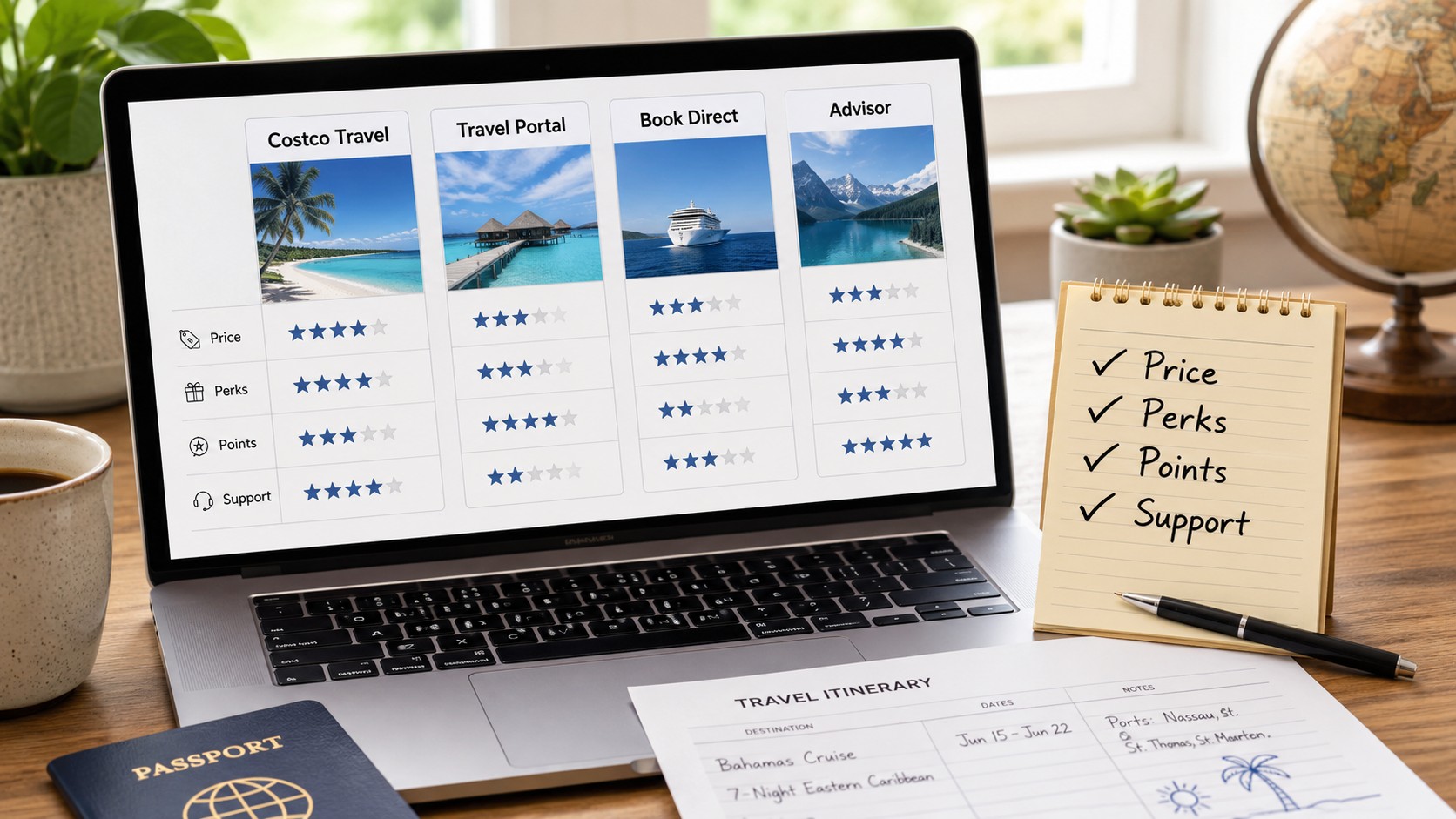
The best booking path can depend on the cruise line, promotion, sailing date, cabin type, available perks, and whether points or outside benefits are involved.
More detail: The places we compare before booking
Cruise line websites
We usually start with the cruise line directly.
This gives us the baseline:
- Current cruise fare
- Taxes and fees
- Available cabins
- Official promotions
- What is included
- What is not included
- Deposit and cancellation terms
Even if we don’t end up booking directly, the cruise line website gives us a clean reference point.
Online travel sites
We may also compare options through places like:
- Costco Travel
- Vacations To Go
- Other online booking platforms
- Credit card travel portals when relevant
Sometimes these can include gift cards, onboard credit, or package variations that make them worth considering.
They can be especially useful for straightforward bookings where someone knows exactly what they want and does not need much support.
Travel agent tools and portals
In many cases, we end up booking through travel agent systems.
That may allow us to:
- Match or beat publicly available pricing
- Add extra perks when available
- Find group rates or amenities
- Provide support before, during, and after the trip
- Help compare options in a more complete way
But here’s the important part:
We always want the best option to win.
If booking direct with the cruise line makes the most sense, we’ll say that.
If Costco Travel or another platform has the stronger deal for your specific trip, we’ll say that too.
If booking through us gives you the best combination of value, support, and perks, great.
The goal is not to force one booking path.
The goal is to help you make the best decision for your trip.
Why “Cheapest” and “Best Value” Are Not Always the Same
Sometimes the cheapest cruise really is the best choice.
But sometimes the cheapest cruise is only cheaper because you are giving up something that matters.
More detail: When paying more can make sense
A slightly more expensive cruise may be the better value if it includes things you would have paid for anyway.
For example, a higher-priced cruise might include:
- Better port times
- A ship you prefer
- A more convenient departure port
- Drink or dining perks you will actually use
- Onboard credit
- A better cabin location
- Lower flight costs
- Less need for extra hotel nights
- More flexibility if plans change
This is why we try not to get stuck on the lowest fare.
A $799 cruise is not automatically better than a $999 cruise.
If the $999 cruise saves you money elsewhere, gives you a better itinerary, or fits your travel style better, it may be the smarter choice.
The opposite can also be true.
A cruise with lots of flashy perks may still be overpriced if those perks do not matter to you.
The math matters.
But the experience matters too.
A Simple Way to Think About Cruise Value
A good cruise deal is not just the lowest number on the screen.
A good cruise deal is the right combination of price, inclusions, itinerary, ship, timing, and fit.
More detail: The questions we ask before booking
Before booking, we like to ask:
- What is the full trip cost, not just the cruise fare?
- What is included in the price?
- What would we have paid for anyway?
- Are the perks useful or mostly marketing?
- Do the ports and port times fit the trip we want?
- Is this ship a good match for us?
- Are flights or hotels going to make this more expensive?
- Is this a cruise we’re excited about, or just a price that looked good?
- Would another booking path give us better value?
- Are we choosing this because it is cheap, or because it is actually right?
Those questions usually make the decision much clearer.
They also help avoid one of the easiest travel mistakes:
Booking something because it looks like a deal, then realizing later it was not the trip you actually wanted.
The Bottom Line
A good cruise is not just about price.
It is about what you’re actually paying, what you’re actually getting, and whether the itinerary, ship, cruise line, and timing match how you want to travel.
Sometimes the cheapest option wins.
Sometimes the better value is the cruise that looks slightly more expensive at first — but delivers a much better overall experience.
That is why we don’t just ask, “What is the cheapest cruise?”
We ask:
Which cruise gives us the best trip for the money?
That is the difference between finding a low price and finding real value.
Latest Posts from Cruise Research & Planning | All Posts in Category
- Would We Sail Alaska in an Inside Cabin? What Real NCL Cruisers Said

- Repositioning Cruises: An Underrated Way to Travel for Less

- Cruise Budgeting in Real Life: What You’ll Actually Spend Beyond the Fare

- Victoria After Butchart Gardens: The Part Most Cruise Excursions Miss

- We Skipped the Excursion in Victoria… and It Ended Up Being the Best Part of Our Cruise

- How to Plan a Cruise Without Overpaying (Step-by-Step Strategy)